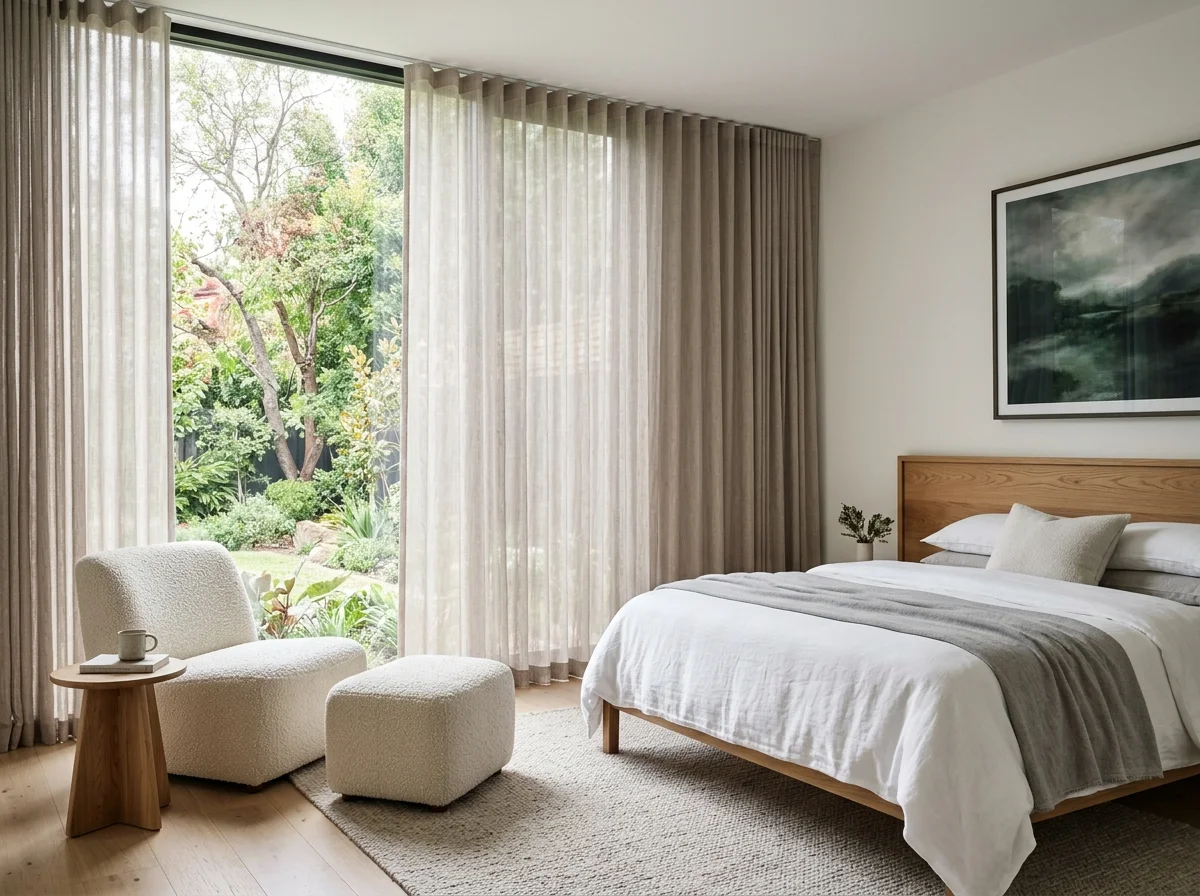
The linen curtains in the living room are floor-length, hung from a wooden rod mounted 8cm below the ceiling. They puddle about an inch at the bottom. They are 2.2 metres of linen across a 1.5-metre-wide window, which gives them enough fabric to gather generously when closed. The fabric is heavy enough to hang straight rather than billowing in the draught from the radiator. They cost £180 for the pair from MagicLinen in 2023.
The curtains in a room are usually the single largest textile surface. They do an enormous amount of cosy work when they're right, and they uncosy a room dramatically when they're wrong. Most domestic curtains are wrong in one of three specific ways: hung too low, ending too short, or made of the wrong fibre.
Related, and genuinely useful here: Textile Layering Guide and Cosy Living Room Decorating Ideas That Actually.
Curtains are the largest soft surface in most rooms, and getting them right does more for warmth than almost any other furnishing. These twelve ideas cover hanging, layering, fabric, and the details that separate curtains that finish a room from curtains that make it look unfinished. Pick what suits your windows.
1. Hang the Rod at the Ceiling Line
The single biggest curtain move: mount the rod at the ceiling, not at the top of the window frame. The curtains then fall the full height of the wall, drawing the eye up and making the window and the room read dramatically taller. It's free height, and it transforms how generous a window looks.
2. Let Them Just Kiss the Floor
Curtains should reach the floor — to brush it exactly for a crisp look, or break an inch onto it for a relaxed one. Floor-length reads finished and generous; anything that stops short reads skimpy and makes the window squat. The length is non-negotiable for a room that looks properly dressed.
3. Buy Enough Fabric for Real Fullness
Skimpy flat curtains read cheap. For proper fullness, the combined panel width should be two to two-and-a-half times the width of the window, so the curtains gather into generous folds even when closed. The fullness is what makes curtains look expensive — more fabric, gathered, beats a tight flat panel.
4. Extend the Rod Past the Window
Run the rod 15 to 25cm beyond the window frame on each side so the open curtains stack against the wall, not the glass. This lets in maximum daylight, makes the window appear wider, and means the curtains frame the view rather than covering part of it. A wider rod is a bigger-looking window.
5. Choose Linen for Relaxed Warmth
Linen is the warm room's curtain fabric — it hangs softly, creases relaxed rather than crisp, and filters light beautifully. Oatmeal, warm white, or natural linen suits almost any room and reads timeless where bold patterns date. The slightly imperfect drape of linen is exactly the relaxed warmth a cosy room wants.
6. Layer Sheers Behind Heavier Panels
A double layer — sheer linen against the glass, heavier panels in front — gives a room privacy and soft daylight by day and warmth and blackout by night. The sheers diffuse harsh light into a glow; the heavy panels draw closed for cosy evenings. Layering is how one window does both jobs.
7. Add a Blackout or Thermal Lining
Lined curtains do more than look fuller — a thermal or blackout lining keeps heat in on cold nights and light out for sleep. In a bedroom it's essential; in any room it makes the curtains hang heavier and more luxurious. The lining is the invisible upgrade that does real work.
8. Pick a Heading That Suits the Room
The heading sets the tone: pinch pleat and goblet read formal and tailored, pencil pleat is classic and gathered, and a relaxed wave or tab-top reads casual and modern. Match the heading to the room — tailored pleats for a formal living room, a soft wave for a relaxed bedroom. The top of the curtain matters as much as the fabric.
9. Use Curtains to Soften a Hard Room
In a room full of hard surfaces — a kitchen, a tiled bathroom, a concrete-floored space — curtains are the quickest way to add soft texture and warm the acoustics. Even a single linen panel at a window absorbs sound and softens the look. Fabric is the antidote to a room that echoes and reads cold.
10. Curtain a Doorway or Alcove
Curtains aren't only for windows. A heavy curtain across a draughty doorway, a wardrobe alcove, or an under-stair recess adds softness, hides clutter, and stops draughts. A portière across a door reads characterful and period; a curtain in place of a wardrobe door reads relaxed and saves space.
11. Hold Them Back With a Soft Tie
A fabric tieback, a leather strap, or a simple holdback gathers the curtain into a soft sweep during the day, letting in light and adding a graceful line. The gentle drape of a held-back curtain reads more relaxed and inviting than a panel hanging dead straight. A small detail with a soft, generous effect.
12. Keep the Colour Quiet and Warm
The curtains are the largest soft surface in the room, so let them sit quietly — oatmeal, warm white, soft clay, natural linen — and let the bed, the sofa, or the art be the focal point. Loud patterned curtains date fast and pull focus; quiet warm panels read timeless and let them frame, not shout.
The Method Behind Curtains That Warm a Room
The ideas above are the menu; the principles below are the rules — the hanging height, the fabric weight, the fullness — that determine whether curtains read as finished and generous or skimpy and afterthought.
Hang Them Higher Than You Think
The single most consequential curtain decision is rod placement. The default — hanging the rod at the top of the window frame, where the frame meets the wall — makes the window read squat and the ceiling lower.
The correct placement is at the ceiling line, or within 5cm of it. The rod runs in a continuous line just below the ceiling. The curtain panels fall from there to the floor, creating a vertical line that visually extends the window from ceiling to floor regardless of where the actual glass starts and stops.
In rooms with crown moulding, hang the rod just below the moulding rather than into it. In rooms with cornices, the rod can be hidden behind a fabric cornice, but the curtain still falls from ceiling height.
The visual effect is dramatic. A standard 1.5m-tall window with curtains hung at the frame reads as a normal window. The same window with curtains hung at a 2.5m ceiling reads as nearly floor-to-ceiling architecture.
Run Them to the Floor (Or Just Past It)
Curtains stopping above the floor are the second most common mistake. Floor-length curtains are the standard for any cosy room.
Three acceptable lengths:
Kissing the floor. Hem just touching the floor with no gap. The most practical length for everyday use; opens and closes without dragging.
1-2 inch break (puddle). Curtains extending an inch or two onto the floor, creating a small fold at the bottom. Reads as more formal and editorial. Best for rooms not opened and closed daily.
Full puddle (4-6 inches on the floor). A pronounced pooling at the bottom. Very formal, somewhat impractical for daily use. Used in dressing rooms, drawing rooms, and bedrooms where the curtains aren't moved.
What does not work: curtains stopping 5-10cm above the floor (looks like a hemming mistake), or curtains in puddles deeper than 6 inches (reads as a costume rather than a curtain).
Generous Fullness
Curtain panels need to be 1.5x to 2x the width of the window (or window section) they cover when stretched flat. Less than 1.5x and the curtains look stretched when closed; more than 2x and they read as theatrical.
The most common version of this mistake is buying off-the-shelf curtain panels at the exact width of the window. The result is panels that just barely close, with no gathering visible at the top or sides.
For a 1.5m-wide window, each panel should be at least 1.1-1.5m wide, with both panels together totalling 2.25-3m of fabric for the closed configuration. The gathering is what makes the curtain read substantial.
Off-the-shelf curtains from most home retailers come in standard panel widths. Order two panels per side (four total) for any window wider than 1.2m to get the right fullness — even if it means the panels overlap in the centre when closed.
The Fibre Decision
Linen is the standard cosy curtain fibre. Specifically: medium to heavy weight linen (200-400 GSM), unbleached or natural oat colour, mid-weight enough to hang straight rather than billowing.
Sources:
- MagicLinen (Lithuanian): £100-200 per panel, generous sizing
- Piglet in Bed: £200-400 per panel, slightly more refined finish
- IKEA Aina, Lenda, or Vivan ranges: £30-70 per panel, lighter weight but acceptable
- H&M Home washed linen: £40-80 per panel, lighter weight
- Soho Home or Heal's: £200-500 per panel for designer-grade linen
For colder climates or formal rooms, wool curtains or wool-blend curtains add weight and warmth. Available less commonly and at higher prices — typically £300-800 per panel from specialist makers.
Velvet works in formal rooms in deep warm colours — burgundy, oxblood, deep teal. Velvet curtains read as more theatrical than linen and suit Victorian houses, dining rooms, and bedrooms more than open-plan living rooms.
Skip: polyester (cheap-feeling, doesn't drape correctly), most synthetic velvet (looks cheap), and any "blackout curtain" sold as a complete unit (always cheap polyester — use a blackout liner behind a proper curtain instead).
The Bedroom Layer Strategy
Bedrooms need to block light. The cosy solution is layered: a blackout liner against the glass, a decorative linen curtain in front.
The blackout liner does the practical work — usually a thermal-coated polyester or cotton-poly blend, hung on a second rod 5-10cm behind the main curtain rod, sized to cover the window frame fully with some overlap on all sides. Brands like Soft Surroundings, John Lewis, and IKEA all sell ready-made blackout liners for under £50 per window.
The decorative linen panel in front does the visual work — full ceiling-to-floor length, generous fullness, in natural linen. The blackout liner stays mostly invisible; the linen is what the room sees.
For bedrooms where light control is critical (people who sleep light, north-facing bedrooms in summer), a roller blackout blind inside the window frame plus the linen curtains in front works better than the curtain-and-liner combination.
The Rod Itself
Wooden curtain rods, brass curtain rods, and wrought-iron curtain rods all read cosy. Chrome and bright stainless steel rods do not.
Standard rod diameter: 25-35mm (1-1.4 inches). Thicker rods read more substantial but require larger brackets and finials. Thinner rods read flimsy.
Brackets should be mounted into wall studs or with proper heavy-duty anchors. The combined weight of a generous linen curtain on a 2m+ rod requires real support. Adhesive or drywall-anchor-only mounts will pull out within months under the weight of substantial curtains.
Finials at the end of the rod — wooden balls, brass cups, simple turned wood — add character. The minimalist endless-rod finials sold at most retailers look unfinished. A real finial reads completed.
What to Skip Entirely
Café curtains. Half-window coverage on a tension rod. Looks dated almost everywhere except authentic French country kitchens.
Curtain valances or pelmets in most modern rooms. They tend to age badly and make windows read fussy. The exception is in genuinely traditional rooms where the pelmet is part of a coordinated treatment.
Patterned curtains in busy designs. A bold floral or geometric on a curtain panel is the largest visual decision in a room. Plain or quietly textured fabric almost always wins.
Tie-back tassels in dramatic colours. Simple fabric ties in the curtain colour, or no tie-backs at all (just open the curtain to one side and let it fall), beat decorative tassels.
Faux silk curtains in saturated jewel tones. Look cheap regardless of the price paid.
A curtain hung at the ceiling line, falling to the floor, made of real linen, is the single fastest cosy upgrade available in most modern rooms.
Hanging the Pair: Practical Steps
For a standard installation:
- Measure ceiling height. The rod brackets mount 2-5cm below the ceiling line.
- Measure floor to bracket point. Subtract 2cm (for kissing the floor) or add 2-4cm (for a slight puddle). This is the curtain length needed.
- Measure window width. Order rod 30-50cm wider than the window so curtains can be drawn fully open to the sides without covering the glass.
- Order panels at 1.5x-2x the rod width in total fabric.
- Mount brackets into wall studs.
- Hang the rod, then the curtains, then steam the panels once they're up. The fabric will hang straighter after steaming.
The right curtains do more for cosy than any other single textile in a room. Hang them high, let them fall to the floor, and choose real linen. The rest is detail.