The wool throw on the back of the sofa is a single piece — heavy, undyed Welsh wool, 480 grams per square metre, oatmeal, with a slight nap that's softened over four winters of being folded and unfolded. It cost £140 in 2022. I have not bought another sofa throw since, and I will not until this one wears out. Most rooms have too many throws and not enough single throws that earn their place.
Most rooms fail at textile layering not because they have too few textiles but because they have too many of the wrong kinds, layered without intent. Five decorative throws in matching colours, eight cushions on a sofa, a "throw blanket basket" overflowing in the corner — all of it reads as bedding-showroom rather than as inhabited room.
The cosy version of textile layering is smaller, more disciplined, and almost entirely about fibre quality and weight variation. For the warm palette these textiles sit best against, see the Lounge Room Colour Palette Guide.
Keep reading from here: Cosy Room-by-Room Guide.
Texture is warmth you can feel before you can name it. These eighteen ideas cover every soft surface in a room — throws, cushions, rugs, curtains, upholstery — and how to layer weights and fibres so a room reads rich and cosy rather than flat. Pick the layers your room is missing.
1. Work in Three Weights
The foundation of textile layering: every room wants a heavy weight (a wool rug, a velvet cushion), a medium (linen curtains, cotton upholstery), and a light (a fine throw, a linen cover). The contrast between the weights is what reads cosy. Get all three into a room and it gains depth no single fabric can give.
2. Drape One Good Wool Throw
A single substantial wool or wool-blend throw over the back of the sofa or the arm of a chair is the easiest textile layer there is. Choose a weight you'd actually pull over your legs at 9pm, not the thin decorative kind sold in matching sets. One real throw beats three decorative ones.
3. Mix Cushion Fabrics, Not Just Colours
A cushion arrangement reads richer when the fabrics vary — a linen, a velvet, a wool, a subtle pattern — rather than matching covers in different colours. The textural mix catches light differently across each cushion and gives the sofa depth. Vary the fabric and even a tonal, neutral group reads layered.
4. Layer a Wool Rug Over Jute
The rug layering move: a large natural jute or sisal rug as the base, a smaller wool or vintage rug on top, slightly off-centre. The coarse base grounds the room; the softer rug brings warmth where feet land. Wool over jute gives a room two textures underfoot and a designer's depth.
5. Choose Linen for Relaxed Softness
Linen is the warm room's workhorse fibre — curtains, cushion covers, bedding, table linen. It creases relaxed rather than crisp, softens with every wash, and reads timeless. The slightly rumpled drape of linen is exactly the unforced softness a cosy room wants, where crisp cotton reads like a hotel.
6. Add a Sheepskin or Hide for Focal Texture
A single sheepskin over a chair arm, a stool, or the floor where bare feet land adds a focal hit of soft texture and a touch of the organic. Real shearling beats acrylic, which mats within a season. The sheepskin is the texture people reach out to touch — the most tactile layer in the room.
7. Bring in a Chunky Knit
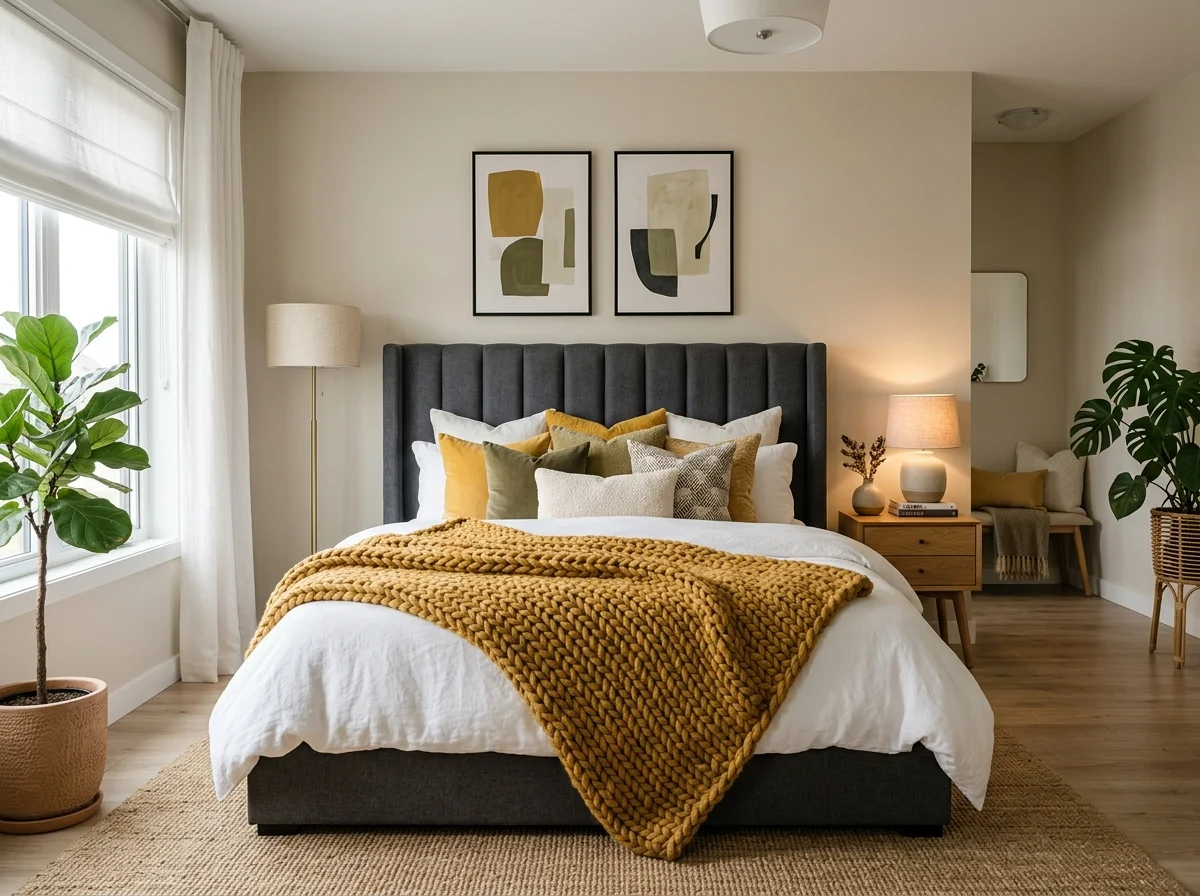
A chunky cable or basket-weave knit throw or cushion adds visible, dimensional texture — the kind you can read from across the room. Its open, heavy weave contrasts beautifully with smooth linen and velvet, and reads as the warmest, most hand-made layer. Winter's signature texture in a room.
8. Use Velvet or Bouclé for Plush Weight
Velvet and bouclé bring plush, light-catching weight — on a sofa, an accent chair, or a few cushions. Velvet's sheen shifts as you move past it; bouclé's nubbly loops read soft and modern. One plush upholstered piece anchors the room's textures and gives the eye something rich to land on.
9. Ground the Room With a Wool Rug
Before any layering, a wool rug is the heaviest, most grounding textile in a room and the one that does the most cosy work. It absorbs sound, warms the floor, and anchors the seating. Wool resists crushing and develops a patina synthetic can't — the foundation layer everything else builds on.
10. Layer the Bed in Four Textures
A cosy bed is a textile-layering exercise: a linen flat sheet, a waffle or cotton duvet, a wool or knit throw at the foot, and cushions in a contrast fabric. Each catches light differently, which keeps even an all-white bed from reading flat. The layered bed is the textile principle at its clearest.
11. Hang Heavy Curtains as a Soft Wall
Floor-length lined curtains are the largest single textile in most rooms, and a heavy pair reads as a soft wall — absorbing sound, holding warmth, and softening hard architecture. Linen or wool-blend, hung high and full. The curtains are a major textile layer, not just a window treatment.
12. Add a Table Runner or Cloth
Soft textiles belong on hard tables too. A linen runner or cloth on a dining table, a throw over a side table, a cloth on a console softens the hard horizontal surfaces and adds a layer most rooms forget. The creased linen reads relaxed and ties the table into the room's textile story.
13. Contrast Smooth With Rough
The principle behind all good layering: pair opposites. Smooth linen against a rough jute rug, a sleek velvet cushion against a chunky knit, a polished wood table against a soft sheepskin. The contrast between smooth and rough is what makes texture read — sameness reads flat, contrast reads rich.
14. Repeat a Fibre Across the Room
While contrast creates depth, repetition creates cohesion. Echo one fibre — wool in the rug, the throw, and a cushion; or linen in the curtains, the bedding, and a table runner — across the room so the textiles read as a considered family rather than a random collection. Contrast within repetition is the balance.
15. Use Natural, Tactile Materials
Lean on natural fibres — wool, linen, cotton, jute, leather, sheepskin — over synthetics. Naturals age into patina, feel better to the touch, and read warmer; synthetics mat, pill, and read flat. The hand of a material matters as much as its look, and natural materials are what give a room genuine tactile warmth.
16. Layer Seasonally
Textiles are how a room shifts with the year. Heavy wool, chunky knits, and sheepskins in winter; lighter linen, cotton, and a thinner throw in summer. Swapping the soft layers seasonally keeps a room comfortable and feeling current without changing the furniture. The textiles do the seasonal work.
17. Match the Throw Weight to the Use
A throw should suit how it'll be used: a fine wool or cotton throw for a styled drape that's occasionally pulled over knees; a heavy knit or blanket-weight throw for a room where it's genuinely used on cold evenings. The weight signals the intent — choose the one that matches how the room actually lives.
18. Edit the Layers, Don't Pile Them
Layering is not piling on. Three to four considered textile layers in a room read rich; eight read cluttered. One good throw, not three; a tight cushion arrangement, not a heap. The discipline of editing the textiles is what separates a layered room from a smothered one — restraint within richness.
The Method Behind Layering Textiles
The ideas above are the breadth; the principles below are the structure — the three-weight principle, the fibre choices, and the ratios that make layered textiles read intentional rather than piled on.
The Three-Weight Principle
A cosy room contains textiles at three different weights distributed across different surfaces:
Heavy. The rug, possibly velvet upholstery on one chair, a heavy wool throw on a winter sofa. Weight you can feel — 500+ GSM for wool, dense pile for rugs.
Medium. Linen upholstery, cotton curtains, a wool-cotton blend throw. The fabric drapes naturally rather than holding shape. 250-450 GSM for throws.
Light. Fine wool gauze, raw silk, sheer linen. Used sparingly — a single light throw at the foot of a bed, gauze curtains as an inner layer behind heavier linen panels, a silk cushion cover.
The variation matters more than the colour scheme. A monochrome oatmeal room with three textile weights reads cosier than a colourful room with only one weight. The eye reads weight variation as depth even when the colours are identical.
The Fibres That Earn Their Place
Six natural fibres do almost all the work of cosy textile layering. Skip everything else.
Wool. The primary cosy fibre. Holds warmth, ages with patina, accepts dye beautifully, and lasts for decades. Welsh wool, Donegal tweed, Pendleton wool, Merino blends — all suitable. The cheapest cosy upgrade in any room is replacing a synthetic throw with a real wool one.
Linen. The summer counterpart to wool. Wrinkles correctly (it folds rather than crumples), softens with each wash, and lasts longer than most other fabrics. European flax linen specifically — French, Belgian, or Lithuanian — outperforms Chinese-grown linen for hand feel and durability.
Cotton. Versatile and washable, useful for cushion covers, lighter throws, and curtains. Brushed cotton flannel makes excellent winter bedding. Stiff cotton percale wrinkles wrong and is not cosy.
Sheepskin. A single real sheepskin draped naturally on a chair or laid over a bench is cosier than almost any equivalent textile. Real, not faux. From an Icelandic, Welsh, or New Zealand source, £80-200 for a single hide.
Silk. Used sparingly — as a cushion cover, a folded throw at the foot of a bed, a runner on a dressing table. Raw silk has more character than smooth charmeuse for cosy purposes.
Leather. As upholstery, as a chair, as a small accent. Aniline-finished leather develops patina; chrome-tanned bonded leather does not. Vintage leather chairs are the easiest entry point.
The fibres to avoid entirely: polyester fleece (pills, develops static, doesn't soften), acrylic "wool blends" (most contain very little wool), synthetic faux fur (sheds and looks like upholstery within months), polyester satin (looks like hotel bedding).
Throws: The Two-Throw Rule
A room should have at most two throws visible at any given time. One folded over the back of the main sofa. One in a basket beside the chair, or draped over the arm of a second piece of seating.
A third throw exists only if it is in active use — if someone is wrapped in it on the sofa. After they get up, it goes back to one of the two visible positions.
The single throw on the sofa is folded loosely. Not draped artfully across one arm in a way that requires re-arrangement after every use. Not folded into a perfect rectangle. Folded the way you'd fold it after using it — in thirds, slightly off-centre, with one corner falling forward.
The wool throw weights to remember:
- 350-500 GSM: general year-round use. The most useful single throw weight.
- 600-800 GSM: deep winter throws. Heavy enough to feel almost weighted on the legs.
- 200-300 GSM: decorative weights, used as bedscapes or summer throws. Less cosy than they look on Instagram.
Brands worth knowing: Foxford (Irish wool, £80-150 throws), Avoca (Irish, £100-200), Tweedmill (Welsh, £60-150), Pendleton (American, £180-300), MagicLinen (Lithuanian linen throws, £80-120). All produce throws that age well across a decade.
Cushions: The Maximum is Five
A standard three-seat sofa wants at most five cushions:
- Two square back cushions at the corners (55x55cm or 60x60cm)
- One or two lumbar cushions centred or slightly off-centre (35x55cm)
- One additional accent cushion in a contrasting texture
Beyond five, the cushions become an obstacle to sitting on the sofa, which is the actual job of the sofa.
The texture mix matters more than the colour mix. Linen plus velvet plus wool plus a knit makes the arrangement read as collected. All-linen or all-velvet cushions in five different colours reads as decorative.
The colours should come from a single palette across the room. If the rug is in warm neutrals (oatmeal, brown, brick), the cushions stay in warm neutrals — possibly adding one deeper colour from the same family (rust, oxblood, warm green). Cushions in primary colours fight the rug.
A sofa should have at most five cushions. Beyond five, the cushions become an obstacle to sitting on the sofa, which is the actual job of the sofa.
Bedding: Five Surface Elements
The cosy bed has five surface elements visible:
- One washed-linen flat sheet (not a fitted top sheet)
- One heavyweight linen or cotton-linen duvet cover
- Two sleeping pillows in the same case fabric as the duvet
- Two euro pillows behind them in a contrast fabric (a stripe, a small check, a deeper solid)
- One folded throw at the foot of the bed
Five components. No additional decorative cushion pile that has to be removed every night.
Linen specifically wrinkles correctly — it folds and softens in ways that read as inhabited rather than rumpled. Cotton percale wrinkles wrong. Cotton sateen looks like a hotel. The fibre is the decision; everything else follows.
For colder months, add: a heavyweight wool blanket folded under the duvet (not visible), an extra throw at the foot, possibly a sheepskin draped over a chair or the end of the bed.
Curtains as the Largest Textile
The curtains in a room are usually the single largest textile surface. They want to do their job quietly.
Hang from the ceiling line (not the top of the window frame). Puddle slightly at the floor — about an inch of break. Linen panels in oatmeal, warm white, or natural unbleached colours work in almost any cosy room. Heavy patterns and bold colours date faster than solids.
For bedrooms, layer two treatments: a blackout liner against the glass, a decorative curtain in linen in front. The liner handles sleep; the linen handles visual.
For living rooms, a single layer of linen is usually enough. The light filtering through linen at 4pm in winter is one of the most cosy effects available, and a blackout liner blocks it.
Rugs as the Foundation
The rug is the heaviest textile in any room and it does the most work. A wool rug specifically — synthetic rugs are not in the conversation for cosy. Hand-knotted, hand-loomed, or hand-tufted in wool.
The size is the most common mistake. The rug should extend at least 15cm under the front legs of all major seating around it, or be large enough for the entire furniture arrangement to sit on. 5x8 feet is too small for most living rooms; 8x10 or 9x12 is correct for typical UK and US living room sizes.
For a beloved rug that is too small for the room, layer it: a larger jute or sisal base rug underneath, the wool rug centred on top. The base grounds the seating; the upper rug adds warmth.
The Mistake of Matching Sets
The single most common textile-layering failure is buying a coordinated set — a throw with matching cushions, a rug with matching curtains, bedding sold as a set. Coordinated sets read as catalogue and never feel collected.
The cosy alternative is intentional mismatch. The rug from one source, the cushions from three different makers, the throw from somewhere else again. The cohesion comes from staying within a single palette (warm neutrals, or muted earth tones, or any narrow colour band) — not from matching specific products.
If you bought a coordinated set in the past and need to break it up, separate the pieces across multiple rooms. The cushion set that came with a throw — put the throw in one room and the cushions in another. The rug-curtain combo — put one in the room it was bought for and the other somewhere else entirely.
What to Skip
Throw pillow piles on beds. Four or six cushions on a made bed that get removed every night and put back every morning. Almost nobody actually does this. Two euros and a folded throw is the cosy ceiling.
Faux fur in any form. The material does not age, the texture reads cheap, and the eye registers it instantly as a synthetic.
Cushion covers with sequins, embroidery, or appliqué. They date faster than any other textile choice and clash with everything around them.
"Throw baskets" overflowing in a corner. A basket with one throw in it is fine. A basket overflowing with five throws is laundry that hasn't been put away.
Quilted bedspreads. Almost never cosy. The quilting reads as guest-room rather than as a slept-in bed.
Good textile layering is about restraint and quality, not quantity and coordination. Buy two excellent throws and keep them for ten years. Skip the matching set entirely.