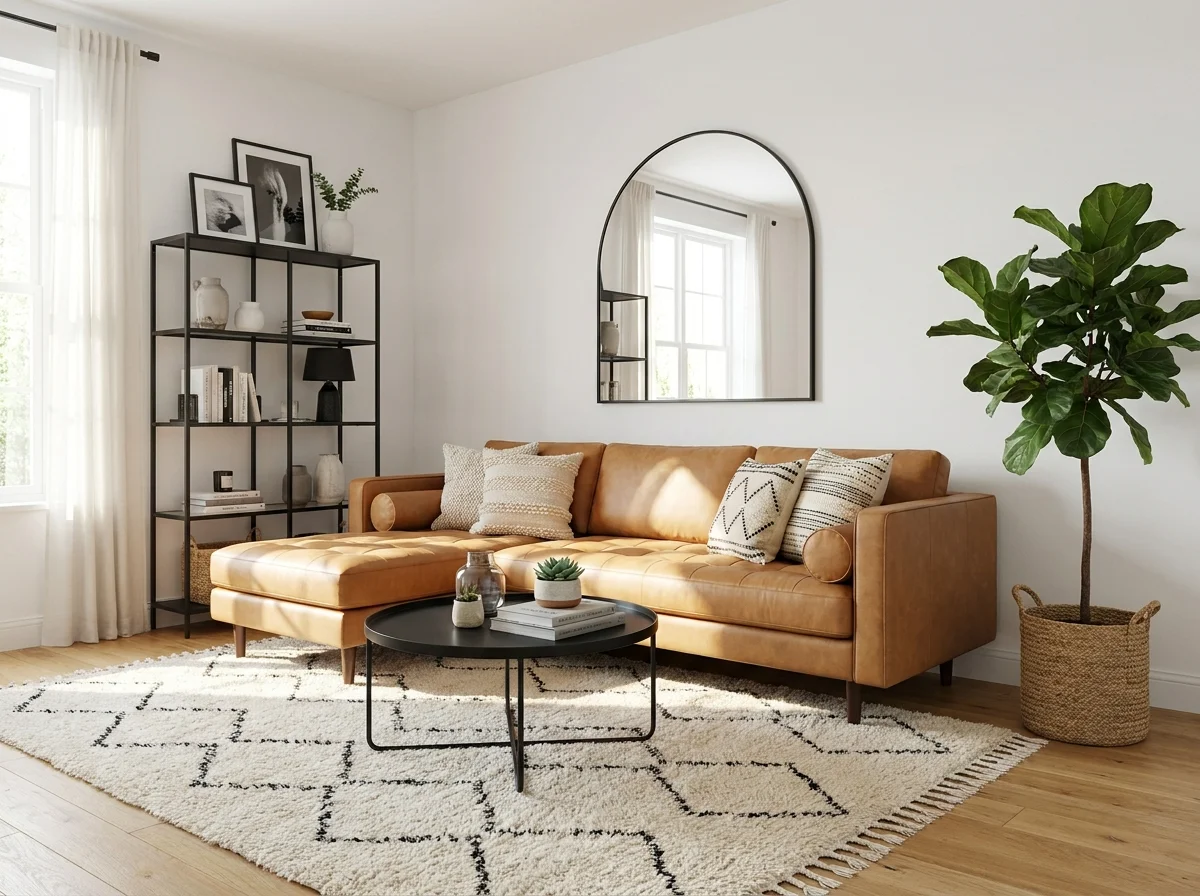
The wool throw on the back of the sofa has been there for three winters now. It's faded along the top edge from being folded the same way every morning. There's a tea ring on the side table that didn't come out, and a stack of magazines on the floor next to the chair I read in. This is the room my friends always end up in when they come over, even though the kitchen is bigger.
Most living rooms fail at one of two things. Either the layout is built around the television and conversation dies, or the lighting is a single ceiling fixture and the room reads as an airport lounge after 5pm. Fix those two first and almost everything else falls into place.
For the wider picture, see Cosy Room-by-Room Guide and Textile Layering Guide.
The method above is the backbone. What follows is the breadth — twenty-two specific, stealable ideas, each one a real move you can make this weekend. Treat them as a menu, not a checklist. Three or four done well will do more than all twenty-two done halfway.
1. Centre the Whole Room on the Fireplace
If you have a fireplace, it wins the focal-point argument before it starts. Angle the sofa and chairs toward it, not toward the television, and let the mantel carry one large object plus a pair of candlesticks rather than a row of clutter. A lit fire at 6pm does more cosy work than any other single thing in the room.

2. Build a Corner Fireplace Seating Pocket
Corner fireplaces are having a real moment, and they solve the awkward-wall problem in small rooms. Float a compact sectional or two chairs at a soft angle across the corner, drop a round coffee table in the middle to keep the circulation open, and you've made an intimate pocket without eating the whole floor plan.

3. Add a Window Seat With Storage Underneath
A window seat turns an architectural feature into a reading spot and hides clutter at the same time. Build a simple bench into the reveal, top it with a 4-inch foam cushion in washed linen, and pile two or three mismatched cushions at one end. The drawers or lift-up lid underneath swallow throws, board games, and the things that otherwise live on the floor.

4. Paint the Walls a Moody, Enveloping Colour
The myth that dark walls shrink a room is exactly that — a myth. A deep ochre, a soft-black, or a muted forest green like Farrow & Ball Studio Green wraps an evening room and makes the lamplight glow against it. Balance it with lighter upholstery and a pale rug so it reads enveloping rather than cave-like.

5. Invest in One Plush, Sink-In Seat
There is a difference between a sofa you sit on and one you sink into. Bouclé, brushed velvet, and deep feather-wrapped cushions are what separate cosy from showroom. You don't need the whole suite in it — one deep armchair or a feather-filled sofa seat earns the splurge and becomes the seat everyone fights for.

6. Layer a Smaller Rug Over a Large Natural One
Rug layering is the fastest way to add depth underfoot. Start with a big jute or sisal rug that runs nearly wall to wall, then drop a smaller wool or vintage Persian rug on top, slightly off-centre toward the seating. The natural base grounds the room; the upper rug brings the warmth and the pattern.

7. Hang One Oversized Piece of Art
A single large artwork reads calmer and more confident than a wall of small frames. Go bigger than feels comfortable — roughly two-thirds the width of the sofa beneath it — and lean it on the mantel or hang it low, so it relates to the furniture rather than floating near the ceiling.

8. Bring in Greenery at Three Heights
Plants soften hard architecture and add the one thing styling can't fake — something alive. Use three heights: a floor plant like an olive tree or fiddle-leaf fig in a corner, a trailing plant on a shelf, and a small bowl of cut stems on the coffee table. Real beats faux at every price point; faux always reads faux in person.

9. Install Floating Shelves Styled the Collected Way
Floating wood shelves in an alcove or beside the fireplace hold the collected mix designers love — stacked books laid flat and upright, a couple of ceramics, a small framed print, one woven basket. Leave gaps. The empty space between objects is what separates a styled shelf from a crammed one.

10. Mix Your Metal Finishes on Purpose
The old rule about sticking to one metal is dead. An aged-brass floor lamp, a black iron fireplace tool set, and a brushed-nickel side lamp together read collected rather than matchy. Keep one metal slightly dominant — usually warm brass in a cosy room — and let the others play supporting roles.

11. Carve Out a Reading Nook in a Corner
You don't need a spare room for a reading corner — just a chair, a light, and a soft surface. Put a wing chair or a deep armchair at a slight angle in an underused corner, add an arcing floor lamp or a small table lamp, throw down a sheepskin, and keep a stack of books within arm's reach. It becomes the spot you actually use.

12. Drape Heavy, Floor-Length Curtains
Thin curtains that stop at the sill make a window — and a room — look unfinished. Hang heavy linen or wool-blend panels from a rod mounted at the ceiling line, wide enough to clear the glass when open, long enough to just kiss the floor. The extra height and weight do as much for cosy as anything you put on the sofa.

13. Lean a Tall Mirror to Bounce the Light
A large leaning mirror is the cheapest way to double the daylight and make a small living room breathe. Lean it against the wall opposite or adjacent to the main window so it throws light back into the room. A warm-toned or antique-glass frame keeps it from feeling like gym equipment.

14. Choose a Round Coffee Table for Flow
In a tight room or one with children, a round coffee table softens the whole arrangement and removes the sharp corners you keep walking into. It also reads more sociable — there's no "head" of a round table — and it lets a sofa and chairs pull in closer without the geometry fighting itself.

15. Add Wood Paneling or Battened Walls
Half-height tongue-and-groove, vertical batten, or a full panelled wall adds texture and a sense of permanence that flat paint can't. Painted out in the wall colour it reads architectural and quiet; left as natural timber it reads cabin-warm. Either way it gives the eye something to rest on behind the sofa.

16. Style a Candle Corner for the Evening Shift
Set aside one surface — a side table, a tray on the ottoman, a corner of the mantel — for candles only. A cluster of beeswax pillars at different heights, lit together at dusk, changes the entire register of the room. Unscented or lightly beeswax-scented; synthetic fragrance fights the calm rather than adding to it.

17. Float the Sofa to Make a Room Within a Room
In an open-plan space, push the sofa away from the walls and let its back define the edge of the living zone. A console table behind it — with a lamp and a stack of books — finishes the back and stops the sofa looking marooned. The room reads intentional rather than furniture-pushed-to-the-edges.

18. Warm the Floor With a Sheepskin or Hide
Where a full rug isn't right — in front of a chair, over the arm of the sofa, across a bench — a single sheepskin adds instant softness and a focal texture. Drape one over a hard dining-adjacent chair or lay it where bare feet land first in the morning. Real shearling beats acrylic, which mats within a season.

19. Hang a Sculptural Pendant or Arc Lamp Over the Seating
A low overhead element pulls the ceiling height down into the seating zone and makes a tall room feel held. A paper-shade pendant, a rattan globe, or an arcing floor lamp reaching over the sofa all work. Keep it dimmable and warm — it's mood lighting, not a reading light.

20. Repeat One Accent Colour in Three Places
A room reads intentional when one warm accent — terracotta, ochre, oxblood, mustard — turns up in three spots: a cushion, a piece of art, a ceramic or a book spine. The repetition does the work; the eye connects the dots and the scheme feels deliberate rather than accidental.

21. Use a Trunk or Ottoman Instead of a Coffee Table
A vintage trunk brings storage and patina; a large upholstered ottoman brings a soft surface you can put your feet on and, with a tray, a drinks surface too. Both read more relaxed than a hard coffee table and both earn their place twice over in a room that's actually used.

22. Leave Breathing Room — Edit Before You Add
The hardest cosy move is restraint. A room reads inhabited but calm when there's space between objects and clear surfaces to set a mug down. Before buying another cushion or throw, remove three things at random and live with the gap for a week. Cosy is not the same as full.

The Method Behind the Ideas
Pick your ideas from the gallery above, then come back here. These seven principles are the load-bearing decisions — the ones that make the difference between a room that's been decorated and a room that genuinely works. Every idea above sits on top of these.
Anchor the Seating Around a Real Focal Point
The default modern living room arrangement points everything at the wall-mounted television. This is functional and uncosy. A conversation circle wants something other than a screen to point at — a fireplace, a tall window, a pair of bookcases, an oversized piece of art.
Move the television to a side wall, into a cabinet, or onto a stand at a 30-degree angle off the main axis. Pull the sofa eight to twelve inches off the back wall. Bring at least one chair in toward the coffee table so the seating arrangement closes into a U or a horseshoe rather than an L pointing at the screen. The walk-around space behind the sofa almost never matters; the conversation distance across the coffee table always does.
The Studio McGee portfolio shows this U-shaped arrangement across roughly half their projects. Architectural Digest has run pieces by designer Bunny Williams making the same point for two decades. The architecture of conversation is older than wall-mounted screens.
Buy the Rug First, the Sofa Second
The rug under the seating arrangement determines whether the room reads as anchored or as floating. A 5×7 rug under an 84-inch sofa floats — the rug is too small for the furniture and the eye reads disconnection. An 8×10 wool rug grounds the entire arrangement. Front legs of the sofa and chairs should sit on the rug, or the whole pieces should sit on it; never just a corner.
A wool rug from a direct importer like Lawrence of La Brea, Tuesday Made, or Revival Rugs runs £700 to £1,400 for 8×10. The same size in synthetic from a high-street store runs £150 and looks worn within two years. Wool resists crushing, shed less after the first month, and develops a patina that synthetic does not. If you spend on one thing in the living room, this is the thing.
For an existing rug too small for the room, layer it: a 10×14 jute or sisal base rug underneath, the wool rug on top, slightly off-centre. The base rug grounds the seating; the upper rug adds the warmth.
Light the Room in Five Places
A cosy living room has at least five light sources. Count them standing in the middle of the room:
- A floor lamp by the primary reading chair, around five feet tall
- A table lamp on a side table, around two feet tall
- A second table lamp on the opposite side table, matching height but not matching design
- One wall-mounted source — a picture light over an artwork, or a sconce by the fireplace
- One low source — a candle, a small ceramic lamp on a low shelf, or a fireplace itself
All bulbs run between 2400K and 2700K. The overhead light, if it exists, is on a dimmer and stays under thirty percent for evening use. Light at multiple heights creates the visual depth that single overhead lighting flattens. This is the change that does the most cosy work for the least money in any room.
"Most rooms are over-lit from above and under-lit from below. Reverse that ratio and the room transforms."
Layer Textiles in Three Weights
A cosy living room has textiles in at least three weights: a heavy weight (the rug, possibly a velvet cushion), a medium weight (linen curtains, cotton upholstery), and a light weight (a fine wool throw, a linen cushion cover). The variation matters more than the colour scheme. A monochrome room with three textile weights reads cosier than a colourful room with one.
The curtains should puddle slightly at the floor — about an inch of break — and hang from a rod mounted at the ceiling line, not at the top of the window frame. This raises the visual ceiling and makes any window read taller. Linen curtains in oatmeal or warm white run around £80 per panel from Soho Home or H&M Home in the standard 240cm drop.
The throw lives on the sofa, folded loosely along the back or draped over one arm. One throw, not three. The throw should be wool or wool-blend in a weight you'd actually want over your legs at 9pm — not the thin decorative throws sold in matching sets with cushions.
Mix the Furniture, Don't Match It
Matching three-piece suites — sofa, loveseat, chair in the same fabric — read as a delivery from a furniture warehouse. Three pieces of seating that don't match read as a room that was assembled over time.
The minimum mix: one upholstered sofa, one accent chair in a contrasting material (leather, caned wood, woven seagrass), one piece of seating that came from somewhere other than a furniture shop (an inherited armchair, a vintage stool, a reupholstered chair from a flea market). Add up to three different timber tones across the side tables, the coffee table, and the shelving. The variation reads as collected.
The accent chair is where the personality lives. A worn leather wing chair, a 1960s rattan chair, a Danish modern armchair with caned sides — any of these single-handedly raises the whole room. Vinterior, Pamono, and most city auction houses sell mid-century chairs for between £200 and £600 with patina that new chairs cannot fake.
The Coffee Table Tableau
The surface of the coffee table is the most-looked-at horizontal surface in the room. Style it for use, not for show.
A working coffee table holds: one stack of two or three large-format books (something tactile — an art monograph, a cookbook with broken-in pages, an architecture survey), one object (a ceramic bowl, a small sculpture, a brass candlestick), and one tray to corral the remote controls. That is three components, four if you count the tray. More than that crowds the surface and signals that the table is for decoration rather than putting your mug down on.
Wood, stone, and rattan coffee tables outperform glass for cosy. Glass shows every fingerprint and reflects upward, which uncosies a room. If you have a glass coffee table you cannot replace, soften it with a large tray that covers most of the surface.
Paint the Walls a Warm Neutral You Actually Saw In Person
Living-room paint colour is the single decision most often made wrong from a phone screen. The colour that looked like warm clay on Pinterest looks like dental scrubs in a north-facing room at 4pm in January.
Buy paint samples. Paint two-foot square boards in three candidate colours. Move the boards around the room across a full day — morning light, midday light, afternoon light, lamp-only evening light. The colour that holds warmth through all four is the right colour. The colour that goes grey under lamp light is the wrong colour regardless of how it looked at noon.
Reliable warm neutrals for living rooms: Farrow & Ball Setting Plaster, Joa's White, and School House White; Benjamin Moore White Dove and Edgecomb Gray; Sherwin-Williams Romance and Accessible Beige; Little Greene Slaked Lime. None of these are surprising. All of them have held up across thousands of rooms because they were tested for decades before being released to retail.
The cosy living room is mostly a layout problem with a lighting problem on top of it. The textile and colour decisions matter, but they matter on top of geometry. Move the sofa first, then change the bulbs, then everything else.