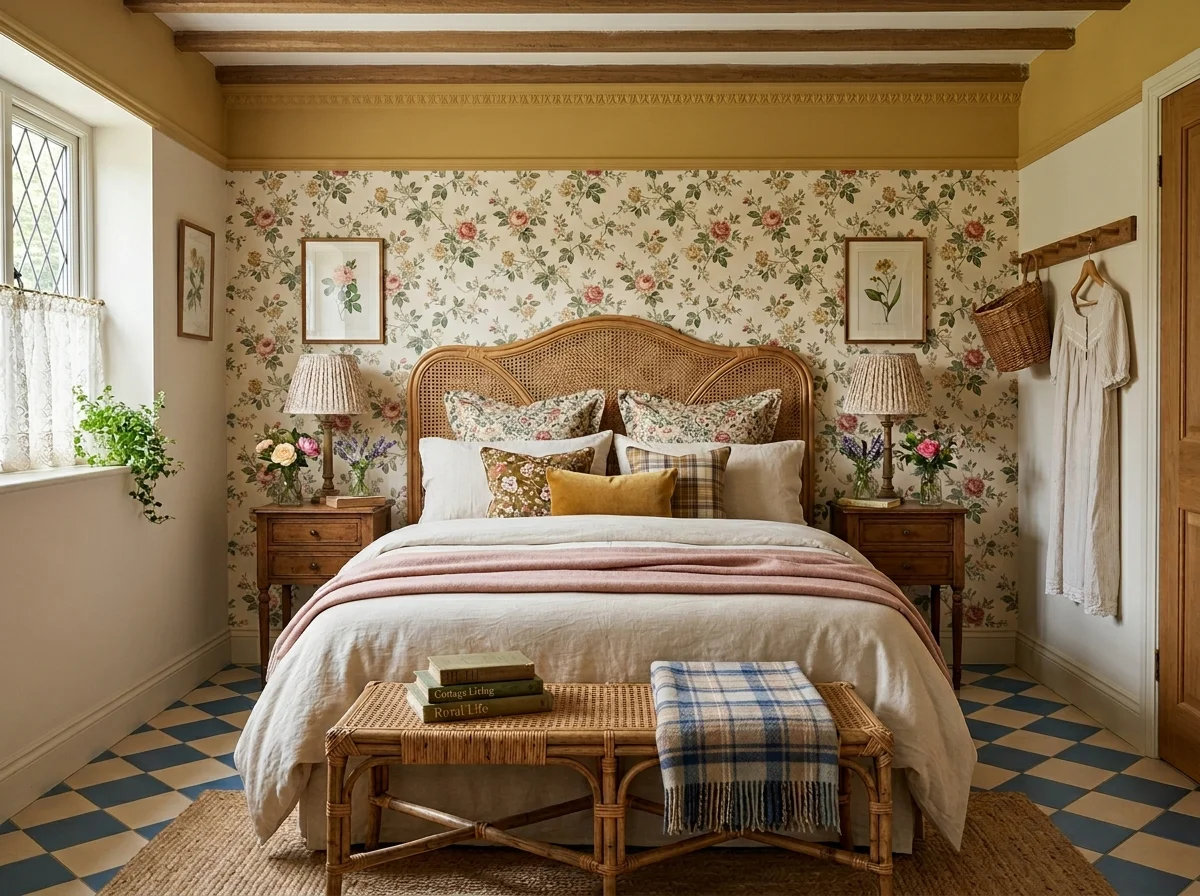
The room is two and a half metres by three. The window faces north, into a brick wall four feet away. By the door there is space for one nightstand, on the wall for one shelf, on the opposite side for a hanging rail behind a curtain. The bed centres on the long wall. That is the entire furniture plan. It has worked for two years.
Small bedrooms get treated as design problems when they are really geometry problems. The room has a longest wall, a shortest wall, a door, a window, and a series of trade-offs. Solve the geometry and the cosy follows.
For the wider picture, see Cosy Bedroom Design, Small Apartment Layout Ideas That Don't Mean, and Apartment Decorating Ideas That Survive a Tenancy.
A small bedroom doesn't have to feel cramped — it has to be planned. These thirteen layout and styling ideas make a tight room feel calm, cosy, and bigger than it is, without sacrificing the comfort that makes a bedroom worth having. Pick the ones that fit your floor plan.
1. Centre the Bed on the Longest Wall
Place the bed against the longest unbroken wall and, where space allows, leave access on both sides. Symmetry does the rest: matching nightstands, matching lamps. A small room reads calm when it's balanced, and balance starts with the bed centred and the two sides mirrored.
2. Choose a Low-Profile Bed Frame
A low platform bed sits the mattress closer to the floor, which gives a small room back the ceiling height it's short on. The lower sightline makes the walls feel taller and the room more open. Pair it with minimal bedding so the bed reads as a calm low plane rather than a bulky block.
3. Use a Storage Bed or Lift-Up Frame
In a small bedroom every cubic foot counts, and the space under the bed is the biggest store you have. A divan with drawers, a lift-up ottoman frame, or simple under-bed boxes swallow off-season clothes and bedding, so you don't need a wardrobe the room can't fit.
4. Hang a Large Mirror Opposite the Window
One large mirror — at least 80 by 120cm — placed opposite or beside the window doubles the daylight and the apparent depth of the room. It's the single most effective trick for making a small bedroom feel bigger, and a warm or antique frame keeps it from reading like a gym.
5. Go Vertical With Storage
Everything above head height is underused space. Tall narrow wardrobes, a shelf running above the door, or built-ins to the ceiling store more in the same footprint and draw the eye up, which makes the room feel taller. Vertical storage is how a small room holds a life without crowding the floor.
6. Mount Wall Lights to Free the Nightstands
Swing-arm wall lights either side of the bed put reading light where you need it without a lamp eating the tiny nightstand surface. In a small room the bedside table might only fit a glass and a book — let the wall carry the light, and the surface stays usable.
7. Float a Slim Shelf as a Nightstand
Where a full nightstand won't fit, a slim floating shelf or a small wall-mounted ledge beside the bed holds the essentials and keeps the floor clear underneath. The visible floor under it is what makes the corner read as open rather than packed, and it costs almost no space at all.
8. Keep the Palette Light and Warm
Light, warm tones — warm white, soft greige, pale clay — reflect what daylight there is and recede, which makes walls feel further away. A small bedroom drenched in one quiet warm tone, walls and trim alike, reads calm and seamless rather than busy and boxed-in.
9. Hang Curtains High and Wide
Mount the curtain rod at the ceiling and extend it past the window on each side. The curtains then frame a window that reads far taller and wider than it is, drawing the eye up and stretching the wall. Frame-height curtains do the opposite — they shrink a small room's one source of light.
10. Pick Furniture With Visible Legs
Furniture raised on legs — a bed, a chair, a chest — lets the floor run visibly underneath, and visible floor reads as space. Skirted and box-based pieces sit heavy and eat the room. In a small bedroom, choosing pieces you can see under is a free way to keep it feeling open.
11. Fit a Compact Desk or Vanity That Doubles Up
Where a small bedroom must also work, a compact desk that doubles as a vanity — one surface, a mirror, a chair that tucks fully under — earns its footprint twice. Vertical wood panelling behind it adds structure without depth. One piece, two jobs, is the small-room rule.
12. Add Backlighting for Depth
A warm LED strip behind the headboard, under a floating shelf, or along the top of a wardrobe throws soft light up the wall and creates an illusion of depth. The glow makes a small room feel layered and intentional after dark, and it's glare-free — exactly the low light a bedroom wants.
13. Edit Ruthlessly and Style the Bed
In a small bedroom the bed is most of the room, so let the bedding be the focal point — quality fabric, a textured throw, one cushion in a contrast — and keep everything around it minimal. The discipline of clear surfaces is what separates a small room that feels calm from one that feels crammed.
The Method Behind a Small Bedroom That Works
The ideas above are the menu; the principles below are the structure — where the bed goes, how to use the walls, and the light and colour choices that make a small room read calm rather than crammed.
Centre the Bed on the Longest Unbroken Wall
The bed wants the longest stretch of uninterrupted wall — no doors, no windows, no radiator. In most small bedrooms this is one specific wall, often the one opposite the door. Centring the bed on this wall gives the room visual symmetry and leaves walking space on both sides where the geometry allows.
If the longest wall has a window in the middle, you have a choice: push the bed off-centre against one wall and gain double-side access, or centre it under the window if the window is high enough that the bed doesn't block it. Beds under windows look striking and create one small problem — the head of the bed gets cold in winter. A textured headboard, or a tapestry hung behind the bed, fixes most of the cold-glass issue.
If the only longest wall is shared with a doorway, the bed pushes against the wall opposite the door, accepting that you'll see the bed first when entering.
Decide Whether to Walk Around the Bed
The biggest small-bedroom decision is whether one person or two will be using the room nightly, and whether both need their own access. For one sleeper, the bed can push against a side wall with access on only one side. This single decision recovers 60cm of usable floor.
For two sleepers, both sides need at least 60cm of clearance. Less than that and the person closer to the wall has to climb over their partner to get out, which sounds fine for six months and stops being fine in year two. If the room is genuinely too small for both-side access with a queen, a full-size (135×190cm) bed gains 15cm per side and is more comfortable than most British couples expect.
Skip the Matched Nightstand Pair
A pair of matched bedside tables takes the same footprint twice. In a room under nine square metres, one nightstand often works better than two. The non-nightstand side gets a wall-mounted lamp and a small floating shelf for the alarm clock and a glass of water.
The single nightstand on the access side handles the lamp, the book stack, and any drawer storage. A wall-mounted shelf above takes the rest. This trade gains roughly 40cm of floor space — substantial in a small room.
For both-side users who insist on equivalent surfaces, narrow drawer towers (35cm wide) replace traditional nightstands. They give vertical storage rather than horizontal sprawl and read less crowded.
One Wardrobe Solution, Not Three
The most common small-bedroom failure is having a freestanding wardrobe AND a chest of drawers AND under-bed boxes. Three storage solutions take up more visual space than one well-designed solution, and force the eye to track between them.
Pick one: either built-in storage along an entire wall (the most space-efficient, but requires commitment), or a single curtained hanging rail in a corner with a chest of drawers under the window, or full under-bed storage on rollers plus a wall of pegs and shelves. Whichever one fits the room's geometry, commit to it and remove the rest.
A curtained hanging rail in particular looks better in a small bedroom than most freestanding wardrobes. Hang a wooden or brass dowel between two walls in a corner, hang a linen curtain in front, and the room reads finished without the visual mass of a wardrobe door.
The most common small-bedroom failure is having three half-solutions for storage instead of one full one.
Light the Room From the Walls, Not the Ceiling
Small bedrooms suffer disproportionately from harsh overhead lighting because the room has nowhere for the light to fall. Wall sconces save floor space and throw light at a height that softens the room.
Two wall sconces flanking the bed, mounted around 130cm from the floor, do the work of two bedside lamps without the table footprint. Add a single wall-mounted reading light on an articulated arm by an armchair or beside the wardrobe and the room has its three light sources without any of them taking floor space.
For renters who can't hard-wire, plug-in sconces with fabric cords look surprisingly intentional. Schoolhouse, Anthropologie, and CB2 sell them between £80 and £180.
Use the Wall Above the Bed
The wall above the bed in a small bedroom is the most under-used surface in most flats. It can take a wall-mounted shelf for books (mounted high enough not to interfere with sitting up), a large single piece of art, a curated arrangement of small works, or a hanging rod for a tapestry.
A single horizontal painting or photograph above the bed reads calmer than a gallery wall. In a small bedroom, less above the bed is usually more. The eye needs somewhere to rest, and the wall above the bed is the natural resting place.
A small bedroom that has been laid out for the actual humans who sleep in it always reads cosier than a small bedroom decorated to a magazine standard. Solve the geometry first.