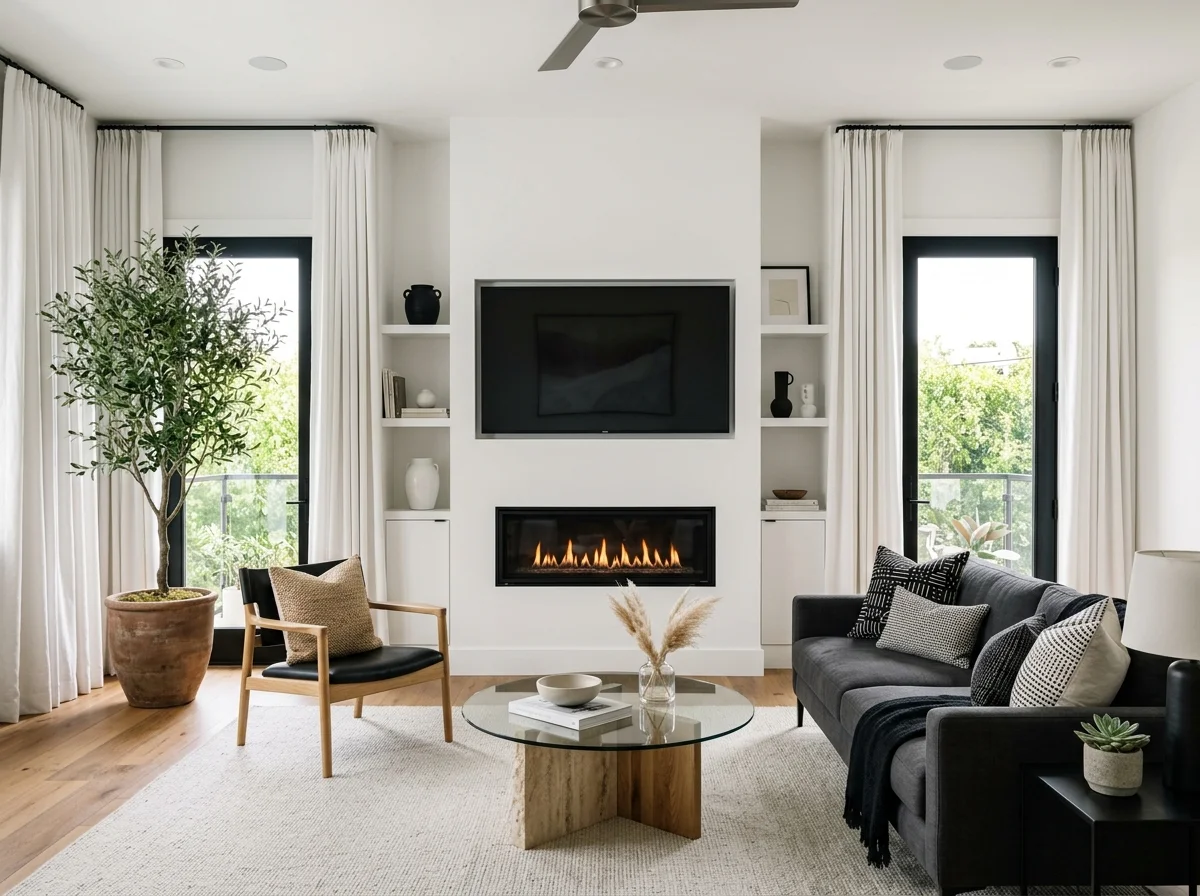
The flat is 41 square metres, on the second floor of a Victorian building in Glasgow. One room serves as living room, dining room, study, and bedroom. There is a wool rug under the sofa, a wool rug under the bed, a heavy linen curtain between them, and a single floor-to-ceiling bookshelf along one wall. The flat holds more cosy than the four-bedroom house I grew up in. Maximalist works at scale and at scale of 41 square metres.
The minimalist small-apartment trap is the assumption that less stuff equals more space. In practice, a small flat with very few objects reads as a holiday rental rather than a home. What makes a small space cosy is not the absence of things — it's the editing of which things stay.
Worth reading next to this: Small Bedroom Layout Ideas That Don't Sacrifice, Cosy Room-by-Room Guide, and Apartment Decorating Ideas That Survive a Tenancy.
A small apartment feels bigger when it's planned around breathing room, not crammed with storage. These thirteen ideas zone an open plan, work the vertical space, and earn double duty from every piece — so a tight flat reads as a calm, cosy home rather than a squeezed one. Pick what fits your floor plan.
1. Zone the Open Plan With Rugs
In a studio or open-plan flat, rugs draw the rooms that walls don't. A large rug under the living seating and a separate one under the dining or sleeping zone create invisible boundaries the eye reads as distinct rooms. Size them generously — a too-small rug shrinks a zone rather than defining it.
2. Divide With a Bookshelf or the Sofa Back
An open-backed bookshelf, a console, or simply the back of the sofa can split a studio into living and sleeping zones without closing it in. A half-height divider keeps the light and sightlines flowing while still signalling two rooms. The division is psychological as much as physical, and it works.
3. Make Every Piece Do Two Jobs
In a small flat every piece must earn its footprint twice. A storage ottoman that's a coffee table and a seat and a blanket box; a sofa bed for guests; an extendable table that's a desk on weekdays; a bench with storage inside. Single-purpose furniture is the luxury a small apartment can't afford.
4. Place One Big Mirror Opposite the Window
A single large mirror — 80 by 120cm at least — opposite the main window doubles the daylight and the apparent depth of the whole flat. It's the highest-impact, lowest-cost move in a small apartment. Lean a tall one or hang it; either way, position it to catch and throw the light back.
5. Think Vertical — Everything Above Head Height
In a small apartment the walls above 170cm are the most underused space you own. Shelves to the ceiling, tall cabinets, hooks and rails on the walls, storage over the doors. Going vertical frees the floor, and visible floor is what makes a flat read as spacious rather than stuffed.
6. Light Each Zone at a Different Level
One overhead light flattens a small flat into a single bright box. Instead, give each zone its own warm light at its own level — a floor lamp by the sofa, a pendant low over the table, a bedside lamp in the sleeping corner. The varied pools of light make the zones read as separate, cosy rooms.
7. Choose a Light, Warm Palette Throughout
A continuous light, warm palette — warm white, greige, soft clay — across a small flat makes the rooms flow into one another and the whole space feel larger and calmer. Carrying one colour through avoids the chopped-up feeling that several wall colours give a small home.
8. Use a Drop-Leaf or Extendable Table
A drop-leaf table folds flat to the wall when it's just you and opens out for guests; an extendable one does the same. Either gives a small flat the dining table it needs without permanently surrendering the floor. Folded down, it's a console; opened up, it seats four. Space on demand.
9. Hang Curtains to the Ceiling
Mounting curtains at ceiling height across a wall — even past the window's edges — draws the eye up and makes a low-ceilinged flat feel taller and the windows grander. Floor-to-ceiling drapery also softens the hard surfaces a small apartment tends to be full of, and warms the acoustics.
10. Float Furniture Slightly Off the Walls
The instinct in a small flat is to shove everything against the walls, but a sofa floated even a few inches forward, with a slim console behind, reads more intentional and can define a zone. Pulling one or two pieces in creates the layered, room-within-a-room feel that pure perimeter furniture lacks.
11. Add a Fold-Down or Wall-Mounted Desk
A fold-flat wall desk gives a small flat a workspace that disappears when the day ends — down for work, up and gone for the evening. Mounted at the right height with a shelf above, it's a full desk that claims zero floor space when closed. The vanishing workspace is the small-home ideal.
12. Keep Surfaces Clear by Default
The fastest way to make a small flat feel bigger costs nothing: keep the kitchen worktop, the coffee table, and the surfaces clear by default. Visual breathing room, not more storage, is the real small-space principle. A flat with clear surfaces reads calm and spacious; the same flat cluttered reads tiny.
13. Bring in Plants for Life, Not Bulk
Greenery adds life to a small flat without the visual weight of more furniture. A trailing plant high on a shelf, a slim floor plant in a corner, herbs on the kitchen sill. Plants soften hard edges and bring the one thing a compact, hard-surfaced flat most lacks — something alive and growing.
The Method Behind a Small Apartment That Works
The ideas above are the menu; the principles below are the structure — zoning without walls, the light and mirror moves that buy apparent space, and the furniture rules that keep a small flat from filling up.
Zone the Open Plan
The first decision in any small apartment is how to break open space into functional zones. A studio without zones reads as one undifferentiated room and feels less, not more, spacious. Three zoning tools do most of the work:
Rugs. A rug under the sofa defines the living area. A second rug under the bed defines sleep. The two rugs don't need to match — in fact they read more intentional if they differ in pile, pattern, or scale. Either can also extend slightly into a circulation path to suggest a hallway where none physically exists.
Lighting. Each zone wants its own light source independent of the others. A floor lamp by the sofa, a bedside lamp by the bed, a desk lamp at the work surface, a pendant or shaded fixture over the dining table. The zones light up independently, which means at any time of day only the zone in use needs to be illuminated.
Partial dividers. A low bookcase, an open shelving unit, or a slatted wood screen can divide sleeping from living without sacrificing light. The divider should sit between 1.2m and 1.6m tall — high enough to define the space, low enough that air and light still travel.
Layer Textiles More Generously, Not Less
A cosy small space has more textile, not less. Layer a wool throw over the sofa, a sheepskin or wool throw at the foot of the bed, a wool runner in the kitchen area, a linen curtain at the window, and ideally a heavier curtain or a tapestry as a partial room divider. Five distinct soft surfaces in 40 square metres is not too many.
The textiles do two jobs in a small space. They soften the acoustic environment — small flats echo without textile — and they break the visual uniformity of hard surfaces (painted walls, floorboards, kitchen tile). The room reads warmer for the addition.
The constraint is fibre quality, not quantity. Wool, linen, cotton, sheepskin, leather — natural fibres earn their place even in small flats. Synthetic throws and polyester cushion covers do not, regardless of how cheap the unit-economics make them.
The Furniture to Buy and the Furniture to Skip
For small flats under 50 square metres, the working furniture list is short.
Buy: A two- or three-seat sofa (a "love seat" or "apartment sofa" — 165-200cm wide). A round dining table or drop-leaf table. Two or four dining chairs that can also serve as desk chairs. A single armchair or reading chair. A floor-to-ceiling bookcase along one wall. A low chest of drawers that can double as a TV stand or side surface. One bedside table or wall-mounted shelf. Lamps at each zone.
Skip: A standard 120cm coffee table (use a vintage trunk, a pair of ottomans, or a small round side table instead). A matched dining set with sideboard. Freestanding wardrobes when any built-in storage exists. A standalone bookshelf less than full-height — it occupies floor space without giving back enough storage.
Vintage helps disproportionately in small flats. A 1960s teak chest of drawers occupying 80cm of floor space holds twice the storage of a flat-pack equivalent and looks better. Pamono, Vinterior, and most city auction houses sell at the scale small flats actually need.
Vertical Storage, Not Horizontal Sprawl
In a small flat, vertical storage almost always wins. A floor-to-ceiling bookcase along one wall holds books, ceramics, art, and personal objects in a way that three scattered low bookcases cannot. The eye reads the single tall element as architecture; the eye reads three small elements as clutter.
The same logic applies to the kitchen and bathroom. Floor-to-ceiling open shelving on a small kitchen wall, a tall narrow shelving unit in the bathroom, wall-mounted pegs or shelves above the bed. Any storage that goes up rather than across recovers floor space.
The exception is under-bed storage. A bed without under-bed boxes wastes a meaningful share of any small bedroom's floor area. Rolling boxes for off-season clothes, spare bedding, or anything else used weekly are essential equipment in any small apartment.
Light From the Walls and Ceilings, Not From the Floor
Floor lamps eat floor space. In flats under 50 square metres, replace as many floor lamps as possible with wall sconces, ceiling pendants over specific zones, and clip-on or wall-mounted reading lights.
Plug-in wall sconces work for renters who can't hard-wire. A pair of sconces by the bed, one above a reading chair, and one above a desk recover three pieces of floor real estate that floor lamps would otherwise occupy.
Two pendants — one over the dining area, one over the bed — define vertical zones in addition to lighting them. A pendant over the dining table at 30 inches above the surface, and a pendant or lantern over the bed at around 1.8m height, work without needing wall sconces.
What Pinterest Gets Wrong About Small Apartments
The minimalist small-apartment look that dominates Pinterest — Scandi white walls, one piece of furniture per zone, no books visible — reads as a holiday let rather than a home. It photographs well and lives poorly.
A small apartment lived in for two years should show evidence of those two years. Books, photographs, ceramics, postcards on the fridge, a stack of magazines, a half-finished knitting project on the sofa. Editing means choosing what stays, not removing everything. The home with one good rug, one good chair, and one good lamp plus thirty objects collected over time is cosier than the same home with three matching pieces from a single retailer and nothing else.
The cosy small apartment is a richly decorated one with careful editing, not a sparse one with three pieces of furniture. Layer in, then take three things away.