A small ceramic lamp sits on the kitchen worktop next to the kettle. It's been there for three years. When I switch it on at five in the afternoon and turn the overhead lights off, the kitchen stops being a kitchen and becomes the room where I drink tea and read the paper. The shift takes one switch. No farmhouse signage required.
Cosy kitchens get accused of being twee because of how the look has been merchandised — distressed signs, decorative roosters, chalkboards labelled with the day of the week. None of those are the actual ingredients. The actual ingredients are material warmth, light temperature, and one or two pieces of evidence that the kitchen is used by a person who likes cooking.
For the wider picture, see Cosy Room-by-Room Guide, Dining Room Decor Fundamentals, and Kitchen Colour Palettes in Warm Neutrals.
A kitchen turns clinical the moment hard surfaces and cool light take over. These fifteen ideas bring the warmth back — wood, brass, lamplight, open shelves of things you actually use. Pick the handful that suit your kitchen and your budget; even three shift the whole room.
1. Swap to Warm Bulbs and Add Worktop Lamps
The fastest warming move costs almost nothing: replace every cool-white kitchen bulb with 2700K warm white, then add a small lamp at the end of the worktop or on an open shelf. A kitchen lit only by overhead spots reads clinical; a kitchen with a pool of lamplight reads like a room you'd linger in.
2. Choose Warm Wood Cabinetry or Open Shelves
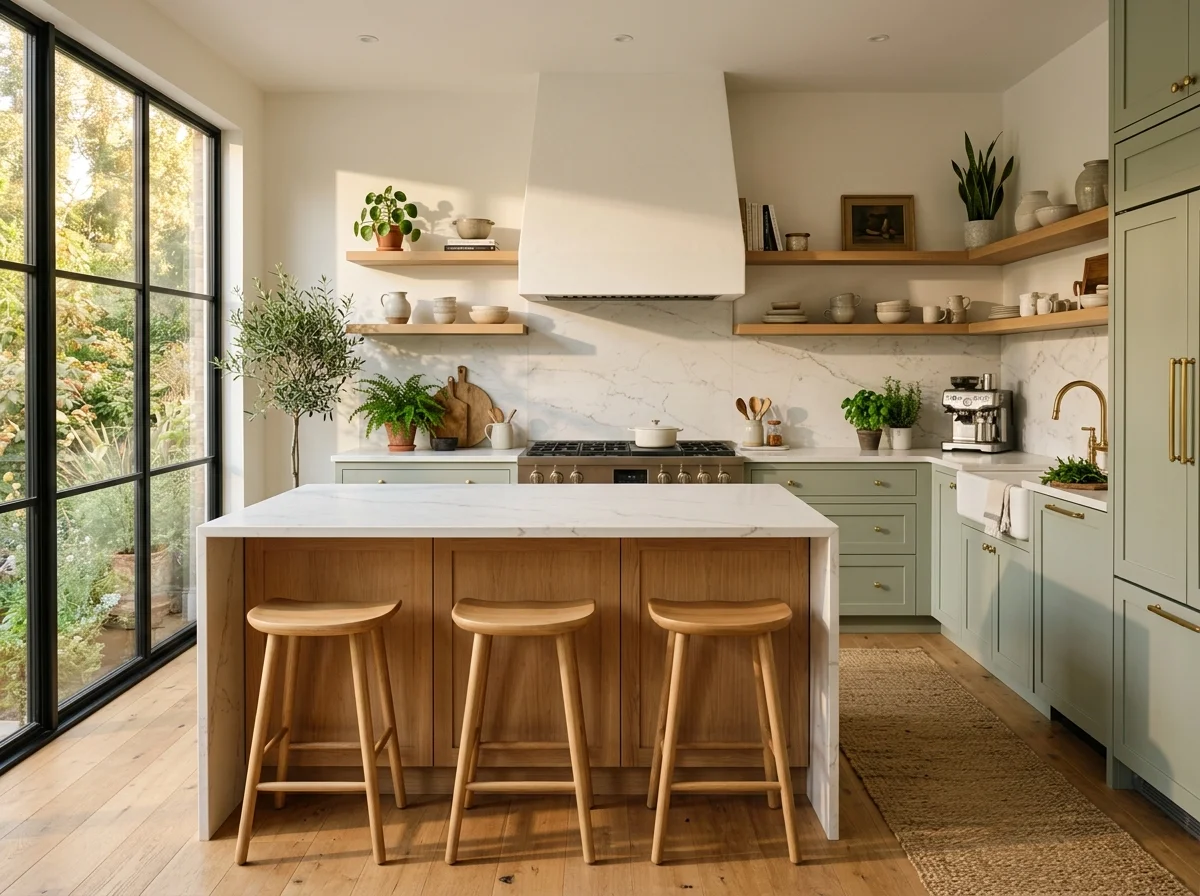
Wood is the single warmest material a kitchen can hold. Oak or walnut cabinetry, or a run of open wood shelves above the worktop, brings grain and warmth that painted units can't. Even one wood element — a shelf, an island top, a plate rack — shifts the temperature of the whole room.
3. Paint the Cabinets a Grounded Green or Navy
A muted sage, deep olive, or navy on the cabinets reads warm and characterful where bright white reads builder-grade. Paired with brass hardware and a butcher-block or marble counter, an earthy cabinet colour is the cheapest path to a kitchen that looks designed rather than installed.
4. Fit Unlacquered Brass Hardware and Taps
Brass is the warm metal, and unlacquered brass — which ages and patinas with use — warms a kitchen the way chrome and stainless never can. Swap the handles, knobs, and ideally the tap. It's a small spend for the visual warmth, and the patina makes a new kitchen read collected.
5. Lay a Runner or Rug on the Floor
A washable runner along the working stretch, or a flat-weave rug under a table, softens the hardest floor in the house and adds colour and pattern at foot level. Vintage-style cotton or a durable indoor-outdoor weave handles kitchen traffic. Underfoot softness is warmth you feel before you notice it.
6. Hang Copper or Brass Pans on Display
A rail or hooks of hanging copper and brass pans turns everyday tools into warm, glinting display — and keeps the things you reach for most within reach. It reads as a working cook's kitchen, the kind that's used daily, which is its own kind of cosy.
7. Style Open Shelves With Everyday Earthenware
Open shelves of the dishes, bowls, and glasses you actually use read warmer and more lived-in than closed cabinets. Stack earthenware plates, line up mugs, lean a board. Mix in a couple of cookbooks and a small plant. The slightly imperfect, collected look is the whole point.
8. Put Herbs and Greenery on the Sill
Something growing is the quickest warmth a kitchen can get. A row of potted herbs on the windowsill, a trailing plant on a shelf, or a jug of cut stems by the sink brings life and scent into the working room. Herbs earn their place twice — they look alive and they get cooked.
9. Add a Stone or Butcher-Block Worktop
A length of butcher-block, a marble slab, or a honed stone counter brings natural texture that engineered surfaces lack. Even a single butcher-block section — a chopping zone beside the hob — adds the warmth of real wood to an otherwise hard worktop run.
10. Hang a Statement Pendant Over the Island
A warm pendant — a brass dome, a rattan shade, a linen-shaded fitting — over the island or table pulls the light down to where people gather and anchors the room. On a dimmer, at warm temperature, it shifts the kitchen into evening mode for slow dinners and lingering at the counter.
11. Bring in a Freestanding Wood Island or Table
A freestanding wood island, a butcher's block on castors, or a farmhouse table in the centre of the kitchen reads warmer and more characterful than fitted units alone. It's the piece people gather around, the prep surface and the breakfast spot, the heart the word kitchen implies.
12. Tile a Backsplash With Texture
A handmade zellige, a terracotta tile, or a stone backsplash brings irregular, light-catching texture where a flat panel reads cold. The slight variation in handmade tile is exactly what makes it warm — no two catch the light the same way, so the wall has depth a uniform surface can't.
13. Layer in Linen — Towels, Curtains, a Blind
Soft textiles in a kitchen absorb the hardness. Linen tea towels on the rail, a linen café curtain or Roman blind at the window, a runner on the table. The fabric softens the acoustics and the look, and the natural creasing reads relaxed rather than precise.
14. Create a Coffee or Tea Station
Devote one corner of the worktop to the morning ritual: the kettle or coffee machine, a shelf of cups, a jar of beans or a tea caddy. Grouped deliberately with a small light or a plant, it turns a functional necessity into a warm little pocket the day starts in.
15. Wrap a Small Kitchen in One Warm Tone
In a small kitchen, drenching the cabinets, walls, and even the ceiling in a single warm tone — a soft clay, a muted green, a warm off-white — makes the room feel enveloping and considered rather than cramped. The continuous colour blurs the boundaries and the small kitchen reads intentional.
The Method Behind a Warm Kitchen
The ideas above are the menu; the principles below are the load-bearing decisions — light, materials, and the softening moves that keep a working kitchen from reading like a showroom.
Replace Every Bulb in the Kitchen Before Anything Else
The single most common kitchen problem is cool-white lighting. Recessed downlights at 4000K or higher, cabinet strips at 5000K, pendants with cool LEDs — together they make any kitchen read as a hospital ward after dark.
Replace every bulb with 2700K. This includes the under-cabinet strips, which usually come pre-installed in cool white. 2700K tape light from Hue, IKEA, or any LED retailer runs around £30 per cabinet length and changes the room more than any single decorating decision short of repainting.
For overhead fixtures with built-in LED panels you can't swap, you have two options: replace the fixture entirely, or put a small lamp on the worktop and run the room on lamp light from 6pm onward. Both work. The lamp option is faster and reversible.
One Material With Movement
A kitchen feels warmer when at least one large surface has visible character — grain, veining, hand-finish, patina. Most modern kitchens are 90 percent flat, uniform surfaces (painted cabinetry, quartz countertops, ceramic tile, laminate flooring) and the eye reads the lack of variation as cool.
The fix is to introduce one area of material with real visual movement. Options, in rough order of expense:
A wooden chopping-board strip set into a stretch of countertop, or a single butcher-block end-grain section near the hob. Marble with bold veining, soapstone with natural mottling, or a slab of breccia with movement. A wood-clad island base in oak or walnut. A backsplash in handmade tile rather than machine-cut subway tile.
One area is enough. A kitchen entirely in marble reads as a luxury hotel; a quartz kitchen with one marble pastry slab reads as a cook's kitchen.
Open Shelving That Works for Cooking, Not for Photography
Open shelving is cosy when it holds objects you use weekly. It fails when it holds decorative props.
The working version: two shelves at accessible height — roughly between 1.2m and 1.7m from the floor — holding a stack of dinner plates, a row of mugs, three or four mixing bowls, a few ceramic jars of dry goods. The shelves are deep enough (around 22cm) to hold plates flat. The brackets are wood, brass, or black iron — not the white painted brackets sold with flat-pack shelves.
The non-working version: four or five shelves stacked to the ceiling, holding decorative tins, photo frames, and ornaments. Dust accumulates within weeks and the visual load overwhelms.
If you have inherited the non-working version, remove three of the shelves and live with the result for a month. Most kitchens improve.
Get Something Older Than You Into the Kitchen
A cosy kitchen needs at least one object that is older than you are. A wooden chopping board with a chipped edge. A cast-iron pan inherited from someone or bought second-hand. A French butter dish. A copper pot. A ceramic bowl with a hairline crack.
The vintage piece does the editorial work of signalling that this is a cooked-in kitchen rather than a photographed one. Even a single object — a heavy enamel jug, a wooden rolling pin worn smooth at the handles — shifts the room.
Charity shops, car boot sales, and the back rooms of antique markets produce these objects for £5 to £40 reliably. They don't have to be expensive. They have to be visibly old.
Wool or Cotton Underfoot
Hard kitchen flooring uncosies the room. Add a runner in front of the sink and a smaller rug in front of the hob — or one long runner that covers both — and the room shifts.
Wool is ideal but requires regular vacuuming and immediate spill response. Flat-weave cotton runners are more forgiving and washable. Indian dhurries, Turkish kilims, and cotton rag rugs all work. Synthetic kitchen mats with rubber backing do not — they look like office mats and don't develop any character with age.
A 60×180cm cotton runner from a brand like Armadillo, Tine K, or any rug importer runs £80 to £200. It's the cheapest cosy intervention in any kitchen and the most underrated.
Art on the Non-Cabinet Wall
The wall in a kitchen that doesn't have cabinets is the most under-used surface in the room. It usually holds a calendar or nothing. Hang one piece of art — a small painting, a framed photograph, a botanical print — and the kitchen stops reading as a utility space.
Art in kitchens does not need to be food-themed. Botanicals, landscapes, abstract works, family photographs in good frames — anything that is not a sign telling you to "EAT" or "GATHER." The art reframes the kitchen as a room you spend time in rather than a galley.
A warm kitchen is mostly about light and material with one piece of evidence that someone cooks in it. Skip the farmhouse signage. The patina on the cast-iron pan does the same job, more honestly.