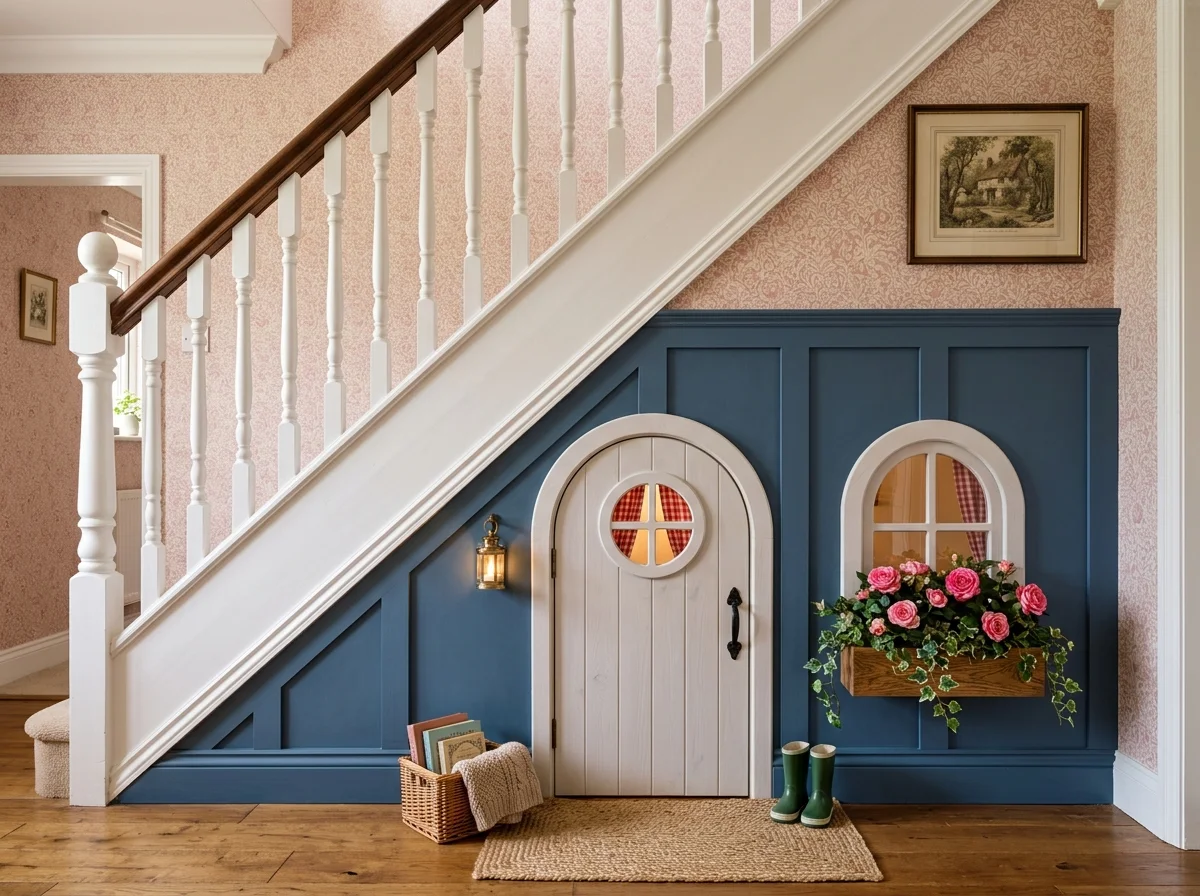
The understairs space in my mother's Edinburgh townhouse used to hold a vacuum, an ironing board, three bags of shoes, and the Christmas tree stand. Two years ago she had it converted into a reading nook — a built-in bench along the high side, a small bookcase along the low side, a single brass wall lamp, a cushion thick enough to read on for two hours. The vacuum lives in a different cupboard now. The reading nook gets used.
The space under a staircase is some of the least-used real estate in many houses. The default — a cupboard with everything the household doesn't quite know what to do with — wastes the corner's potential. With a small build investment, the space can become one of the cosiest corners in the house.
Worth reading next to this: Cosy Corner Design, Reading Nook Design, and Small Apartment Layout Ideas That Don't Mean.
The triangle under a staircase is the most wasted space in most homes — and the most rewarding to claim. These twelve ideas turn dead circulation space into storage, a nook, a workspace, or a small room of its own. Pick the one that suits your hallway and your need.
1. Build Bespoke Drawers Into the Steps
The single most efficient under-stair solution is a run of bespoke drawers following the staircase line — deep at the tall end, shallow at the low. They swallow shoes, bags, and household clutter completely behind a flush front. Joiners build these to the exact wedge; nothing else uses the space so fully.
2. Make a Reading Nook in the Triangle
Slot a bench cushion under the high end, add a wall light and a few cushions against the back, and the under-stair triangle becomes the most characterful reading spot in the house. The enclosing slope overhead is exactly the cocooning a nook wants.
3. Tuck a Compact Desk Underneath
The high end of an under-stair recess fits a small desk and a chair, making a tucked-away workspace that doesn't claim a whole room. A shelf above for books, a task lamp, hidden cables, and you've got a study nook in space that was holding nothing.
4. Add Open Cubbies for Display
Open shelving in the recess turns storage into display: a stepped run of cubbies following the slope, holding books, baskets, and a couple of objects. It reads lighter than closed cupboards and makes the staircase line a feature rather than something to hide.
5. Create a Boot-and-Coat Drop Zone
In an entrance hall, the under-stair space is the natural landing spot for the daily mess: a bench to sit and pull boots off, hooks on the wall behind, a basket for each family member, and a shelf above. It absorbs the clutter that otherwise spreads across the hall floor.
6. Slide in a Wine Rack or Drinks Store
The cool, dark wedge under the stairs suits a wine store. A bespoke angled rack, or a small run of cubbies sized for bottles, makes a feature of a collection and uses the awkwardest corner for something genuinely practical. A small counter on top holds the decanting.
7. Hide a Cloakroom WC
Where plumbing allows, the under-stair space is the classic spot for a downstairs loo. The high end gives standing headroom at the door; the basin and WC tuck under the slope. It's the use that adds the most to a house's function and value in the smallest footprint.
8. Carve Out a Pet Nook
A built-in dog bed or cat cubby under the lowest part of the stairs gives a pet its own den out of the traffic. A cushioned base, a small opening, maybe a name above it. It uses the lowest, otherwise-useless tapering end for something the household genuinely values.
9. Install a Slim Bookcase
A shallow bookcase fitted to the staircase profile turns the recess into a library wall. Shelves stepped to follow the slope hold a surprising number of books and make a feature of the collection in what is usually circulation space. Add a light to read the spines.
10. Light the Recess So It Reads Intentional
Whatever the use, lighting transforms an under-stair recess from a dark cubbyhole into a deliberate feature. LED strips along the underside of the steps, a small picture light over a nook, or a lamp on a built-in shelf. Light is what tells the eye this space was designed, not forgotten.
11. Paint or Panel It to Belong
Carry the hallway's colour and any panelling into the under-stair recess so it reads as part of the architecture rather than a leftover gap. Or drench just the recess in a deeper tone to make a deliberate pocket. Either way, finishing it properly is what separates designed from default.
12. Keep It Open as a Display Moment
Not every recess needs filling. Left open with a single console, a piece of art above, and a lamp, the under-stair space becomes a quiet display moment in the hall — a place for a vase of stems and the post. Sometimes the most considered use is restraint.
The Method Behind Using the Recess Well
The ideas above are the menu; the principles below cover how to measure the wedge, deal with the sloping ceiling, and decide between open and closed solutions for your particular staircase.
The Reading Nook Conversion
The most rewarding under-stair use is a built-in reading nook. The triangular geometry favours a bench along the high side of the stairs and bookshelves built into the angled wall.
The build:
- A bench at standard seat height (42-46cm), running along the high side of the stairs
- Cushion in linen or wool, 80-100mm thick
- Custom bookshelves stepping down to match the stair angle, on the wall opposite the bench
- A wall-mounted lamp or sconce at the high end
- Hinged storage underneath the bench
Total build cost: £600-2,000 depending on whether DIY or commissioned. A skilled DIY-er can complete this in two weekends.
The result is a reading nook with built-in books, a comfortable seat, and clear architectural definition. Reads as one of the most considered corners in the house.
The Hidden Study
For households that work from home occasionally, an under-stair study works better than a corner of the living room. The build:
- A desk at standard height (75cm), 90×50cm, mounted against the high wall
- A chair that pushes under the desk when not in use
- Wall-mounted shelves above the desk for books and stationery
- A directional desk lamp
- A small cable channel to manage power cords
The space closes off with a curtain or a panel door, which means the working evidence (open laptop, notebooks) can be hidden when not working. The cosy version of working from home in a small house.
Total build cost: £300-1,200 depending on whether using existing storage configuration or building from scratch.
Wine Storage
If the under-stair space isn't above a heated room (no kitchen, no living-room radiator directly underneath), the temperature stability favours wine storage. Custom diamond-pattern wine racks fit the stair angle cleanly.
Capacity: 30-100 bottles depending on the size of the recess. The diamond rack pattern uses the height efficiently and looks better than horizontal-bin storage.
The build can be DIY (plywood diamond inserts, sized to wine bottle diameters) or commissioned (£800-2,500 from a wine-rack specialist).
Add a small light inside the storage area so bottles can be read in low ambient light. The whole arrangement reads as a small private cellar in domestic scale.
A Dog Bed Nook
Households with a dog can use the recess as a permanent dog bed area. The build:
- A raised platform with a comfortable cushion
- A small water bowl recess
- Walls finished in materials that take wear (painted plywood, washable wood)
- Hooks for the dog's lead and harness nearby
The dog area becomes a defined territory; the dog stops sleeping on the sofa as much. Total build cost: £100-400 for a small platform with cushion.
A Coat and Boot Room (Better Than a Cupboard)
If the recess is near the front door, it can become a proper boot room rather than a generic cupboard. The build:
- A row of hooks for coats at adult and child heights
- A bench for putting on and removing shoes
- Open storage underneath the bench for shoes
- A small mat for wet boots
- A wall-mounted shelf above for hats and gloves
The visible-but-functional approach reads cosier than the door-closed cupboard. Works particularly well in family homes.
When the Default Cupboard Is Right
For some households, the under-stair cupboard genuinely earns its place — handling vacuum, ironing board, suitcases, Christmas decorations, sports equipment. Households without good alternative storage often need this.
If keeping as a cupboard, optimise the inside: shelving at multiple heights, hooks on the inside of the door for hanging items, a single internal light that comes on when the door opens. The cupboard becomes functional rather than chaotic.
But: many households assume they need the cupboard when they don't actually fill it. Empty the under-stair space for a month, store items elsewhere, see what you actually miss. Most households find they miss less than they expected.
The under-stair cupboard usually holds three years of accumulated half-forgotten items. Most of it could leave the house entirely without anyone noticing.
What Not to Do
Open shelving displaying random clutter. If the under-stair space stays open, what's visible matters. Random storage on open shelves reads as worse than a closed door.
A wine fridge that doesn't fit cleanly. Make sure the appliance fits the angle; awkward fit reads as awkward forever.
A play area for children in a damp recess. Some under-stair recesses are colder and damper than the rest of the house. Test for damp before committing children's space there.
An overstuffed coat cupboard with too many hooks. Two hooks per family member, plus one or two spares. More hooks accumulate more coats and the cupboard becomes chaos.