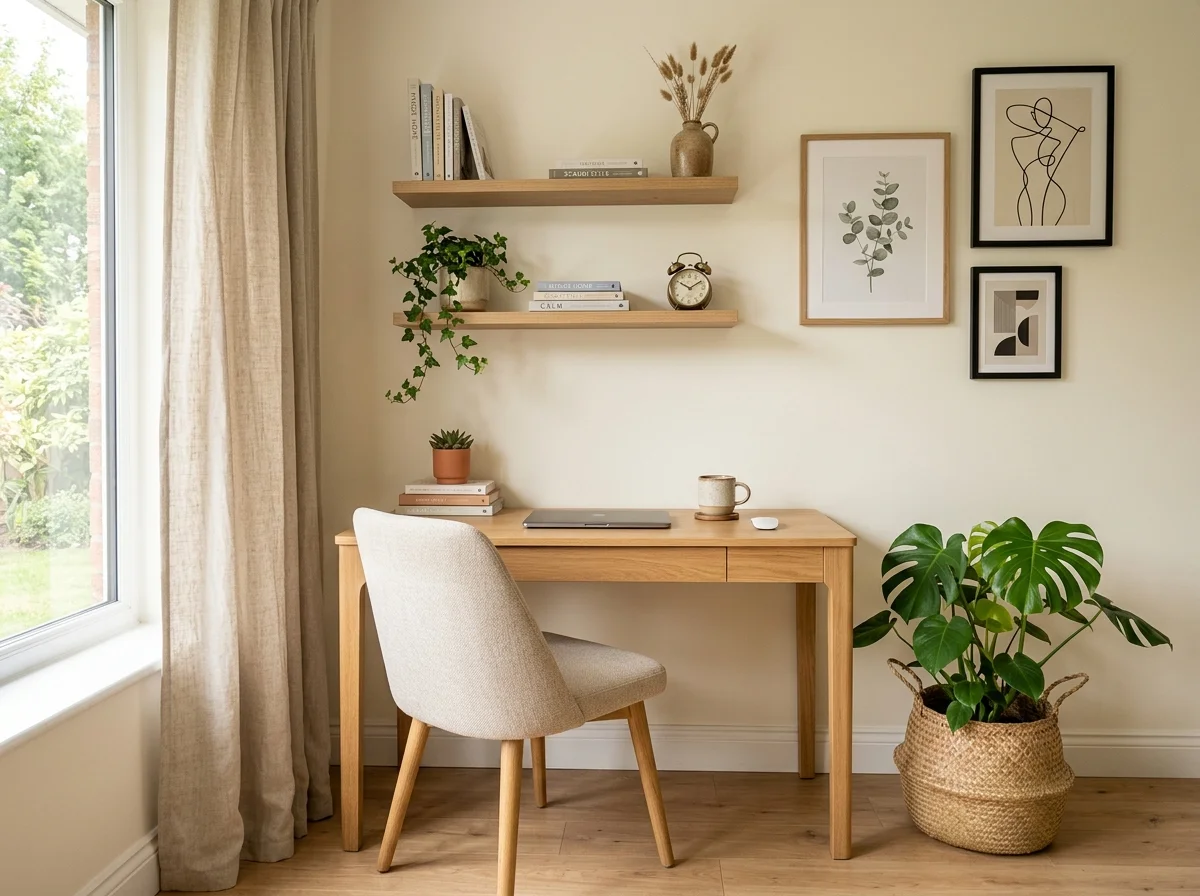
The home office here is the corner of the spare bedroom — a 1960s teak writing desk against the wall, an Eames-style ergonomic chair softened with a sheepskin, a single articulated brass lamp, a pegboard on the wall holding pens and notebooks. When the workday ends at 6pm, the laptop closes and the room becomes a guest room again. The chair stays out (it's the room's only chair besides the bed), but the working evidence — the open laptop, the notebooks — goes away. The room shifts function in five minutes.
The home office became a permanent part of many households after 2020. Most homes accommodated it by retrofitting existing rooms — the corner of a bedroom, the dining room, a section of the living room. The cosy version of this retrofit is concerned with how the office reads when it's not in use, as much as with how it functions during the workday.
Worth reading next to this: Cosy Corner Design, Reading Nook Design, and Small Apartment Layout Ideas That Don't Mean.
A working corner doesn't have to uncosify the room it sits in. These twelve ideas cover fitting a real desk into a living space, keeping it warm rather than corporate, and packing it away at the end of the day. Pick the ones that fit your corner and your work.
1. Choose a Desk That Reads as Furniture
The fastest way to keep a working corner cosy is a desk that doesn't look like an office. A wooden writing table, a vintage bureau, or a slim console reads as furniture when you're not working. Skip the laminate office desk — it announces work to a room that's meant to relax.
2. Sit at a Real Chair, Softened
An ergonomic task chair has its place, but in a living space a wooden or upholstered chair softened with a sheepskin or a wool seat pad reads far cosier. If you work long hours, choose a supportive dining-style chair with arms and add the soft layer. Comfort and warmth without the office look.
3. Light the Desk, Not the Room
A directed desk lamp — an articulated arm or a classic brass task light — puts light where you work without flooding the room with cool overhead glare. Warm bulb, around 3000K for task work. The pool of focused light makes the corner feel deliberate and the rest of the room stays soft.
4. Hide the Cables Completely
Nothing uncosies a corner faster than a tangle of cables. Channel them behind the desk, into a cable tray underneath, or through a single grommet, and tuck the power strip out of sight. Visible cables read as office; hidden ones let the desk pass as furniture. This one detail does outsized work.
5. Float a Slim Desk Behind the Sofa
In an open room, a slim console-depth desk behind the sofa makes a working spot without claiming new floor space. It doubles as a sofa-back console when you're not working, and the sofa screens the desk from the rest of the room. Two functions, one piece, no dedicated corner needed.
6. Use a Secretary Desk That Closes
The cosiest small-space office is one that disappears. A fall-front secretary desk or an armoire desk closes over the laptop, papers, and clutter at the end of the day, so the work is genuinely gone from the room. Out of sight is the most effective cosy move a working corner can make.
7. Add a Shelf Above for Storage
Going vertical keeps the desk surface clear. A shelf or two above the desk holds reference books, a plant, a small lamp, and the bits that would otherwise clutter the work surface. Styled like the rest of the room's shelving — books and objects, not box files — it keeps the corner reading as home.
8. Put a Plant in the Workspace
A plant on or beside the desk softens the hard lines of a working setup and brings something alive into the corner. A trailing plant on the shelf above, a small pot on the desk, or a floor plant beside it. Greenery is the quickest way to make a workspace feel less like work.
9. Anchor the Corner With a Small Rug
A rug under the desk and chair draws a boundary around the working zone and warms the floor underfoot. It signals this is a defined spot within the larger room, and the texture underfoot reads cosy. A wool runner or a small flat-weave does the job without bulk.
10. Face a Window, Not a Wall
If the corner allows, orient the desk to face or sit beside a window. Daylight is better to work in, the view rests the eyes, and natural light keeps the corner from feeling like a cupboard. Beside the window beats facing it for screen glare — light from the side, not behind the monitor.
11. Hang Something Personal on the Wall
The wall above a desk is prime real estate for one personal thing — a piece of art, a pinboard styled with care, a small framed print. It pulls the eye and makes the corner yours rather than generic. Keep it to one considered element, not a wall of sticky notes.
12. Set an End-of-Day Reset
The cosy home office depends on the work being put away when the day ends. Build a five-minute reset into the routine: laptop closed and stowed, papers in a single tray, chair pushed in, lamp off. The corner returns to being part of the room, and the boundary between work and home holds.
The Method Behind a Corner That Works
The ideas above are the menu; the principles below are the structure — the desk, the chair, the light, and the boundary that let a working corner function without taking the room hostage.
Choose a Desk That Reads as Furniture
The single biggest decision in a cosy home office is the desk itself. A typical "office desk" with L-shape, fake-wood laminate, cable management trays, and integrated monitor arms uncosies any room.
The cosy alternative is a piece of furniture that happens to be used as a desk:
A vintage writing desk. Often from the 1950s-1970s, in teak, walnut, or oak. Often around 110-130cm wide and 55-60cm deep. From auction houses, Vinterior, or vintage marketplaces. £200-800 for a quality piece.
A slim console table. Console tables typically too narrow for serious use (35-45cm deep), but generous consoles at 50-60cm work as desks. Place against a wall in any room. £200-1,000.
A refectory-style table. A long narrow oak or pine table that can double as a desk during the day and a serving surface or family activity table at other times. £200-600 for vintage.
A trestle desk. Two sawhorses and a thick wood plank, or a designer trestle setup. Reads as Italian architect's studio rather than as office. £100-400 depending on choices.
A bureau or secretary desk. Closes when not in use, hiding all evidence of work. The cosiest solution for a desk in a living room. £300-1,500 for vintage; new ones from West Elm or similar £400-800.
Skip: pre-fabricated office desks, L-shaped corner units, anything labelled "home office" by a retailer. The visual register is wrong for cosy interiors.
The Chair Question
If you work at the desk less than three hours a day, a regular dining chair or accent chair works. If you work more than three hours a day, the chair needs to support actual ergonomics.
Three approaches:
A proper ergonomic office chair, softened. A Herman Miller Aeron or Embody, a Steelcase Leap, a Vitra Pacific. These chairs cost £400-1,500 new but support 8-hour days. Soften the office aesthetic with a sheepskin draped over the back and seat. The result reads as a chair-in-a-room rather than as office equipment.
A vintage architect's or designer's chair. A 1970s Vitra Pacific, an Eames management chair, a Knoll Pollock — these read as design rather than as office. Vintage examples from auction houses for £200-800. Less ergonomic than current chairs but supportive for shorter work days.
A reupholstered office chair. Take an unloved ergonomic chair and reupholster it in linen or wool. £300-500 for the reupholstery; produces a chair that no other office has.
What to skip: cheap office chairs in any colour, gaming chairs (always uncosy), and anything with a logo or commercial branding visible.
The Lighting Setup
Home office lighting has different requirements from cosy ambient lighting. The desk needs directional task light; the surrounding room still needs warm ambient.
The setup:
A dedicated desk lamp. Articulated arm for direction control. Daylight-balanced bulb (4000K) during working hours for clarity; switch to warm white (2700K) in the evening to transition into cosy use. Vintage anglepoise lamps from auction houses for £80-250.
The room's existing cosy lighting. Lamps at multiple heights, all on 2700K, providing ambient warmth around the work area. Don't try to make the whole room cool-toned just because there's a desk in it.
A second lamp on the desk if it's against a wall. A small ambient lamp on the desk itself adds personality without affecting the task light. Reads as office-as-room rather than as office-equipment.
For early morning or late evening work in winter, the warm ambient lighting matters more than the desk light. A cool-white-only home office is uncosy at 7am in December even when you need to see clearly.
Cable Management Without Tech-Bro Aesthetics
The cables under a desk are the biggest enemy of cosy. Three approaches:
Hidden cable trays underneath. Adhesive or screw-mounted trays underneath the desk hold power strips and excess cable lengths. The trays sit out of sight; the visible cables run cleanly along the desk leg.
In-wall cable channels. Where the desk is against a wall, paintable cable channels (D-Line, Cablefix) run along the wall, painted to match. Less visible than trays, more work to install.
A single woven basket on the floor. Accept that the cables exist; corral them in one place. A basket beside the desk holds the cable mess; the rest of the desk reads clean. The least-perfect technical solution, but the cosiest one.
The principle: hide the cables you can; corral the rest. A clean-cabled desk reads as office; a cable-managed desk in a cosy room reads as inhabited.
A Pegboard or Wall Storage
Wall storage above the desk handles the things that would otherwise clutter the surface. Two approaches:
A pegboard. A wooden or painted-metal pegboard mounted to the wall, holding pens, notebooks, photographs, a small clock, headphones. Customisable, removable, and visually distinct from generic shelving. £40-120 for a quality pegboard.
Floor-to-ceiling shelves on one wall. If the desk is against a wall with room for shelving above, floor-to-ceiling shelving (Vitsoe, String, or DIY plywood) holds reference books, files, and small objects. The shelving reads as library; the desk becomes part of a study.
A small noticeboard or cork board. For more visual quietness. Pinning notes, photographs, postcards. Reads as personal rather than as systematised.
Skip: generic wire mesh organizers, plastic file holders, anything labelled as "desk organizer." The aesthetic is wrong for cosy interiors.
The End-of-Day Reset
The cosy home office depends on the work being put away when the day ends. The five-minute reset:
- Close the laptop
- Stack notebooks neatly or put them in a drawer
- Empty the coffee mug
- Push the chair in
- Switch the desk lamp to warm white (or off)
This shifts the room from working to inhabited. The desk reads as a piece of furniture in the evening rather than as the place work happened.
For a desk in a living room, the reset matters more than for one in a dedicated office. The work evidence visible at 8pm uncosies the room.
A cosy home office is one that has been put away by 6:30pm. The work evidence at 8pm uncosies the rest of the room.
Where to Place the Office Corner
In a small flat or shared house:
A bedroom corner. Away from the bed itself, ideally near a window. The bedroom-office boundary works if the work is contained to the corner. Becomes unsustainable if work spreads across the room.
A living room corner. A console-as-desk against a wall, with an ergonomic chair softened to read as furniture. Best if you can close the desk (bureau or secretary style) when not working.
A dining room corner. If the dining table is large, one end can become a working corner. Works only if dinner reclaims the space cleanly each evening.
A hallway niche. Some flats have wide hallways that accommodate a slim console as a working surface. Best for quick admin work, not for full days.
A purpose-built office room. If a room is available, a dedicated office allows more office equipment without aesthetic compromise. Even then, the room reads better as a study (books, a chair besides the desk chair, art on the walls) than as a corporate cubicle.
What to Skip in a Home Office Corner
L-shaped desks. Read as cubicle equipment, take twice the floor space, accumulate clutter.
Wire mesh storage cubes. Always uncosy.
Large monitor arms with multiple monitors. A single monitor or laptop is enough for most home work. Multiple monitors uncosy the space disproportionately.
Modular office furniture systems. They look identical to the office you left to work from home.
"Standing desk" converter platforms on a regular desk. Visually messy. If standing desk function matters, get a proper standing desk; otherwise use a regular one.
Cable management boxes labelled as such. Tuck the cables out of sight rather than displaying that they've been managed.