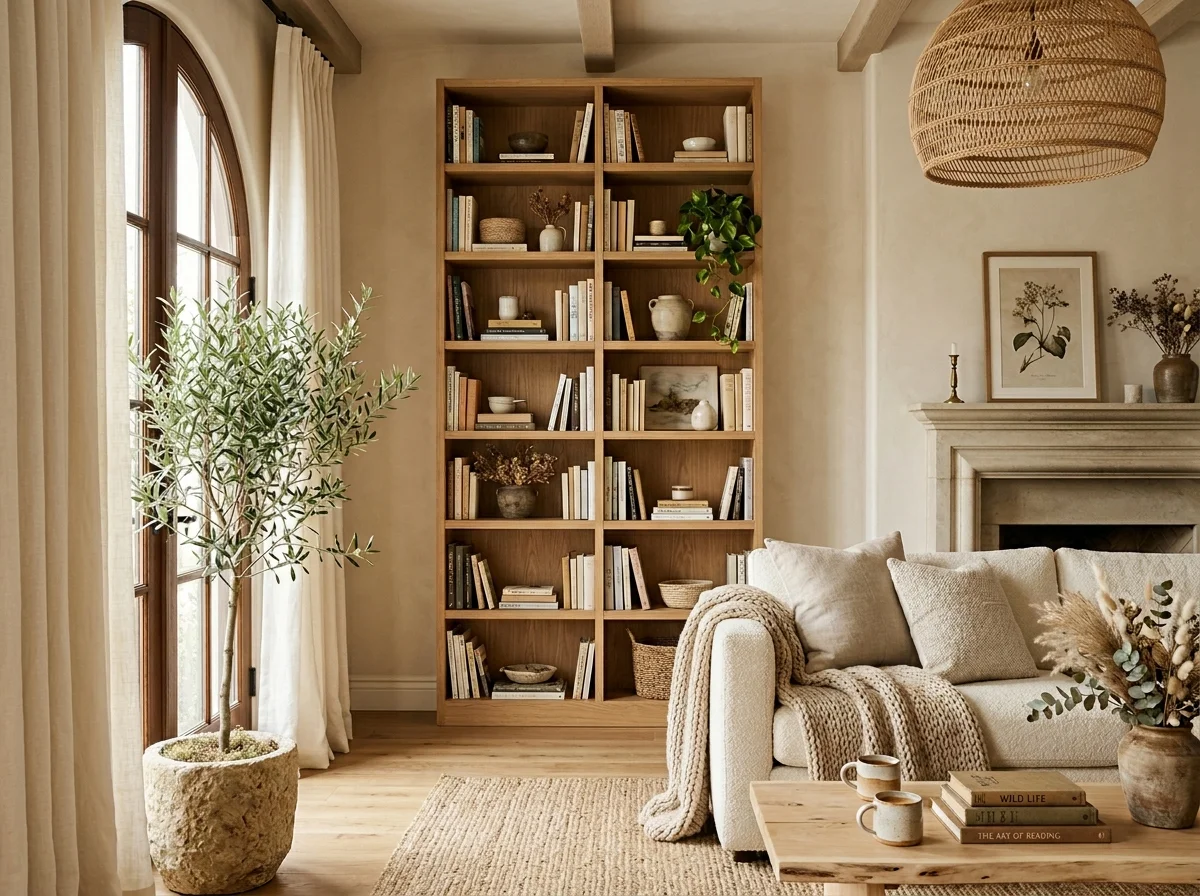
The corner of the living room nearest the window has held the same arrangement for two years: a Heal's wing chair from a 1970s lot at an Edinburgh auction house, a low brass-and-marble side table, an articulated floor lamp behind the chair throwing light onto the open book in your lap, a sheepskin on the floor under your feet, a wool throw across the chair arm. Two square metres of floor space. The single most used corner of any room in this flat. People come over and sit in it without asking.
A cosy corner is the most reliable way to add warmth to almost any room. It's smaller and more focused than full-room renovation, less expensive than reupholstering a sofa, and pays back its setup time within days. The corner becomes the room within the room — the place people gravitate to, the place where reading actually happens, the place where conversations get serious after dinner.
This guide walks the components, the placement options, and the variations across different rooms and floor plans.
Worth reading next to this: Reading Nook Design, Solving the Awkward Living Room with a, and Textile Layering Guide.
A cosy corner is the most achievable project in the house — a small, defined pocket that does one thing well. These eighteen ideas span every room and every kind of corner, from reading spots to coffee stations to plant corners. Choose the handful that fit the dead corners you already have.
1. Start With the Chair
Every cosy corner begins with one good seat. A wing chair, a deep armchair, a curved tub chair — something you can fold into. The chair defines the corner's purpose and scale; everything else supports it. Choose comfort over elegance, then make the elegant version comfortable with a throw.
2. Add a Directed Light
A corner needs its own light or it disappears after dark. A floor lamp arcing over the seat, a table lamp on a small surface, or a wall sconce. Warm bulb, positioned for the corner's task. The pool of light is what makes the corner read as a place rather than a shadow.
3. Draw a Boundary With a Small Rug
A rug under the corner's furniture draws an invisible line around the pocket and warms the floor. It tells the eye this is a defined zone within the room. A small wool rug, a round one, or a sheepskin — the boundary is what turns a chair-in-a-corner into a corner.
4. Keep a Surface Within Reach
A corner you actually use needs somewhere for a mug, a book, a phone. A side table, a stool, a stack of books topped with a tray. At armrest height, within reach without leaning. Small, but the difference between a corner used daily and one merely admired.
5. Layer in One Throw and a Cushion
The soft layer makes the corner. One throw over the chair's arm or back, one cushion for support. Two textures, not a heap. Wool, a chunky knit, or a sheepskin — something you'd actually reach for. The throw reads cosy even unused and gets used the moment it's cold.
6. Back It Into a Corner for Enclosure
The whole point is the corner: two walls behind you, nothing able to approach from behind. Angle the chair across the corner or set it square into it. The enclosure is the oldest comfort there is — see the room, guard your back — and it's free, built into the architecture.
7. Make a Coffee Corner
A small table or counter corner with a kettle or coffee maker, a shelf of cups, and a basket of beans turns a kitchen or dining corner into a morning ritual spot. Everything for the first cup in one place, so the day starts in a pocket made for it.
8. Build a Plant Corner in the Light
A corner with good light becomes a green pocket: a floor plant, a plant stand with two or three pots at different heights, a trailing plant above. Group them so the corner reads as a small indoor garden. The mass of green softens the room's hardest geometry — the right angle itself.
9. Set Up a Bar Corner
A drinks cabinet, a bar cart, or a corner shelf with bottles, glasses, and a few good objects makes a sociable pocket for the evening. It signals a shift from day to night and gives guests somewhere to gather that isn't the kitchen. Add a small lamp for the after-dark glow.
10. Carve a Desk Corner
A small desk angled into a corner makes a workspace that doesn't claim a room. Wooden table, softened chair, a shelf above, hidden cables, a plant. Backed into the corner with the window to one side, it's a study pocket that packs away into the room at day's end.
11. Make a Music or Listening Corner
A chair, a turntable on a low cabinet, a shelf of records, and a good lamp turns a corner into a listening spot. Single-purpose and analogue, it's a deliberate pocket for doing one thing slowly. The kind of corner that pulls you off your phone for an hour.
12. Build a Window Corner Seat
Where two walls meet a window, a built-in corner bench catches the light from two directions. Cushion it, bank pillows into the corner, add storage below. It's the brightest cosy pocket in the house and doubles as seating, a reading spot, and a place to watch the weather.
13. Use a Folding Screen for Instant Enclosure
Where a corner is too open, a folding screen draws a wall and creates the enclosed pocket the corner lacks. A caned, linen, or timber screen angled across the space makes an instant room-within-a-room — and moves when you want the openness back.
14. Hang Art Low to Anchor the Corner
A corner reads finished when there's something on the wall at sitting-eye height. A piece of art, a small gallery pair, a mirror to bounce the corner's light. Hung low, related to the chair below, it gives the eye somewhere to land and tells you the corner was composed.
15. Add a Tall Plant or Tree for Height
A corner often needs vertical weight to feel filled. A tall plant — an olive tree, a fiddle-leaf fig, a palm — or a slim tree fills the dead vertical of a corner without bulk and brings the right angle to life. Height is the dimension corners most often lack.
16. Create a Toy or Play Corner
In a family room, a defined corner for play — a small rug, low open baskets, a child-height shelf — contains the toys and gives a child their own pocket. Bounded clearly, it keeps the mess in one place and packs away at night, so the room returns to the adults.
17. Style a Tea Ritual Shelf
A wall-mounted shelf or small cabinet in a corner, holding the things for a daily ritual — the teapot and cups, the good mugs, a small kettle — turns a sliver of wall into a purposeful pocket. It works where there's no floor space at all, claiming only the vertical.
18. Leave a Corner Deliberately Empty
The most sophisticated corner move is restraint: a single floor lamp, a lone plant, or nothing but a beautiful chair and clear floor. An empty corner gives a busy room somewhere to breathe. Not every corner needs a job — sometimes the job is rest for the eye.
The Method Behind a Corner That Works
The ideas above are the breadth; the principles below are the structure that makes any corner cosy — the chair, the light, the surface, and the soft layer underfoot that turn a dead corner into the seat everyone chooses.
The Four Essential Elements
A cosy corner needs four things. Each does a specific job. None can be skipped without the corner reading as incomplete.
1. A chair. Comfortable, with arms wide enough to hold a mug, and a back tall enough that you can lean back without your head having no support. Wing chairs are the classic for the head-support reason — the wings cradle the head. Deep modern armchairs work if the back is at least 90cm tall.
2. A light source. A directional warm light aimed at your lap when seated — not into your face, not behind you. A floor lamp on an articulated arm is ideal. A swing-arm wall lamp mounted to the right height works equally. The bulb stays at 2700K and around 60-watt equivalent.
3. A side surface. Within arm's reach when seated. A small table, a stool, a stack of large books, or a low chest. Holds a mug, a book, possibly a candle. 40-50cm wide is enough.
4. A soft underfoot element. A small wool rug, a sheepskin, a flokati. The floor where your feet land matters. Bare wood floors uncosy any seating arrangement.
These four together produce the corner. Skip any of them and the corner reads as an incomplete idea.
Where to Place a Cosy Corner
The placement decision matters as much as the components. The corner needs:
- Proximity to natural light for daytime use (a window or a glass door)
- Distance from the main traffic path (people walking through breaks the cosy)
- An actual corner — two adjacent walls forming a L
- Enough floor space for the four elements (1.5 to 2.5 square metres typically)
Good corner locations:
The corner across from a sofa. Most living rooms have an underused corner diagonally opposite the main sofa. This corner often has nothing in it or holds a forgotten side table. Cosy corner placement here adds a second seating gravity to the room.
Bay windows or alcoves. Built-in nooks that already define themselves as separate spaces. A chair tucked into a bay window with a small table beside it is one of the most reliable cosy corners in any house.
The corner of a bedroom. Far from the bed itself, ideally near a window. The reading corner in a bedroom transforms how the room functions in the evening.
Under stairs. The dead triangular space under a staircase often holds storage but can hold a chair, lamp, and small table instead.
In an entryway or hallway with enough space. A chair-and-lamp corner in a hallway makes the transitional space feel inhabited.
The Chair Question
The chair is the largest single decision in a cosy corner. Worth choosing carefully.
The chair categories that consistently produce cosy corners:
Wing chairs. Tall back, side wings that block draughts and cradle the head. Classic English wing chairs from auction houses (£200-600) outperform new wing chairs from retailers because the proportions tend to be better in older pieces.
Deep modern armchairs. Lower back than wing chairs but generous in depth. The mid-century deep armchair (think Børge Mogensen 2204 or Hans Wegner Papa Bear) is the modern equivalent of the wing chair. Vintage originals £400-2000; modern reproductions £600-1500.
Reupholstered occasional chairs. A vintage chair with new upholstery in linen or wool produces a one-of-a-kind chair at lower cost than designer originals. Vintage chair £80-300, reupholstery £300-600 — total under £900 for a chair that holds its character.
Reading chairs in caned wood or rattan. A Wegner Wishbone chair, an Adirondack-style wooden chair softened with a sheepskin, or a vintage rattan chair with cushions. Looser and lighter than upholstered options. Works for warmer climates or rooms with already-heavy upholstery.
What to skip: rocking chairs (they discourage settling), recliners (they look like furniture-showroom rather than corner reading), and any chair with a back lower than 75cm (insufficient head support).
The Light Source
The lamp in a cosy corner does the most important job after the chair itself. Three categories work:
Articulated floor lamp. An adjustable arm that lets you direct the light onto a book in your lap from above or behind. The Bestlite BL3, Tolomeo Mega, or any anglepoise-style floor lamp. £200-600 for a quality piece. Vintage articulated lamps from auction houses for £80-300.
Swing-arm wall lamp. Mounted to the wall at chair height, swings out over the chair to light reading. Excellent for spaces without floor for a lamp. Plug-in versions for renters, hardwired versions for owned homes. £80-300.
Standard floor lamp behind the chair. A simple floor lamp 5-6 feet tall positioned slightly behind and to the side of the chair, throwing light forward and down. Less precise than articulated but easier to find. £40-150.
The bulb temperature is non-negotiable at 2700K or warmer. The wattage equivalent should be around 60-75 watts for reading; anything brighter starts to feel like task lighting in an office.
The Side Surface
Within arm's reach when seated in the chair. The surface holds:
- A mug or glass
- A book or magazine
- Possibly a candle
- The lamp's switch if it's not a foot-operated switch
Surface options:
A small side table. Wood, marble, brass, or any natural material. 40-50cm wide, 50-60cm tall. Vintage examples abundant at auction houses for £40-200.
A stack of large books. Three or four large-format books in a tall stack make a stable side surface. The books themselves contribute to the cosy.
A small chest or trunk. Storage plus surface. A vintage steamer trunk, a small painted chest, or a lacquered Japanese tansu work beautifully.
An ottoman or pouffe with a tray. A round ottoman with a tray on top doubles as a footrest or surface. The Moroccan leather pouffe is a classic of this approach.
A wide windowsill. If the corner is in a bay window or against a window, the sill itself can serve as the side surface without an additional piece.
The Soft Underfoot Element
Bare floors uncosy any seating area. The corner needs something soft underfoot.
Options:
A small wool rug. 50x80cm to 100x150cm, placed under the chair so feet fall onto it. Wool only — synthetic rugs uncosy disproportionately at this scale.
A real sheepskin. Single sheepskin draped naturally on the floor in front of the chair. Icelandic or Welsh sheepskins from suppliers like Hide House, Sheep Inc, or any local sheepskin specialist run £80-200.
A flokati or shaggy wool rug. Long-pile wool rugs in cream or natural colours. Greek flokati rugs from £100-300 for a small size.
A vintage kilim or small Persian rug. Flat-weave or pile, depending on preference. Used over the existing room rug (layered) or as the primary rug for a corner without one underneath.
For corners on already-carpeted floors, a sheepskin or smaller textured rug still adds. The layered textile is what reads as cosy, not the absence of carpet underneath.
Optional Additions Beyond the Four
After the four essentials, the corner can take a few small additions:
A folded throw across the chair arm. Wool, accessible without getting up, ready for evenings.
A small piece of art on the wall behind the chair. Single piece, not a gallery wall. The art's job is to soften the wall behind the chair, not to dominate.
A houseplant nearby. A trailing plant on a shelf, a fern in a corner, a small tree near a window. Adds living material to the otherwise inanimate corner.
A candle on the side table. Lit in the evening when reading shifts to lounging. Single beeswax taper in a holder, or a small jar candle.
A small footstool or ottoman. If the chair doesn't have built-in foot extension. £40-200 depending on quality. Vintage poufs and footstools work particularly well.
Stop at five additions total beyond the four essentials. Beyond that, the corner reads as styled rather than as used.
A cosy corner that has been built from the four essentials reads as inhabited within a day. A cosy corner over-styled with twelve elements never quite gets there.
Common Cosy-Corner Mistakes
Putting the chair in the corner facing the wall. The chair should face into the room, ideally toward a focal point (a fireplace, a view, a sofa) or in a position that gives the seated person a sense of the room.
Using a chair with insufficient back support. A chair you can't fall asleep in is not the right chair for a cosy corner.
A lamp that lights the room rather than the lap. Ambient lighting belongs in the room. The corner lamp specifically lights the book in your hand.
A side table too far from the chair. If the table is more than an arm's length away, you have to get up to set down a mug. The corner fails its own function.
No soft surface underfoot. Bare floor in front of a chair always reads uncosy regardless of how good the chair is.
Too many cushions on the chair. A chair piled with five cushions is a styling shot, not a reading chair. Two cushions maximum.
Room-Specific Cosy Corners
Living room corner: Wing chair or deep armchair, articulated floor lamp, marble or wood side table, wool rug under foot. The corner becomes the alternative seating gravity to the main sofa.
Bedroom corner: Smaller upholstered chair, a swing-arm wall lamp instead of floor lamp, a small chest or pouf for the side surface, a sheepskin underfoot. The bedroom corner is for morning coffee and evening reading.
Office corner: A comfortable non-desk chair, a reading lamp, a small table for books and tea. The office corner is where you read for an hour to decompress before leaving the work area for the day.
Kitchen or breakfast nook corner: A bench or armchair beside a window, a small lamp, a side surface. The kitchen corner is for the morning newspaper or the evening glass of wine while dinner cooks.
Hallway corner: A chair at the end of a long hallway, a small lamp, a piece of art on the wall. The hallway corner is brief — for putting on shoes, for setting down a bag — but earns its space.
A cosy corner is one of the most reliable additions to any room. Two square metres, four elements, two hundred to two thousand pounds depending on choices. The corner repays its setup time within days of use.