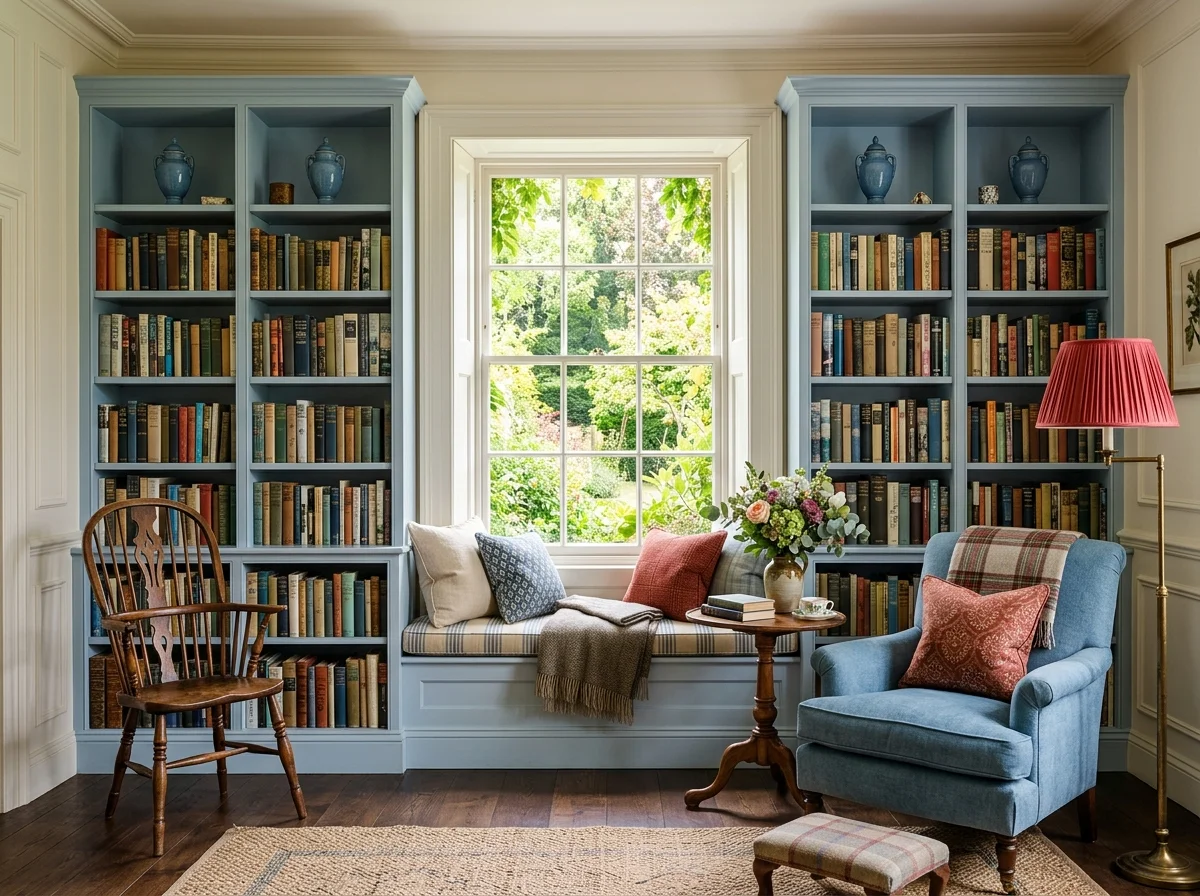
The reading nook here is two metres deep and a metre and a half wide — a corner of the spare bedroom that didn't have a use for the first eight months. There is a single deep armchair in cane and linen, a wall-mounted swing-arm lamp, a tall narrow bookcase along one wall, a sheepskin underfoot, and a small marble side table that came from an estate sale. The view through the window is a brick wall four metres away. The nook gets two hours a day in winter. It earns its corner.
A reading nook is the cosy corner with a specific function. Where the general cosy corner accommodates conversation, evening drinks, and lounging, the reading nook commits to one activity. That focus makes the design simpler and the success more reliable.
Pairs well with Cosy Corner Design, Bay Window Seating Design, and Textile Layering Guide.
A reading nook is the simplest cosy project in the house — a chair, a light, a soft surface, and the books. These twelve ideas cover where to put it, what to put in it, and how to make it the spot you actually return to. Pick the handful that suit your room.
1. Claim a Window for the Light
A reading nook lives or dies by its light. Put the chair where daylight falls over your shoulder — beside a window, not facing it, so the page is lit without glare. A north window gives steady, shadowless light all day; a west one gives golden late-afternoon reading hours.
2. Choose a Chair You Can Sink Into
The chair is the whole project. A wing chair, a deep armchair, or a curved tub chair with a seat you can fold your legs into beats anything upright and elegant. Test it the way you'll use it: sit sideways, tuck your feet up, lean into the wing. If it isn't comfortable in five minutes it won't be in an hour.
3. Add a Directed Reading Light
Daylight handles the afternoon; a focused lamp handles the evening. An adjustable floor lamp that reaches over the shoulder, or a swing-arm wall light, puts light on the page without lighting the whole room. Warm bulb, around 2700K, on the brightish side for reading specifically — this is the one spot task light beats mood light.
4. Keep a Surface Within Arm's Reach
A reading nook needs somewhere to set a mug, your glasses, and the book you're halfway through. A small side table, a stool, or a deep windowsill does it. It should be at roughly armrest height so you're not reaching down. Without it, the floor becomes the table and the nook stops getting used.
5. Layer in a Throw and a Cushion
The soft layer is what turns a chair into a nook. One folded throw over the arm or back — wool or a chunky knit you'd actually pull over your legs — and a lumbar cushion for the small of your back. Two textures, not a pile. The throw is for use, not for show.
6. Put Books Within Reach
A reading nook should hold the books, not send you to another room for them. A small stack on the side table, a narrow shelf on the wall beside the chair, a basket on the floor, or a ledge along the windowsill. Seeing the next book is half of why you sit down.
7. Back the Nook into a Corner
A reading nook feels safest with something solid behind you. Angle the chair into a corner, against a bookshelf, or under a sloped ceiling so your back is protected and the spot feels enclosed. The psychology is old — we relax where we can see the room but nothing can come up behind us.
8. Use a Sheepskin or Footstool
A footstool or pouffe lets you stretch out, and a sheepskin over it or underfoot adds the texture that reads cosy. Even a low stool doubles as a footrest and an extra surface. The point is to be able to put your feet up — reading upright with feet flat is sitting, not nesting.
9. Tuck a Nook Under the Stairs
The triangle of space under a staircase is the classic found nook. A bench cushion, a wall-mounted light, a couple of cushions against the wall, and a shelf for books turns dead circulation space into the most characterful seat in the house. Built-in storage underneath earns it twice.
10. Make a Window Seat the Reading Spot
If you have a bay or a deep reveal, build a window seat and you've got a reading nook with a view and storage in one. A firm cushion, a scatter of pillows against each end, and a throw. Morning coffee, afternoon reading, somewhere for guests to perch — it earns its build several times over.
11. Give the Nook Its Own Small Rug
If the chair sits on a hard floor or floats in a larger room, a small rug under it draws a boundary and says this is a place. A wool runner, a round rug, or a sheepskin defines the nook as a room within the room and warms the floor your feet land on.
12. Keep It Screen-Free
The one rule that makes a reading nook work: no television in its sightline, and a deliberate spot to put your phone down — a small dish or tray on the side table. The nook is a single-purpose place, and that's its whole value. Protect it from the screens that have colonised everywhere else.
The Method Behind a Nook That Lasts
The ideas above are the menu. The principles below are why a reading nook works at all — the small decisions about light, comfort, and enclosure that separate a chair in a corner from a spot you return to every evening.
The Three Non-Negotiables
A reading nook fails when any of these three are wrong. Get them right and the nook gets used; get them wrong and the nook becomes a styled spot for photographs.
The chair you can settle into. A chair that lets you sit for an hour without shifting your position. This means: arms wide enough for elbows, back tall enough to support the head when reclining, depth deep enough that your knees aren't pushed forward, and cushion firmness right for your weight. Test by sitting for at least twenty minutes before buying.
Light focused on the page. A directional warm light source aimed at where the book will be — usually your lap or chest height. Floor lamps with articulated arms, swing-arm wall lamps, or table lamps with focused shades. The lamp should not light the room; it should light the book.
Books within arm's reach. The reading nook works because getting a book doesn't require getting up. A bookshelf adjacent to the chair, a small table with a stack of books on it, or a wall-mounted ledge with books above the chair all qualify.
Without any of these three, the nook fails its own purpose.
Where to Place a Reading Nook
The placement priorities for a reading nook, in order:
1. Near natural light. A window within view of the chair, ideally letting in light onto the reading surface. Best for daytime use; not essential for evening reading.
2. Away from traffic. A corner where people don't walk through. The interruption of someone passing breaks the reading meditation in a way that other activities don't suffer from.
3. With a wall behind the chair. Sitting with your back to an open room feels exposed. A wall behind reads as enclosed and psychologically settling.
4. With at least two square metres of dedicated space. A nook crammed into 1 square metre works for occasional reading but doesn't reward long sessions. Two square metres minimum for comfortable habitation.
5. Acoustically separate from busy parts of the house. A reading nook off the kitchen with cooking noises drifting in works less well than one in a quieter part of the house.
Locations that consistently work: bay windows in living rooms, the corner of a bedroom near a window, the alcove off a hallway, a dedicated wall-end in a study.
The Chair Specifically for Reading
The reading chair is the most important component. Chairs that work specifically for reading:
Vintage wing chairs. The wings cradle the head when leaning back. English wing chairs from 1940s-1970s often have proportions that exceed modern wing chairs. £200-700 from auction houses, reupholstered or as-found.
Deep modern armchairs. Mid-century Scandinavian chairs (Børge Mogensen, Hans Wegner, Finn Juhl originals or reproductions) have deep seats and supportive backs designed for long sitting. £500-3000 for originals, £400-1500 for licensed reproductions.
Reupholstered occasional chairs. A vintage chair body with new linen or wool upholstery — often the best value proposition. Buy a vintage chair (£80-300) plus reupholstery (£300-700) for a chair that holds character and supports the body. Total under £1000.
Cane and rattan reading chairs. Lighter aesthetic than upholstered. A Wegner Wishbone-style or a vintage rattan chair with a deep cushion. Works in warmer interiors or for shorter reading sessions.
Chesterfield-style armchairs. Deep buttoning, low back, traditional aesthetic. Works in libraries and studies more than in modern living rooms. £400-1500 for vintage; £800-3000 new.
What to skip: rocking chairs (don't suit settling), recliners (read as TV-watching chair), folding chairs (no settling possible), and any chair with a back lower than 75cm.
The Lighting Specifically for Reading
The lighting decision matters more for reading than for general cosy corners because the book is the focal object.
Articulated floor lamps. An adjustable arm that puts light precisely where needed. Bestlite BL3, Anglepoise, Tolomeo. £200-600 for quality lamps. The articulation lets you direct light from above or behind the chair onto the book.
Swing-arm wall lamps. Mounted to the wall beside the chair, swings out over reading position. Best where floor space is limited. The Schoolhouse Industry Swing Sconce, the Cedar & Moss swing-arm, or any vintage swing-arm wall lamp from estate sales.
Reading floor lamps with focused shades. Floor lamp with a downward-facing cone or directional shade. Less precise than articulated but easier to find at lower price points. £40-200.
The bulb should be 2700K (warm white) at around 60-75 watts equivalent. Brighter is task lighting; dimmer makes reading hard.
A second ambient light source helps but isn't essential — a small lamp on a windowsill or a candle. The ambient light prevents the reading lamp from being a single hot spot in an otherwise dark room.
Books Within Arm's Reach
The reading nook fails when books aren't accessible. Three approaches:
A bookshelf adjacent to the chair. A tall narrow bookcase along the wall beside the chair, holding the books you're currently working through plus reference materials. IKEA Billy with the height extender works; vintage bookcases work better aesthetically.
A small bookcase or low shelf within reach. A 80cm-tall bookcase positioned beside the chair holds 40-60 books at arm height. Books rotate in and out as you read through them.
A wall-mounted ledge or shelves above and beside the chair. Floating shelves with current reading material. Limited in capacity but doesn't take floor space.
A stack of large books on the side table. Reading-in-progress stack on the table itself. Less capacity than dedicated shelves but immediate access.
The principle: the books you might want to read next should be visible and reachable without getting up.
The Soft Material Underfoot
A reading chair without a soft material underfoot reads as institutional. The options:
- A small wool rug under the chair (50x80cm minimum)
- A sheepskin draped on the floor or over the chair
- A flokati or shaggy wool rug at the foot of the chair
- A vintage kilim layered over an existing rug
In a reading nook in a bedroom or study with existing carpet, an additional sheepskin or small rug adds layered texture and reads cosier than the bare carpet.
The Side Surface
Within arm's reach when seated. Holds:
- A mug or glass
- The lamp's switch (or a foot switch)
- A candle (lit during evening reading)
- Reading glasses
- Possibly the book you're between (not currently reading but next up)
Options: a small marble or wood table (30-50cm wide), a stack of large books with a small tray on top, a low chest or trunk, or an ottoman with a tray. Vintage tables from auction houses for £40-200.
A reading nook fails when getting a book requires getting up. The friction of fetching breaks the meditation that reading depends on.
Privacy and Enclosure
The psychological feeling of enclosure makes a reading nook different from a chair in a room. Three approaches:
A wall behind the chair. The simplest enclosure. The wall provides physical and psychological boundary.
A high-backed chair. A wing chair or a chair with side wings creates enclosure within the chair itself. You sit with the chair around you.
A curtain or screen partial division. A heavy curtain that can be drawn around the nook for fuller privacy, or a folding screen between the nook and the rest of the room. Most useful when the nook is in an open-plan space.
A bookshelf as partial divider. A bookcase running perpendicular to a wall divides the nook from the rest of the room while remaining open at the top. Useful in open-plan layouts.
The Window Seat Variation
A built-in window seat is one of the highest-quality reading nooks if your house has a deep window reveal that supports it. Construction:
- A bench top extending from one wall to the other across the window
- Cushion (50-80mm thick foam wrapped in linen or wool) full length of the seat
- Hinged storage underneath for blankets, off-season cushions, books not currently read
- Bookshelves built up the walls on either side or set into the wall above
Window seats in bay windows are the classic. Window seats in flat windows can work if the wall is at least 30cm thick (typical for Victorian houses; uncommon in modern builds).
For modern flats without deep window reveals, a freestanding bench placed against a window with cushions and books on a side shelf approximates the effect.
The Single Most Common Reading Nook Mistake
Buying everything at once from a styling guide, photographing it, and never using it.
The reading nook that gets used is built over time — chair first, then live with it for a month. Add lamp, refine. Add bookshelf or side surface. Refine. After three months, the nook reflects how you actually read rather than how the styling guide imagined.
The chair you can settle into is decisive. Test by sitting in it for an hour before committing. If you shift position twice in that hour, the chair is wrong and the rest of the nook won't compensate.
The reading nook earns its space by being used. Build the four elements over time rather than all at once, and the corner becomes the place in the house where reading actually happens.