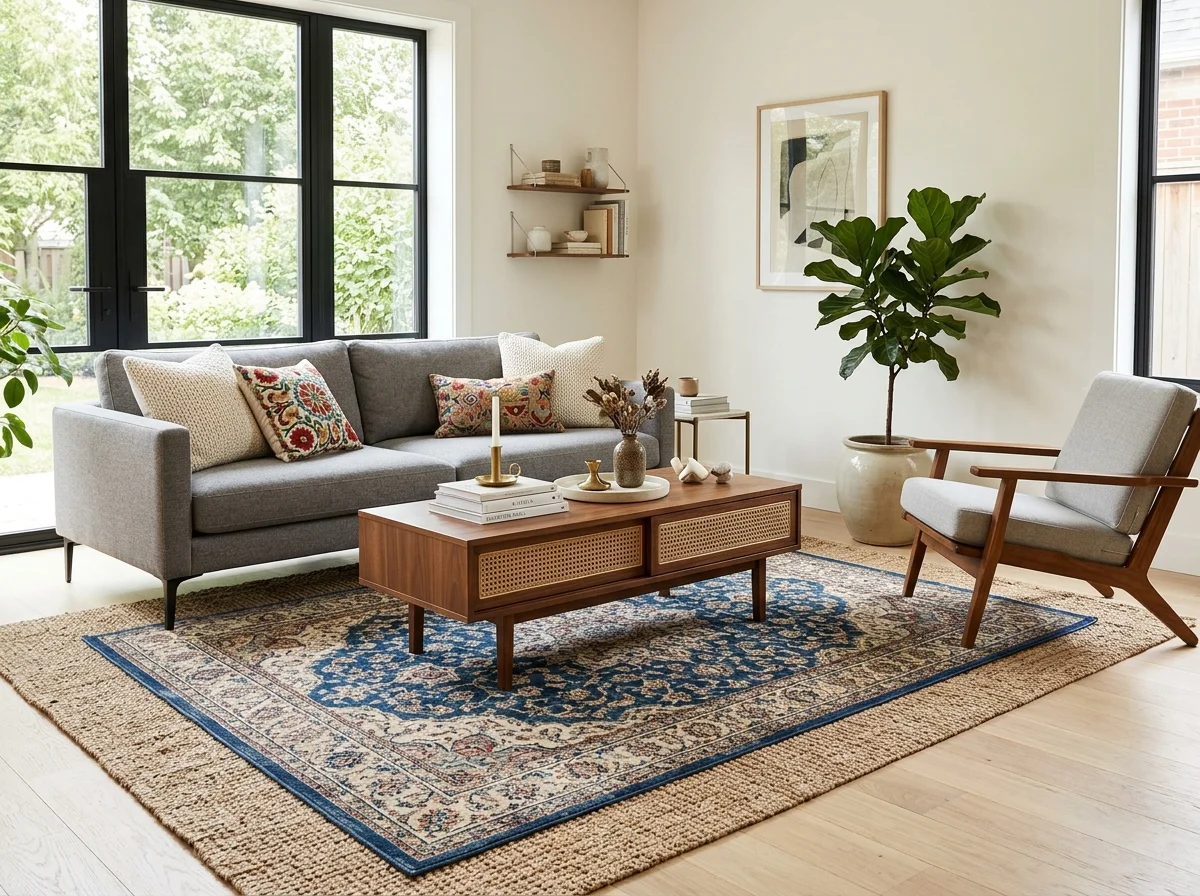
The wool rug under the sofa here is a hand-knotted Persian from an Edinburgh auction house — £620 in 2021, roughly nine by twelve feet, in muted oxblood and warm cream. It has held three winters of dog claws, two spilled glasses of red wine, and a steady stream of bare feet. It looks better now than the day I bought it. A rug like this is the closest thing to a non-negotiable investment in a cosy home.
The rug under your seating area is the single largest textile in most rooms and the one that most affects cosy. Get it right and the rest of the room layers on top easily. Get it wrong — too small, wrong fibre, jarring pattern — and no amount of cushioning recovers the room.
This guide walks the decisions in order: size, fibre, pattern, source, and price.
If this is the room you're working on, Where to Buy Cosy Home Essentials and Cosy Living Room Decorating Ideas That Actually go deeper on the pieces that fill it.
The right rug grounds a room; the wrong one floats and dates. These thirteen ideas cover fibres, sizes, placements, and styles for warm rooms, so you buy a rug that anchors the space and lasts. Each is a practical move; pick the ones that fit your room and budget.
1. Buy Wool for Warmth and Longevity
Wool is the rug fibre worth paying for — warm underfoot, naturally resilient, and ageing into patina over decades rather than wearing out in a couple of years like synthetic. It resists crushing and dirt, and feels good on bare feet. If you spend on one rug, make it wool; it's the false economy to skimp here.
2. Size Up — Bigger Than You Think
The most common rug mistake is buying too small. The rug should be big enough that at least the front legs of all the seating sit on it, ideally the whole sofa. A generously sized rug grounds the entire arrangement; a small one floating in the middle makes the room look unanchored. When between two sizes, take the larger.
3. Layer a Wool Rug Over Jute
For depth, texture, and a bigger look on a budget, layer: a large natural jute or sisal base rug, a smaller wool or vintage rug on top, slightly off-centre toward the seating. The coarse base grounds the room and extends the coverage; the wool top brings the softness and pattern where it's wanted.
4. Choose a Vintage or Persian for Character
A vintage wool rug — a worn Persian, a faded Turkish, a kilim — brings colour, pattern, and patina that new rugs can't fake, and the existing wear means you stop worrying about the next spill. Warm reds, rusts, and golds in an old rug ground a room beautifully. Character and durability in one buy.
5. Anchor a Dining Table on a Flat-Weave
Under a dining table, a low-pile flat-weave or indoor-outdoor rug handles crumbs and chair movement better than a deep pile. Size it so the chairs stay on the rug even pulled out — about 60cm beyond the table edge on every side. The rug grounds the table and warms the floor without trapping every crumb.
6. Run a Runner Where Feet Travel
In a kitchen, hallway, or beside a bed, a runner warms and softens the path feet actually travel. A washable cotton or a durable wool runner in a warm tone or pattern adds colour at floor level and protects high-traffic flooring. The runner is the rug for the narrow spaces a full rug can't fit.
7. Add a Sheepskin for a Soft Hit
Where a full rug isn't right — in front of a chair, over a bench, where bare feet land by the bed — a single sheepskin adds a focal hit of softness and warmth. Real shearling beats acrylic, which mats within a season. Small, soft, and the texture people reach out to touch.
8. Match the Rug Tone to the Room's Warmth
A warm room wants a rug in a warm tone — cream, oatmeal, rust, ochre, faded red, warm brown. A cool grey rug, however nice, pulls a warm room toward cold at floor level. The rug is a large surface; let it reinforce the room's warmth rather than fight it. Tone matters as much as pattern.
9. Use a Rug to Zone an Open Plan
In an open-plan space, rugs draw the rooms walls don't. A generous rug under the living seating and a separate one under the dining area create distinct zones the eye reads as separate rooms. Size each generously — a too-small zoning rug shrinks its area rather than defining it.
10. Buy From Direct Importers for Value
A wool rug from a direct importer — Lawrence of La Brea, Revival, Tuesday Made, or a local rug dealer — runs a fraction of the high-street price for the same quality, because you're skipping the markup. The same 8x10 wool rug can vary by hundreds of pounds depending on where you buy. The source is half the value.
11. Always Use a Rug Pad
A rug pad underneath stops the rug slipping, protects the floor, adds cushioning underfoot, and makes the rug feel and wear better. It's the cheap accessory that doubles a rug's comfort and lifespan, and stops the corners curling. Never lay a good rug without one — it's the unseen upgrade.
12. Consider a Washable Rug for Family Rooms
In a family room, a kitchen, or anywhere with children and pets, a washable rug — a flat-weave that goes in the machine, or a low-pile indoor-outdoor weave — means you stop policing the room. The peace of mind of a rug you can actually clean is worth the slight trade in plushness for the rooms that get the hardest use.
13. Test the Rug at Home Before Committing
Rug colour and scale read differently at home than in a showroom or online. Order a sample or a returnable rug, lay it in the actual room, and live with it for a few days in your own light before committing. A rug that looked perfect online can read too small, too cool, or too busy in the room. Test before you keep.
The Method Behind Buying the Right Rug
The ideas above are the menu; the principles below are the structure — the size decision, the fibre choice, and the placement rules that decide whether a rug anchors a room or undermines it.
The Size Decision
The most common rug mistake is buying too small. A 5×7 foot rug under an 8-foot sofa makes the furniture float. The rug becomes an island in the middle of the room rather than the foundation of the seating arrangement.
The size rules:
Option A: All furniture on the rug. The rug is large enough that the sofa, the chairs, and the coffee table all sit entirely on it. Generally requires 10×14 feet or larger for a typical living room. The most luxurious option; reads as grounded.
Option B: Front legs on the rug. The major seating pieces have their front legs on the rug; back legs may sit on bare floor. The coffee table sits entirely on the rug. This is the standard cosy configuration for most living rooms — 8×10 feet covers it for most arrangements.
Option C: Floating in front of the sofa only. A smaller rug (6×9 or even 5×8) placed in front of the sofa, with the sofa itself not on the rug. Works only when the rug functions as a layered accent over a larger sisal or jute base.
What does not work: a small rug under a coffee table only, with all seating on bare floor. This is the configuration that uncosies more living rooms than any other. The rug looks orphaned; the seating reads as floating.
For dining rooms, the rug extends at least 60cm beyond the table on every side, so that chairs pulled out for sitting still sit on the rug. A 150×90cm dining table wants a 270×180cm rug at minimum.
For bedrooms, the rug extends past the foot of the bed by at least 60cm and runs the length of the bed on the side(s) you sleep on. For a double or queen bed with both-side access, a single large rug under the bed extending 60cm on each side works.
The Fibre Decision
For cosy rooms, wool wins. The alternatives:
Wool. The default. Resists crushing, develops patina, takes dye in warm tones, lasts decades. Hand-knotted wool rugs from Persia, Turkey, India, Nepal, and Morocco all qualify. Modern hand-tufted or machine-woven wool also acceptable. Sheds slightly for the first 3-6 months, then stabilises.
Wool-silk blends. Premium option for formal or bedroom rugs. The silk adds sheen and softness; the wool provides durability. £1,500-8,000 for hand-knotted wool-silk.
Hand-knotted silk rugs. Heirloom-quality pieces, expensive (£3,000+) and impractical for high-traffic rooms. Best in bedrooms or formal sitting rooms.
Cotton flat-weave (dhurries, kilims). Useful for kitchens, hallways, and layered over larger pile rugs. Washable, lighter weight, less expensive. £80-400 for a good cotton kilim.
Jute and sisal. Natural-fibre rugs in pale tones. Best as base layers under wool rugs, or as primary rugs in entryways and casual spaces. Not as cosy as wool but cheaper and acceptable for layering.
Synthetic rugs (polypropylene, polyester, nylon). Skip entirely. They look acceptable for the first six months and decline rapidly. Surfaces shine under light, develop static, attract dust differently than wool, and never feel right underfoot. The cost savings disappear within two years.
The Pattern Decision
The rug's pattern is a major design choice. Three approaches work:
Vintage Persian and Turkish rugs. Hand-knotted, often featuring traditional medallion or all-over patterns in warm reds, oranges, deep blues, and cream. The patina from real use produces colour fading that machine-made imitations cannot replicate. Best for rooms with otherwise simple decoration — the rug becomes the visual anchor.
Plain wool rugs in solid colour. Oatmeal, cream, warm grey, soft pink, sage green. Reads modern and editorial. Best for rooms with strong pattern elsewhere (gallery walls, patterned curtains, vintage furniture).
Moroccan Beni Ourain and Azilal. Cream wool with simple dark linear patterns. Modernist aesthetic with handmade warmth. Premium pieces £1,000-3,000; reproductions £300-800.
Tonal abstract patterns. Modern hand-tufted rugs with subtle pattern in narrow colour palettes. Designers like Christopher Farr, Madeline Weinrib, or designer-led collections at brands like Ferm Living. £800-3,000.
What to skip: bright pastel "modern" rugs (date quickly), busy floral patterns in cool colours, rugs with bright primary colours, and any rug with the brand or designer name visibly woven into the pattern.
The Source Decision
Where to actually buy the rug:
Direct importers (best value new): Lawrence of La Brea (US/global), Tuesday Made (UK), Revival Rugs (US/global), Jaipur Rugs (US/UK). Hand-knotted wool from India, Turkey, and Iran sold direct to consumers. 8×10 wool rugs from £500-1,400. The same quality at high-street retailers runs £1,800-3,500.
Local auction houses (best value vintage): £150-1,500 for hand-knotted Persian and Turkish vintage rugs in 6×9 to 9×12 sizes. Online bidding makes regional auction houses accessible. Inspect condition descriptions carefully; ask for additional photos.
Vinterior, Chairish, 1stDibs (verified vintage): £400-3,000 for verified vintage rugs with condition descriptions. More expensive than auction houses but with provenance and easier returns.
Speciality rug dealers in major cities: Rug Society (UK), Mansour Modern (US), local Persian rug shops in any city with strong Iranian or Turkish communities. Higher prices than direct import but expert advice and curated selections.
Designer brands and home retailers: John Lewis, Heal's, Soho Home, West Elm, Anthropologie. Mixed quality. Read fibre content carefully — many "wool" rugs at high-street retailers are wool-blend with synthetic backing. £500-3,000.
IKEA selectively: the Tvistad and Stockholm wool rugs work for budget setups. Skip the synthetic ranges entirely. £200-600.
Habitat selectively: has a wool rug line with acceptable quality at mid prices.
What to avoid: Amazon-sold "Persian-style" rugs (almost always synthetic), drop-shipped rugs from generic home retailers, and any rug with "machine-made" in the description for under £200.
The Price Question
What you actually pay for, in rough categories:
£0-200: Charity-shop vintage finds, small cotton flat-weaves, IKEA budget wool rugs. Acceptable for small spaces, secondary rooms, or temporary setups.
£200-500: Local auction house vintage Persian or Turkish rugs in medium sizes (5×7, 6×9). Mid-tier direct-import wool rugs. The first tier where quality consistently exceeds expectation.
£500-1,500: Direct-import hand-knotted wool rugs in 8×10 or 9×12. Vintage rugs in good condition from auction houses or verified marketplaces. The sweet spot for most cosy home investments.
£1,500-5,000: Premium hand-knotted Persian rugs, Beni Ourain authentic Moroccan rugs, designer wool rugs from premium brands. For the rug-as-investment level.
£5,000+: Heirloom-quality silk rugs, museum-grade Persian antiques, designer collaborations. The level where a rug becomes a furniture investment.
For most cosy homes, the £500-1,500 range produces the right rug. Going below £500 usually means accepting compromises on size or fibre. Going above £1,500 is choosing investment-grade rather than working rug.
The Layering Question
Layering rugs is increasingly common and works particularly well in cosy interiors. The setup:
Base rug: large jute, sisal, or seagrass rug covering the full seating area. £200-600 for an 8×10 jute rug. Provides texture and grounds the seating.
Upper rug: a smaller wool rug, often vintage, layered on top off-centre. The upper rug becomes the visual focal point; the base provides the foundation.
Layering works when the upper rug is genuinely visually interesting (vintage Persian, designer wool, hand-knotted) and the base rug provides the warm-neutral foundation. Layering doesn't work when both rugs are competing for attention or when the upper rug is too small to read intentionally.
The wool rug is the closest thing to a non-negotiable investment in a cosy home. Spend on this before any single piece of furniture.
Common Buying Mistakes
Buying too small. Covered above. Most common mistake by a wide margin.
Buying for the wrong room. A bedroom-suitable wool rug may not survive in a high-traffic living room. A kitchen-suitable flat-weave is wrong as a living-room rug. Match the rug to the wear it will receive.
Choosing pattern over fibre. A beautiful synthetic rug is still synthetic in five years. A plain wool rug improves over the same period. Fibre matters more than pattern.
Buying online without inspecting condition (for vintage). Vintage rugs vary widely in condition. For purchases over £400, ask for additional photographs of any damaged areas, holes, or staining before committing.
Skipping the rug pad. A felt or natural-rubber rug pad protects the rug from wear, prevents slipping, and adds cushion underfoot. £40-120 for a quality pad. Required equipment, not optional.
Buying matching rugs for adjacent rooms. Different rooms benefit from different rugs. Matching rugs between living and dining room reads as catalogue rather than collected.
The rug is the foundation of every cosy room. Spend on this category first; the rest follows.