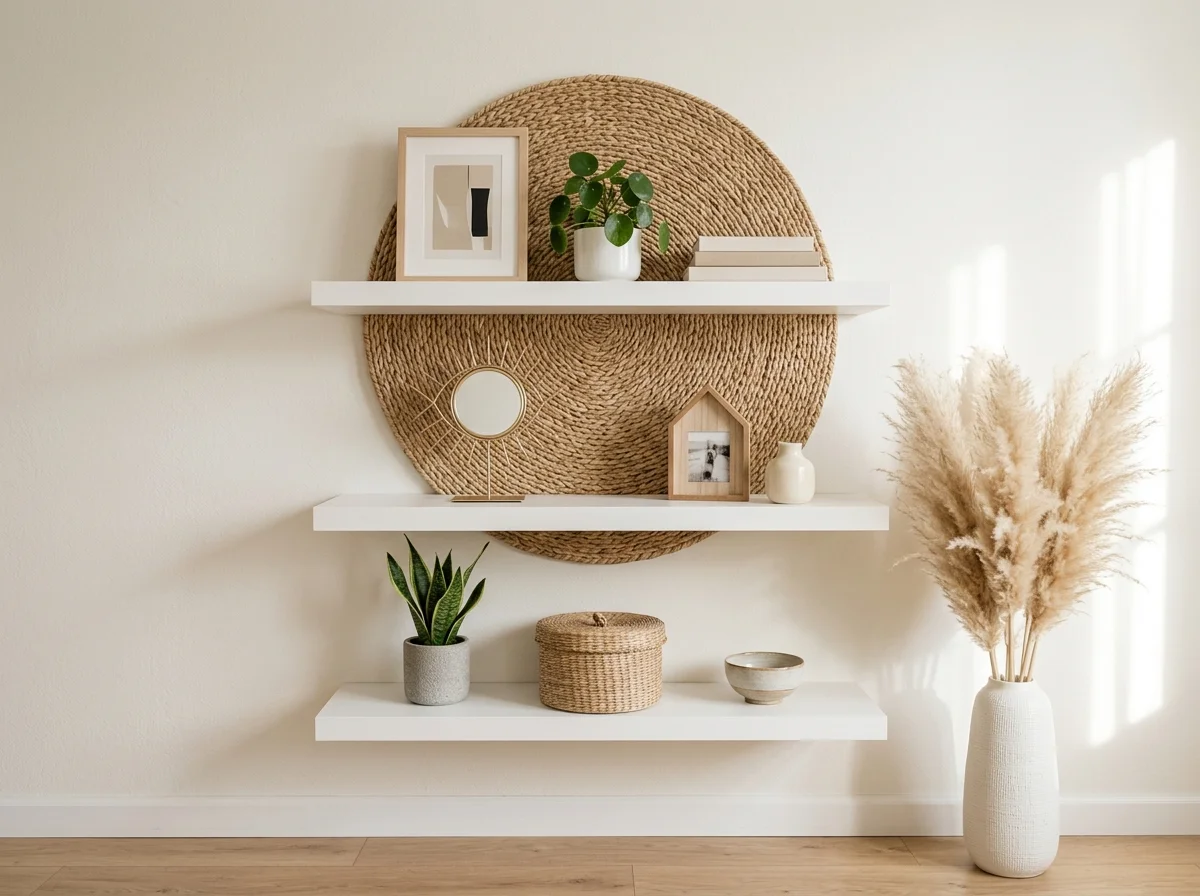
The living room shelves are full of books in mixed orientations — some standing, some stacked, some leaning. The kitchen shelves are full of mugs and plates. The bedroom shelf above the bed holds one book, one candle, and a small ceramic pot. The bathroom shelf has one painting and a stack of face cloths. Each room asks for a different ratio.
The principles of shelf styling change room by room. A living room shelf and a bedroom shelf decorated the same way would fail one of the two rooms — usually the bedroom. Each room has a different ratio of function to decoration, of object density to breathing room.
From the same corner of the site: Floating Shelf Styling and Warm Kitchen Design Ideas Without Going Full.
What belongs on a shelf depends entirely on which room it's in — a kitchen shelf wants different things from a bedroom one. These twelve ideas cover styling shelves in every room of the house, so each display reads right for its setting. Find the room you're working on.
1. Living Room: Books, Art, and Objects
Living room shelves are the most styled in the house. Mix stacked and upright books, a leaned piece of art, sculptural ceramics, a plant, and the occasional personal object. Keep a tight palette and leave gaps. These shelves carry the room's personality, so let them read collected and considered.
2. Kitchen: The Things You Actually Use
Open kitchen shelves read warm and lived-in when styled with everyday items — stacked plates, lined-up glasses, mugs on hooks, a leaned board, a small plant or herb pot. The slight imperfection of real, used things beats a showroom display. Function and styling occupy the same shelf.
3. Bedroom: Calm and Personal
Bedroom shelves should stay quiet — this is the room for rest. A few books, a small plant, a framed photo, a candle, one or two personal objects. Resist crowding; the bedroom shelf reads cosiest when it's edited and calm, with plenty of breathing room between a small number of meaningful things.
4. Bathroom: Soft and Practical
Bathroom shelves balance the practical and the styled — a stack of rolled towels, apothecary jars or decanted bottles, a humidity-loving plant, a candle, a small dish. The soft towels and the green plant warm up the hard tile and porcelain. Practical things, arranged with care, read as considered.
5. Hallway: A Landing Spot
Hallway shelves work hardest as a landing spot — a dish for keys, a small lamp, a vase of stems, a leaned mirror or piece of art, a stack of post corralled in a tray. Styled but functional, the hallway shelf is the first surface you meet and sets the tone for the house.
6. Home Office: Useful and Styled
Office shelves above a desk should keep work tidy while reading like home — reference books, a plant, a small lamp, a styled box or two for supplies, a personal object. Avoid the box-file look; the office shelf can be both useful and considered, which keeps a working corner from feeling corporate.
7. Children's Room: Low and Reachable
Children's shelves work best low, where small hands can reach, with open baskets for toys, picture books face-out, and a few soft objects. Keep it simple and robust. Face-out books invite reading, and low open storage makes tidying something a child can actually do themselves.
8. Alcove: Built-In and Balanced
Alcove shelves either side of a chimney breast want to read as a balanced pair — not identical, but visually weighted to match. Books, objects, and a plant on each, with a heavier grouping on one balanced by a taller piece on the other. Painting the alcove back a deeper tone makes the contents pop.
9. Dining Room: Display and Serve
Dining room shelving or a sideboard top mixes the practical and the decorative — serving pieces, a stack of good plates, glassware, a vase, candlesticks, a piece of art behind. It's display that's ready to be pressed into service when you host. Beautiful and useful in the same breath.
10. Vary Height in Every Room
Whatever the room, the universal move is height variation — a tall element, a medium stack, a low object — to give the shelf a rhythm. Use book stacks as risers, lean art tall at the back, sit a low bowl at the front. The varied skyline is what stops any shelf, in any room, reading flat.
11. Leave Negative Space Everywhere
The discipline holds in every room: leave roughly a third of each shelf empty. Crowded shelves read as clutter no matter how nice the objects; shelves with breathing room read as styled. The empty space is the luxury, and it's free. Edit until each grouping has room around it.
12. Refresh by Room With the Seasons
Different rooms invite different seasonal refreshes — branches and warm objects on the living room shelf in autumn, lighter stems in the bedroom in spring, seasonal produce on the kitchen shelf. Swapping a few objects keeps each room's shelves alive and tied to the time of year without any real cost.
The Method Behind Decorating Any Shelf
The room-by-room ideas above are the menu; the principles below are the universal rules — the object mix, the negative space, the height variation — that make a shelf in any room read as a styled composition.
Living Room Shelves
Living rooms permit the most decorative density. Built-in bookshelves, floating shelves around a fireplace, or a tall freestanding bookcase can hold many objects without uncosying the room.
The mix that works: 70% books, 30% objects. Books in varied orientations — most standing upright on the shelf, some stacked horizontally to break up the verticality, occasional books leaning at an angle. Objects placed in the gaps: small ceramics, framed photographs, small pieces of art, brass candlesticks, a small plant.
For a wall of built-in shelves, the rule is to fill them. Empty shelves in a living room read as unfinished. A wall of books in active use plus objects scattered throughout reads as inhabited.
For a single floating shelf, four to six objects (mixed books and items) is the ceiling.
Kitchen Shelves
Kitchens want function first. The working dishes are the decoration when displayed well.
Open shelving in a kitchen at accessible height (1.2-1.8m from the floor) wants to hold things used weekly: stacks of dinner plates (5-8 plates in a stack), rows of mugs (6-8 mugs, ideally matching at least loosely), small mixing bowls in graduated sizes, a few clear glass jars of dry goods.
One or two decorative additions are fine — a single small painting, a brass candleholder, a wooden chopping board on edge. Beyond that, the working dishes are the visual interest.
Skip in kitchens: trinkets, decorative jars with no contents, themed objects (chicken figurines, signs about coffee or wine), too many small plants. The plants on kitchen shelves tend to die from the heat and humidity.
Bedroom Shelves
Bedrooms ask for restraint. Anything visually loud — bright colours, many small objects, busy patterns — fights the calm the bedroom wants.
The cosy bedroom shelf: two or three calm objects per metre. One book, one candle, one small ceramic. Possibly a single dried botanical or a small piece of art leaning.
Shelves above a bed should be especially restrained. The eye drops to the bed as the room's centre of gravity, and competing visual mass above the bed disrupts that. A single object on a shelf above the bed, or a single horizontal piece of art on the wall, beats five carefully styled small items.
For bookshelves in a bedroom (away from the bed itself), more density is acceptable — but still less than in a living room. 50% books, 50% breathing room and a few objects.
Bathroom Shelves
Bathrooms reward the most restraint of any room. Three or four objects per shelf is the ceiling. The bathroom's small scale amplifies any visual clutter.
The working bathroom shelf:
- One small painting or vintage piece leaning against the wall
- One candle (unscented or lightly botanical, not gourmand)
- One stack of folded face cloths or a small towel
- Possibly a single foliage stem in a small ceramic bottle
That is the full inventory. No additional decorative objects, no soap dispensers, no bath salts in decorative jars. The bathroom shelf is a small still-life, and a small still-life with three objects is more striking than with seven.
Office or Study Shelves
Home office shelves hold the working library of the role — reference books, files, a few framed images, perhaps a single object that signifies the work (a microscope for a scientist, a wooden block of artist's tools for a maker).
Density is acceptable here — offices benefit from looking used. The objects should be the actual things used in the work rather than decorative props of work. A real stack of working notebooks beats a styled "office shelf" with leather-bound decoy journals.
A real stack of working notebooks beats a styled office shelf with leather-bound decoy journals, every time.
Entryway and Hallway Shelves
Narrow hallway shelves or small entryway shelves hold:
- A single sculptural object (ceramic, brass piece, vintage object)
- A small bowl or dish for keys
- Possibly a single foliage stem in a vessel
That is the full inventory for a small entry shelf. The shelf is a punctuation mark in the hall rather than a feature.
For longer console-table shelves in entryways, the same principles as living-room floating shelves apply — three to seven objects, varied heights, breathing room between groupings.