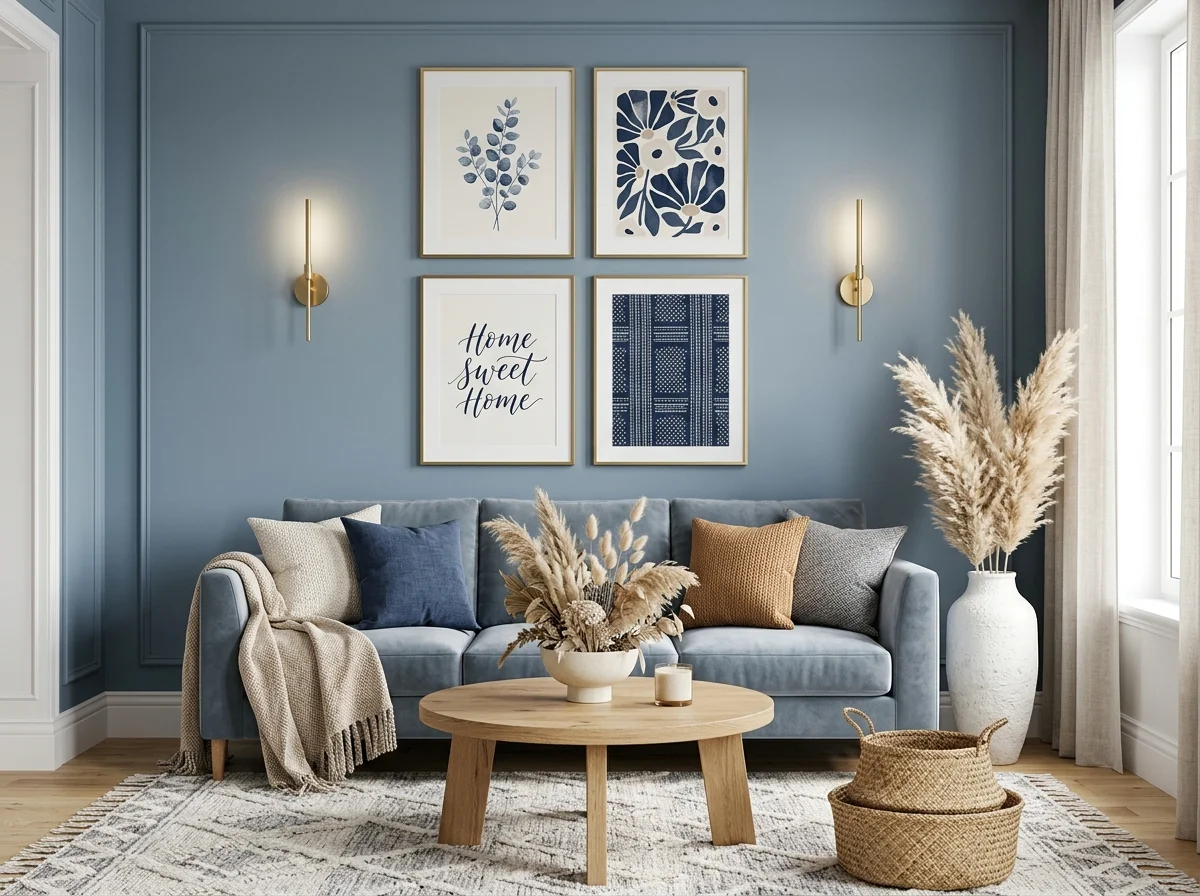
The triptych above the sofa is mine — three cyanotype prints of ferns from a walk in October, exposed on heavy watercolour paper, washed and dried, then matted in oatmeal cream paper and framed in narrow black wood. Total cost for the three: £42. Total time: an afternoon and an evening. The triptych has been mistaken for gallery art twice.
The wall above a sofa, behind a dining table, or in a stairwell asks for art that reads as real. Reproduction prints and mass-produced canvases never quite land. Original work — even simple original work — does.
Worth reading next to this: DIY Home Decor Handbook, DIY Bedroom Decor Projects That Aren't Twee, and How to Arrange a Gallery Wall That.
A blank living-room wall is an opportunity, and you don't need to buy expensive art to fill it. These thirteen DIY wall art projects — from framed textiles to cyanotype prints — give a room real character for the cost of materials. Pick the ones that suit your style and your patience.
1. Frame a Beautiful Textile
A vintage textile, a block-printed cloth, an embroidered panel, or even a beautiful scarf, stretched and framed or hung flat on a dowel, makes warm, characterful art with no painting skill. The fabric brings colour, pattern, and texture all at once. It's the easiest DIY art there is, and it reads collected and personal.
2. Paint a Large Abstract
A big canvas, two or three warm colours from your palette, and a loose hand with a wide brush or palette knife makes an abstract that reads as a deliberate statement. Abstract work forgives imprecision, and the scale is what sells it. Go bigger than feels comfortable; one large homemade abstract anchors a whole wall.
3. Make Cyanotype Prints
Cyanotype paper, a few leaves or ferns, and a sunny windowsill produce striking blue-and-white botanical prints with no skill at all — lay the leaves, expose to sun, rinse. Framed as a set of three or a grid, they make a calm, characterful display. The most satisfying DIY art for the least effort and cost.
4. Print Your Own Photography Large
A photograph you took — a landscape, a close-up, an abstract — printed large and framed reads as real, personal art. Online print services produce big prints cheaply; a simple frame finishes it. One large photographic print of somewhere that means something to you beats any mass-market art, and costs far less.
5. Press and Frame Botanicals
Pressed leaves, ferns, or flowers, mounted on neutral card in simple frames, make delicate natural art for almost nothing. A press (or a heavy book) and a few weeks' patience yield a set that reads botanical and calm. Grouped as a series, pressed botanicals bring the outside in with quiet, timeless character.
6. Frame Pages From Art Books
A large second-hand art book — bought cheap for the plates — yields a dozen frame-able images: botanical illustrations, old maps, vintage prints, fine-art reproductions. Cut carefully, mounted, and framed as a coordinated set, they make a gallery wall for the price of one book and some frames. Cheap, characterful, endlessly variable.
7. Build a Frame Ledge Gallery
A picture ledge lets you lean and layer prints, photos, and small art without committing to a fixed arrangement — and swap them whenever you like. Overlap a few pieces, mix in a small mirror or object. It's the most flexible DIY gallery, and the leaned, layered look reads relaxed and collected. Build the ledge, then play.
8. Hang a Woven or Macramé Piece
A woven wall hanging or a macramé piece — bought from a maker or made yourself — brings soft, dimensional texture to a wall that flat framed art can't. The fibre reads warm and handmade, and it softens a hard wall. One textural hanging among framed pieces, or alone over a sofa, adds the tactile layer a gallery often lacks.
9. Frame Architectural Salvage
A piece of old moulding, a fragment of decorative tile, a salvaged corbel, or an architectural drawing, mounted or framed, makes characterful, three-dimensional wall art with history. Salvage yards and architectural reclaimers are full of frame-able fragments. It reads collected and unique, and brings the patina of age that new art can't fake.
10. Make a Plate or Object Wall
Hung plates, baskets, hats, or small objects arranged on a wall make a dimensional, characterful display that's pure DIY — just the right hooks and an eye for arrangement. A collection of vintage plates or woven pieces reads collected and warm, and adds depth a flat gallery lacks. Group them like a gallery wall, with consistent spacing.
11. Stretch Fabric Over Canvas Frames
Beautiful fabric stretched over cheap canvas stretcher bars makes instant large-scale art for the cost of the fabric and frames. Choose a bold print or a textured weave, staple it taut around the bars, and hang as a single piece or a triptych. It's the fastest route to big, colourful wall art with zero painting.
12. Create a Single Statement Over the Sofa
Whatever the medium, one large piece over the sofa — two-thirds its width, hung with the base a hand above the sofa back — makes a calmer, more confident statement than a wall of small frames. Scale up your DIY: a big textile, a large abstract, an oversized print. The empty space around a large piece is part of the impact.
13. Hang It Right to Finish the Job
Good DIY art is undone by bad hanging. Centre a piece or a group at eye level (around 145-150cm to the centre), keep consistent spacing in a group, and use proper fixings for the weight. The difference between homemade and handmade is often just careful hanging — measure, level, and space it, and even simple art reads intentional.
The Detailed Project Walkthroughs
The projects above are the menu; below, the same ideas with step-by-step technique, materials, and the framing and hanging details that make DIY art read intentional rather than improvised.
Category 1: Cyanotype Prints
The easiest "real art" technique. Cyanotype is a 19th-century photographic process that produces deep Prussian blue prints from sunlight exposure on coated paper.
Materials:
- Cyanotype paper or sensitised watercolour paper (Jacquard, Lawrence Art Supplies, Rockland) — £15-30 for 20 sheets
- Objects to print: leaves, ferns, lace, paper cutouts, dried flowers
- A flat surface and direct sunlight
- A basin of water for rinsing
Process:
- In dim indoor light, lay the paper face-up on a flat surface (a sheet of plywood works).
- Arrange your objects on the paper. Press down with a sheet of glass or plexiglass to keep objects flat.
- Carry the whole assembly outside into direct sunlight. Expose for 5-20 minutes — longer on cloudy days.
- Bring inside. Remove the glass and objects. Rinse the paper under cold water for 1-2 minutes. The exposed areas turn deep Prussian blue; the masked areas turn white.
- Hang or lay flat to dry.
Best subjects: ferns, large leaves (oak, maple, plane tree), lace, fishing net offcuts, hand-cut paper shapes.
A series of 3-6 cyanotype prints framed identically creates a coherent wall composition. Cost: £40-80 total for the series including frames.
Category 2: Monoprint and Simple Printmaking
A monoprint is a one-of-a-kind print made by applying ink or paint to a smooth surface (glass, perspex, gelatin plate), then pressing paper onto it. The resulting print has texture, irregularity, and the visible marks of the artist's hand.
Materials:
- Watercolour or block-printing ink — £15-25
- A piece of plexiglass or glass to use as the plate — free if you have a picture frame to disassemble, or £8-15 to buy
- Heavy paper (300gsm watercolour or printmaking paper) — £15-25 for a pack
- A brayer (rubber roller) or a few brushes — £8-15
Process:
- Roll or brush ink onto the plate in a thin, even layer.
- While the ink is still wet, draw or scratch into it with a stick, the end of a brush, or your finger to create the image.
- Lay the paper carefully over the inked plate. Press evenly with your hands or a clean roller.
- Peel the paper off — slowly and carefully. The image transfers in reverse.
- Set aside to dry.
Each print is unique because the ink shifts on the plate each time. A series of 4-6 monoprints in muted colours framed together produces a striking living-room wall.
Category 3: Scaled-Up Photography
A photograph you've taken — a landscape, a still-life detail, an architectural shot — printed at scale and framed properly, reads as art.
Where DIY photography fails: smartphone snaps printed at small sizes in cheap frames. Where it succeeds: deliberate photographs printed at 30x40cm or larger on quality paper, properly framed.
Sources for quality prints:
- Loxley Colour (UK) — professional photo lab, fine art paper options
- Saal Digital (Europe) — high-quality prints at moderate prices
- Bay Photo Lab (US) — equivalent US option
- WhiteWall — premium option for larger prints
Print specifications worth choosing:
- Matte rather than glossy paper for art (hahnemühle photo rag is the standard)
- 30x40cm minimum for living-room display
- A larger statement piece at 60x80cm or 80x120cm for above a sofa
- True black-and-white conversion (not greyscale from a colour file)
Costs: £20-50 for a 30x40cm print. £60-120 for a 60x80cm. Framing adds £30-100 per piece.
Photographs worth printing: landscape photographs from trips, still-life details from your kitchen or studio, architectural details (a window frame, a doorway, a stone wall), portraits of family members in considered compositions, your own work if you photograph regularly.
Category 4: Hand-Cut Paper Collage
A composition assembled from cut paper — coloured papers, vintage book pages, music sheets, marbled paper. The assemblage reads as contemporary art when done with restraint.
Materials:
- Heavy substrate paper (300gsm) — £15-25 for a pack
- Coloured papers in a narrow palette — £20-40
- Sharp craft knife and cutting mat — £25-40
- PVA glue or acrylic medium — £8-15
Process:
- Choose a palette of 3-5 colours. Restrained palettes outperform colourful ones for living-room art.
- Cut shapes — geometric (rectangles, circles, triangles) or organic (torn edges, irregular curves).
- Arrange the shapes on the substrate paper. Move them around until the composition settles.
- Glue down once satisfied.
Best for abstract compositions rather than representational images. Look at Matisse cut-outs and Sonia Delaunay for reference. The simpler the composition, the more contemporary it reads.
Category 5: Small Original Abstract Painting
The accessible end of original painting — small works (20x30cm to 40x60cm) in muted colours with minimal composition.
Materials:
- Stretched canvas or canvas board — £8-25 each
- Acrylic paint or watercolour — £30-60 for a starter set in muted earth tones
- Brushes — £15-30 for a basic set
The approach: muted colours (cream, oatmeal, oxblood, sage green, warm brown, soft grey), simple compositions (one or two shapes, large areas of single colour, occasional gestural marks), and the willingness to leave most of the canvas blank.
The mistakes that produce visible-amateur results: bright primary colours, busy compositions, attempts at representation, glossy varnish finishes.
Look at Agnes Martin, Cy Twombly, Hilma af Klint, and Pierre Soulages for reference. The simplest compositions are the hardest to fake but also the easiest to make personally distinctive.
The simplest DIY paintings — large areas of muted colour with a few gestural marks — outperform busy, technically ambitious DIY paintings every time. Restraint reads as deliberate.
Framing: The Decisive Step
DIY art lives or dies by its framing. The same cyanotype print in a cheap clip frame versus in a proper frame with mat board reads as two completely different objects.
Frame options that work:
- Custom framing from a local framer — £80-200 per piece (expensive but always right)
- Pre-made frames in standard sizes from John Lewis, IKEA Ribba, or West Elm — £20-80 per piece
- Building simple wooden frames from moulding — £15-40 per piece (requires some woodworking)
Matting:
- A 5-8cm cream or off-white mat board around the artwork
- Acid-free matting only — coloured or patterned mats look amateur and damage the artwork over time
- Consistent matting across a series of works unifies them
Glass:
- Float glass for most works — affordable and acceptable
- Museum glass or non-reflective glass for important pieces — expensive but eliminates glare
What to Skip Entirely
"Paint your own canvas" kits. Pre-printed canvases that you paint over with numbered sections. The results look like paint-by-numbers, because they are paint-by-numbers.
Inspirational quote art. "Live, Laugh, Love" and all variations. None of these belong on a wall.
Spray-painted typography on canvas. The visual style is dated and the technique is amateur-visible.
Hand-lettered chalkboard signs. Date instantly and read as café decor.
Anything involving glitter, sequins, or applied jewellery. Always uncosy.