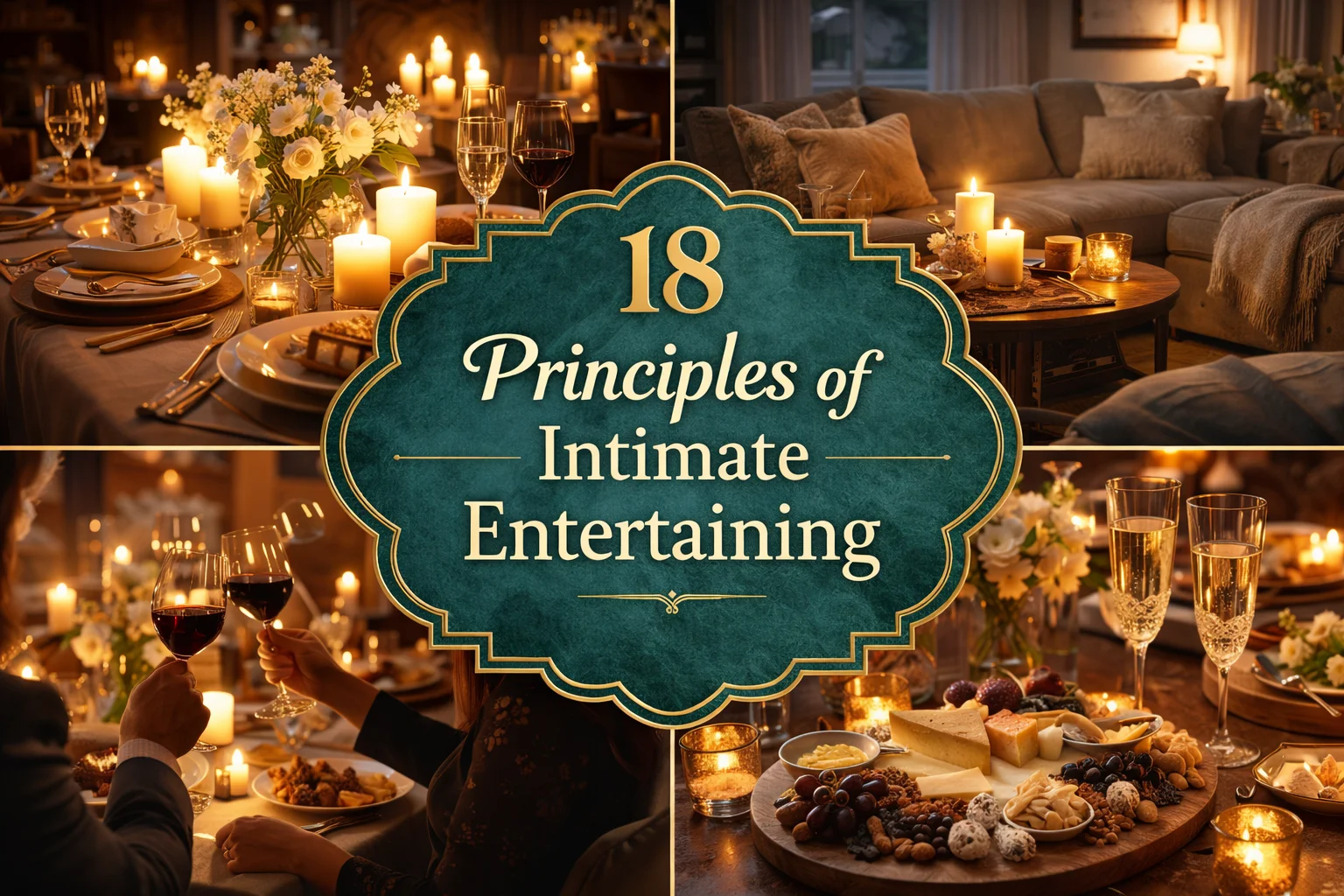
The Saturday dinner started at 7pm and ended at midnight. Six people, two bottles of wine, one braised lamb shoulder that had been in the oven since two. The candles burned down through the evening. Nobody got up except to refill glasses. The table was the same dining table at which I'd had homework with my niece on Tuesday afternoon. This is what intimate entertaining is — not a production, but the same table doing more.
The magazine version of dinner-party hosting is a production: complicated multi-course menus, professional-quality plating, elaborate floral centrepieces, full silver service. The cosy version is much smaller and much more enjoyable to host. The key difference is that the magazine version is about the host; the cosy version is about the guests.
This sits alongside Breakfast Nook Styling, Tablescaping for Small Tables, and Dining Room Decor Fundamentals in the same series.
Intimate entertaining is about warmth, not performance — a small gathering where people feel welcome and linger late. These eighteen principles, the heart of hosting well, cover the guest list, the light, the food, and the touches that make an evening memorable. Take the ones that suit how you like to host.
1. Keep the Numbers Small
Intimate entertaining starts with restraint on the guest list. Six to eight people around one table is the sweet spot — small enough for a single conversation, large enough for energy. Beyond ten, the evening fragments into clusters. The best dinners are the ones where everyone can hear everyone; size the gathering for connection, not for show.
2. Light It Low and Warm
Lighting sets the entire mood of an evening. Dim the overheads, light the table with candles in mixed holders, add a tabletop lamp or two, and let the room glow low and warm. Bright overhead light kills intimacy instantly; low warm light flatters faces, slows the pace, and signals that this is an evening to linger over. Light first.
3. Layer the Tablescape, Don't Overdo It
A considered table — a linen runner, earthy mixed ceramics, low candles, seasonal greenery — reads warm and thoughtful where an elaborate one overpowers the conversation. For intimate gatherings, lean toward the layered-but-minimal: enough to show you cared, not so much that it competes with the people. Personal and warm beats maximalist.
4. Mix the Seating
Mismatched chairs, a bench down one side, a settee pulled up — mixed seating reads relaxed and collected, and it lets you seat more people without a matching set. The variety signals an evening that's about gathering rather than formality. Pull in chairs from around the house; the squeeze and the mix are part of the warmth.
5. Serve Food Made for Sharing
Communal, shareable food — a big pot in the centre, platters passed around, a help-yourself spread — is more sociable and less stressful than individually plated courses. The passing and sharing is itself a conversation starter and breaks down formality. Food in the middle of the table, reached for together, is the heart of an intimate meal.
6. Cook Something You Can Make Ahead
The host who's stuck in the kitchen misses the party. Choose dishes you can largely prepare ahead — a braise, a baked pasta, a make-ahead pudding — so you're at the table with your guests rather than plating frantically. The relaxed host sets the tone for a relaxed evening; do the work before anyone arrives.
7. Set Up a Self-Serve Drinks Spot
A small drinks nook — a console or a corner with the bottles, glasses, ice, and a few mixers — lets guests help themselves and keeps you out of the role of full-time bartender. In a small home, a console table does it. The self-serve bar is sociable, takes pressure off the host, and gives guests something to gather around.
8. Use the Whole Home, Not Just One Room
An intimate evening flows better when it moves — drinks in the kitchen or a cocktail nook, dinner at the table, coffee and cards in the snug. Letting the night unfold through the home rather than staying pinned to one room keeps the energy moving and gives the evening a natural rhythm. Open the doors and let it flow.
9. Add Personal Touches at the Table
A handwritten place card, a sprig of herb at each setting, a tiny favour, an inside-joke element only your guests will get — small personal touches turn a dinner into your dinner. They cost little and signal real thought. On an intimate table these details are seen and appreciated up close, and they're what guests remember.
10. Entertain Without an Occasion
The best intimate gatherings don't wait for a birthday or a holiday — they happen on an ordinary Friday because you wanted to see people. Breaking out the good plates for no reason but connection is the warmest kind of hosting. Lower the bar for having people over and you'll do it more often; the occasion is the people.
11. Warm the Room Before They Arrive
A guest walks into the atmosphere you've set. Light the candles, put on low music, get the room warm and lit and smelling of cooking before anyone arrives. The first thirty seconds set the tone for the whole evening — a warm, glowing, welcoming room relaxes guests instantly, where a cold, bright, scrambling-host arrival does the opposite.
12. Keep Music Low and Constant
A low, constant background of music fills the silences, eases lulls in conversation, and sets a mood without anyone having to think about it. Keep it quiet enough to talk over and warm in tone — something instrumental or familiar. The absence of music leaves an intimate gathering feeling exposed; the right low soundtrack holds the evening together.
13. Create a Cocktail or Listening Nook
A dedicated corner — a bar nook, a listening spot with a turntable and records — gives an intimate gathering a destination and a focus beyond the table. It's where the pre-dinner drinks happen and where people drift back for a nightcap. The nook recreates the enveloping feel of a favourite bar in your own home, and it's having a real moment.
14. Make Guests Comfortable Enough to Linger
The mark of a good evening is that nobody wants to leave. Comfortable seating, enough to drink, warmth, low light, and a host who's relaxed all encourage lingering well into the night — cards in the game room, more conversation, a nightcap. Design the evening so people can settle in and stay; the lingering is where the best parts happen.
15. Style the Table With What You Own
A beautiful table comes from what's already in your cupboards — a linen cloth, mismatched charming plates, garden flowers, candles in the holders you have. You don't need to buy a coordinated set; the collected, slightly imperfect table reads warmer and more personal. Shop your own home first; intimacy isn't bought, it's arranged.
16. Embrace the Small Space
A small home is an asset for intimate entertaining, not a limitation. Guests crowded around a kitchen island, perched on floor cushions, squeezed shoulder to shoulder at a small table — the closeness breeds exactly the warmth and conviviality that makes a gathering memorable. Don't apologise for the squeeze; the proximity is the point.
17. Prioritise Connection Over Perfection
The point of having people over is the people, not a flawless performance. A relaxed host, a warm room, good-enough food, and genuine attention to your guests beat an immaculate but anxious evening every time. Guests remember how an evening felt, not whether the napkins matched. Aim for connection; let the rest be imperfect.
18. Send Them Off Warmly
How an evening ends matters as much as how it begins. A nightcap, leftovers pressed into their hands, a warm goodbye at the door rather than a relieved one. The warm send-off is the last impression and the one that makes guests want to come back. End the evening as generously as you began it; hospitality runs to the door and beyond.
The Detailed Hosting Guide
The eighteen principles above are the menu; below, the same thinking in depth — the right number of guests, the flow of an evening, and the practical hosting decisions that turn a dinner into a gathering people remember.
The Right Number of Guests
Four to six is the working range for intimate entertaining. Eight maximum if the table comfortably holds eight. Beyond eight, the dinner becomes an event: multiple conversations break the table into clusters, the host gets up too often, and the intimate quality disappears.
Six is the optimal number for most dining tables. Three couples or six individuals can hold one conversation across the table without anyone being left out. The table seats them all without crowding.
For larger gatherings, change the format entirely — buffet-style cocktail party, casual lunch with people coming and going, or a long-table dinner where the conversation runs in two halves rather than one. Don't try to scale up an intimate dinner.
The Menu: One Course Is the Work
A working dinner-party menu has three or four courses, but only one of them is "the work." The others are prepared in advance or assembled at the table.
The standard structure:
-
An aperitif moment. Drinks and small snacks while people arrive. The host pours drinks but doesn't cook. Olives, almonds, a wedge of good cheese, sliced fennel with anchovy butter — none of this requires cooking on the night.
-
A starter that holds. A simple soup made the day before. A platter of charcuterie and bread. A dish of marinated vegetables. A composed salad that sits well — chicory with blue cheese and walnuts, beets with goat curd, peaches with prosciutto in season. Plated in the kitchen and brought to the table.
-
The main course (this is the work). Something that holds in an oven or pot for several hours: braised lamb shoulder, slow-roasted pork belly, a whole roasted fish, a vegetable gratin, a coq au vin, a tagine. The main course is timed to be ready, not exact. It improves with sitting, doesn't require precise plating, and can be served on a single large platter at the table.
-
Dessert that's made in advance. A simple fruit tart, a chocolate pot de crème, sorbet bought from a good source, cheese with quince paste and good bread, poached pears. The dessert needs only to be brought to the table.
The hard rule: avoid anything timed precisely while guests are seated. Steaks, soufflés, pasta cooked to order, anything that requires the host to leave the table for more than three minutes. The host should be at the table from the moment the first course is served.
Setting the Table the Day Before
The single biggest stress-saver in dinner-party hosting is setting the table the day before. This shifts the work to a calm afternoon rather than the rush of the actual day.
A working table the day before:
- Linen runner laid down the centre of the table
- Plates, cutlery, glasses, napkins set at each place
- Candlesticks placed at intervals along the centre
- Salt and pepper, water carafes, wine glasses prepped
- One or two small bowls of seasonal fruit or other low decorative elements
On the day, the only additions are fresh foliage cut from the garden or florist (laid loose down the centre), candles lit at 6:45pm, and serving dishes brought to the table at appropriate moments.
The night before, photograph the table. If something looks wrong, you have a day to fix it.
Place Settings and Tableware
A cosy place setting does not need matching everything. The components:
- A dinner plate (around 27-28cm diameter)
- A smaller plate for the starter (or the same plate cleared and reused)
- A water glass and a wine glass per person
- Knife and fork for the main, plus dessert spoon or fork at the top of the place setting
- A linen napkin per person — folded in a single fold or rectangle, not in a fancy shape
Mixed dinner plates within a palette read cosier than fully matched sets. Three or four sets of vintage plates picked up over years, mixed deliberately, signals a real life rather than a wedding registry. Charity shops and auction houses sell vintage plate sets of 4-6 for £15-50 each.
Glassware can be similarly mixed. Vintage coloured glassware (amber, smoke, pale green) suits warm-neutral interiors particularly. Wine glasses don't need to be a matching set — different glasses for different guests reads as more interesting than ten of the same.
Cutlery: stainless steel from any source is fine. Vintage cutlery from estate sales (£20-50 for a set of 6 or 8) offers more visual character at lower cost than new equivalents.
Linen napkins are essential. Paper napkins for a dinner party fight the intimate quality. Linen napkins from MagicLinen or Piglet in Bed sales run £8-15 each; a set of six builds across a couple of orders for £50-90 total.
The Lighting Decision
Dinner-party lighting is candlelight at the table, lamp light at the edges of the room, no overhead lighting near the table itself.
A pendant over the dining table can be on if it's dimmable and set to under 25%. Most pendant lights, even on dimmers, are too bright at standard settings. Better to turn it off entirely and rely on candles.
Around the room: lamps on side tables, a lamp on the sideboard, a floor lamp by a chair. All on warm-toned bulbs (2700K or warmer). The result is a room lit at multiple low points around the candle-lit centre, with no harsh overhead light anywhere.
For a six-person dinner, the candles should be enough to actually see by — typically 6-9 tapers across the centre of the table, in unmatched holders. Lit before guests arrive so the table is glowing when they walk in.
Pacing the Evening
The pace of an intimate dinner matters as much as the food. The standard timing for a 7pm start:
- 7:00 — guests arrive. Drinks poured immediately. Small snacks available on a side table.
- 7:30 — sit at the table. Starter served.
- 8:00 — main course brought out, served on a large platter at the table.
- 8:45 — main course winding down. Cheese or salad course optional here.
- 9:15 — dessert served.
- 9:45 — coffee or digestifs offered. Move to the sofa if guests want.
- 11:00 onward — natural end depending on the energy.
Don't rush the courses. Twenty minutes between starter and main is correct. Fifteen minutes between main and dessert. The pacing creates conversation room.
The host's job during dinner is to keep glasses topped up and the conversation moving. Cooking that happens during dinner breaks both. The advance preparation enables both.
The host should be at the table from the moment the first course is served. Anything that requires leaving the table for more than three minutes belongs to a different kind of meal.
What to Skip in Intimate Entertaining
Complicated multi-course tasting menus. Eight courses suit restaurants. Three or four suit homes.
Restaurant-style plating. Save the tweezers and microherbs. Family-style platters at the centre of the table read as inhabited.
Music that demands attention. Background instrumental music or jazz at low volume, not music with lyrics demanding conversation around it.
A floral centrepiece taller than 30cm. It blocks sightlines. Low and wide always wins.
Themed dinner parties. "Italian Night," "Mexican Fiesta," etc. Cook food you actually love and serve it. The theme is the table itself.
Place cards for six guests. Direct seating with a hand gesture is friendlier than printed cards.
The Aftermath
Clean up tomorrow. Stack plates, put leftovers in the fridge, blow out candles, turn the lights to standard. Bed.
The kitchen the morning after looks worse than during, but the rest of the room is unchanged. By Sunday afternoon the dishwasher has run, the linen is in the wash, and the dining table is set with a bowl of fruit and one candlestick — back to its weekday state.
The intimate dinner leaves traces (wax drips, used plates, half-empty wine bottles) that read as the residue of a real evening rather than as a logistical failure. The traces are part of the experience.
The cosy dinner party is much smaller than the magazine version and much more enjoyable to host. The host should be at the table, drinking wine, by 7:35. Everything else is logistics that should already have been resolved.