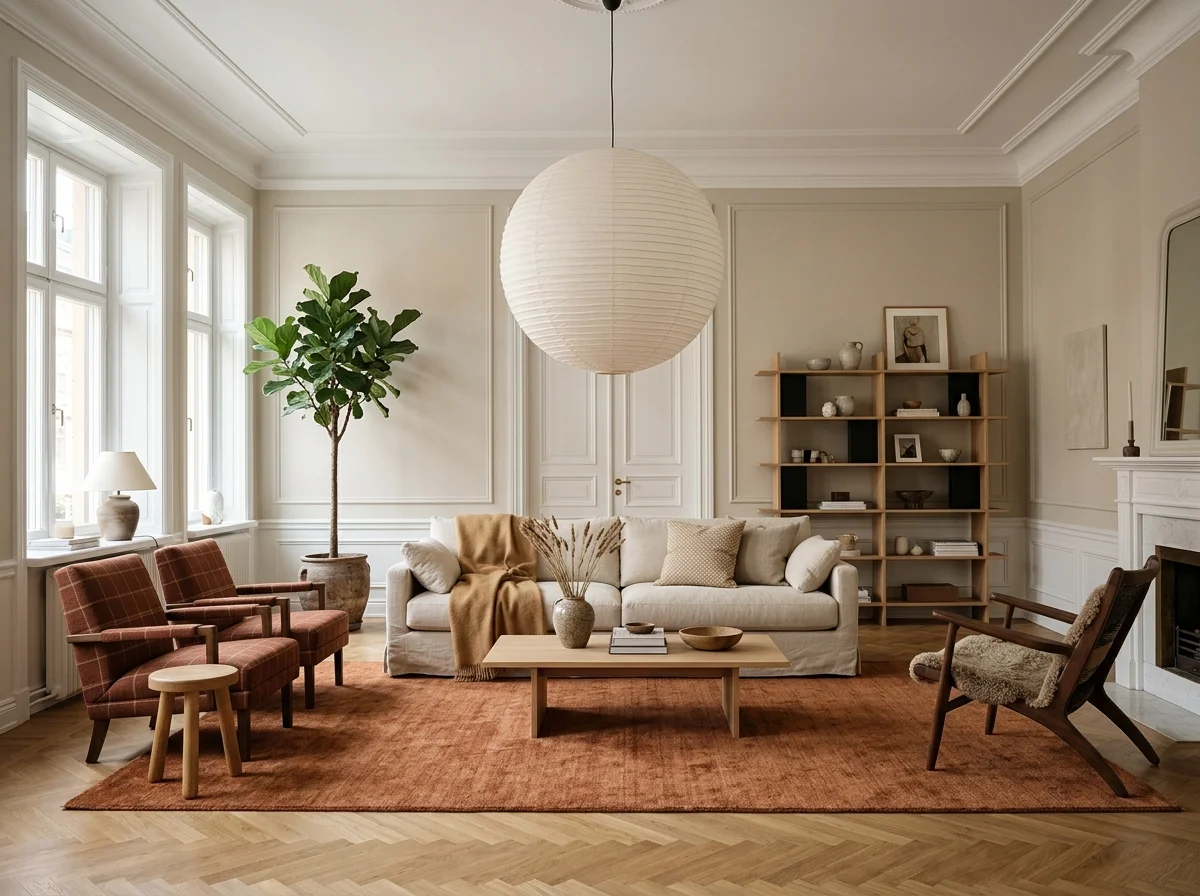
The Stockholm flat I stayed in last summer had walls in a warm dusty pink, ash floors, a linen sofa in oatmeal, a single mid-century chair in caramel leather, and brass lamps throughout. There was nothing grey in the apartment. The owner said the grey-Scandinavian look had peaked years ago among people who actually lived in Scandinavia. The export market still wants it. The locals moved on to warmth.
The cool-grey Scandinavian style that filled magazines from 2010 to 2020 was always a marketing version of Nordic interior design. Real homes in Stockholm, Copenhagen, and Helsinki used the warm palette that Northern climates require — pale pinks and creams to compensate for cool light, generous natural wood, candle light in quantity. The grey export version was thinner than the original.
The warm Scandinavian palette is what's happening now. It keeps the Scandinavian principles (restraint, natural materials, minimal pattern, light-filled rooms) and executes them in warm undertones.
Related, and genuinely useful here: Warm Paint Colour Master Guide and Lounge Room Colour Palette.
Scandinavian design has warmed up — the cold white minimalism of a decade ago has given way to soft, layered, genuinely cosy interiors. These thirteen palette and styling ideas capture the warm Scandi look: light but never cold, pared-back but inviting. Pick the elements that suit your room.
1. Start With a Warm White, Not a Cool One
The whole warm-Scandi difference begins with the white. Choose a creamy, warm-undertoned white over a stark brilliant white — it reads soft and inviting where the cool white reads clinical. The same minimal room in a warm white versus a cool white is the difference between cosy and cold.
2. Bring in Pale Natural Wood Everywhere
Wood is the warmth in warm Scandinavian. Pale oak, ash, or beech on floors, furniture, and shelving brings grain, tone, and natural warmth to the white base. The more wood, the warmer the room. It's the material that stops a pared-back Scandi scheme from reading empty and cold.
3. Layer Natural-Fibre Textiles
Warm Scandinavian leans hard on texture because the palette is restrained. Layer wool throws, linen cushions, a sheepskin, a chunky knit, a flatweave rug — all in naturals and neutrals. The texture does the work colour would in a busier scheme, giving a calm room depth and tactile warmth.
4. Add Soft Greige and Oatmeal
Beyond the white, bring in soft greige, oatmeal, and warm grey in the upholstery and textiles. These gentle mid-tones add quiet depth without breaking the calm, and they read warmer than the cool greys of old Scandi. The result is layered and soft rather than stark white-on-white.
5. Accent With Muted Sage or Soft Black
Warm Scandinavian uses accents sparingly and quietly — a muted sage cushion, a soft-black chair frame, a dusty-pink throw, a warm-tan leather. One or two restrained accents give the eye somewhere to land without disturbing the calm. The restraint is the point; a little colour goes a long way against the warm white.
6. Light It Warm and Low
Scandinavian winters mean Scandinavians are experts at warm light. Several low sources at 2700K — table lamps, a floor lamp, candles — create the hygge glow that overhead light can't. The warm, layered, low light is as essential to warm Scandi as the wood and the white. Candles especially are non-negotiable.
7. Keep Furniture Low and Simple
Warm Scandinavian furniture is low, clean-lined, and simple — a low sofa, a low platform bed, simple wood pieces — letting the room breathe and the light move. The pared-back forms keep the space calm; the warm materials keep it cosy. Simplicity of shape, richness of texture, is the balance.
8. Bring in Abundant Greenery
Plants are everywhere in Scandinavian interiors — they bring life and a soft organic line to the restrained palette. A floor plant, trailing greenery on shelves, branches in a vase, herbs on a sill. Against the warm white and wood, the green reads fresh and alive and adds the colour the scheme otherwise withholds.
9. Add a Sheepskin for Hygge Texture
The sheepskin is practically the Scandinavian signature — draped over a chair, a bench, or the foot of a bed, it adds the softest focal texture and a touch of the cabin. Real shearling in cream or warm grey. It's the single most hygge object you can add, and it reads warm even in a minimal room.
10. Choose Handmade Ceramics and Natural Objects
Warm Scandinavian styling favours the handmade and natural — a hand-thrown ceramic vase, a wooden bowl, a stone object, a woven basket. The slight imperfection of handmade pieces reads warm and human against the clean architecture. A few well-chosen natural objects beat a shelf of mass-produced decor.
11. Use a Warm Wood-Toned Floor
A pale-to-mid warm wood floor anchors the whole warm-Scandi scheme. Oak in a warm honey tone, laid plank-style, grounds the room and reflects warm light up into the space. A cool grey or whitewashed floor would pull the room cold; the warm wood floor is the foundation everything else builds on.
12. Let Negative Space Do Its Work
Warm Scandinavian is still minimal at heart — the calm comes from restraint and clear space. Resist filling every surface; let walls breathe and surfaces stay clear. The warmth comes from materials and light, not from quantity of stuff. The empty space is what makes the warm elements read, rather than crowd.
13. Test the Whites Together in Your Light
Warm whites vary, and they have to work together — wall white, trim white, ceiling white. Sample them side by side in your room across the day. The combination that stays warm and soft from morning light through evening lamp-glow is the one. A white that reads warm at noon can go grey under cool afternoon light.
The Method Behind Warm Scandinavian
The ideas above are the menu; the principles below are the structure — the core palette, the role of wood and texture, and the lighting that makes Scandinavian design read warm rather than clinical.
The Core Warm Scandinavian Palette
The palette breaks into four colour bands:
Walls. Warm whites and creams, occasionally drenched soft pinks or pale mushroom. Specific colours: Farrow & Ball Slipper Satin, School House White, Wevet, or Setting Plaster (drenched); Benjamin Moore White Dove, Simply White, or First Light; Jotun Lady Smaragdgrønn or Lady Pure (Scandinavian brand) in warm whites; Bauwerk Colour limewash in pale clay or pearl.
Soft warm accents. Pale pink, peach, soft terracotta in textiles and small furniture pieces. Setting Plaster on one accent wall. A pink or peach linen cushion. A small terracotta ceramic.
Mushroom and putty mid-tones. Skimming Stone, Hardwick White, Mole's Breath as cabinet colours, large furniture pieces, or drenched accent areas. The middle of the palette holds depth without going dark.
Wood and natural materials. Natural ash, oak, beech, birch — pale to medium woods with visible grain. The wood is the warmest single element in many warm Scandinavian rooms. Furniture, floors, and small objects.
Accent colours used sparingly:
- Caramel or cognac leather
- Warm brass (lamps, hardware, small objects)
- Black (used as a graphic accent in small quantities, not as a major colour)
- Deep muted green (mossy, olive) in a single accent piece
Natural Wood as the Warmth Engine
The single most important element in warm Scandinavian palettes is natural wood. The wood does what cool-grey palettes try to compensate for with textiles and lighting.
Three wood applications:
Wood floors. Wide-plank ash, oak, or pine in a natural finish (oil or matte lacquer, not glossy varnish or dark stain). Pale floors brighten the room and reflect light upward. Existing dark floors can be re-sanded and re-finished in lighter tones, though the work is substantial.
Wood furniture. Dining tables, side tables, bookshelves, and chairs in natural ash, oak, or birch. Mid-century Scandinavian designs (Hans Wegner, Børge Mogensen, Alvar Aalto) are the obvious references. Modern interpretations from Skagerak, Ferm Living, Hay, and Carl Hansen all suit.
Wood objects. Bowls, boards, candlesticks, small carved objects. The accumulation of small wooden objects across the room adds warmth.
For rooms with existing dark floors that can't be refinished, the wood elements come through furniture and objects rather than the floor. A natural ash dining table on dark floors still adds wood-warmth.
The Light Question
Warm Scandinavian lights generously. The Nordic standard is multiple light sources at multiple heights, all warm-toned, all dimmable. The room gets dim in the evening and supplemented by candle light.
The lighting standard:
- One overhead pendant or chandelier in a paper, rattan, or warm brass finish — on a dimmer, used at low intensity
- Two or three floor lamps and table lamps at different heights
- One or two wall sconces or picture lights
- Candles at evening — beeswax or natural-coloured tapers, lit in clusters
The cool LED light that dominates non-Scandinavian interiors uncosies the warm palette. Bulbs must be 2700K or warmer throughout. Track lighting and recessed spots almost never appear in warm Scandinavian rooms.
Textile Choices
Warm Scandinavian textile choices are restrained. The principle: fewer textiles in better fabrics.
Curtains. Linen panels in oatmeal or warm white, hung from ceiling line to floor. Skip patterned curtains entirely.
Throws. One wool throw per main seating piece. Foxford, Avoca, or Lapuan Kankurit (Finnish wool). Plain colours or simple checks; skip large patterns.
Cushions. Two or three per sofa, mixed textures within the palette (linen and wool, perhaps one velvet). Plain colours; skip statement patterns.
Rugs. Wool rugs in warm neutrals (oatmeal, cream, soft pink, mushroom). Flat-weave kilims, Finnish ryjijot rugs, or simple loop-pile wool. Skip patterned rugs in saturated colours.
Bed linen. Linen in warm white, oatmeal, soft pink, or pale grey-pink. Two pillow types: sleeping pillows in plain linen, euro pillows in a subtle stripe or warmer-toned linen.
The Material List
Beyond paint and wood, warm Scandinavian materials are short and consistent:
- Linen for upholstery, curtains, bedding
- Wool for throws, rugs, occasional upholstery
- Sheepskin for chairs and benches
- Brass (unlacquered or aged) for hardware, lamps, candle holders
- Ceramic (unglazed terracotta, hand-thrown stoneware) for vessels and dishes
- Stone (warm marble, soapstone) for occasional surfaces
What's not in the palette: plastic in any form, polished chrome, glass-and-metal furniture, anything with high-tech aesthetic, anything with logo or branding visible.
Lighting Fixtures Specifically
Warm Scandinavian lighting has its own visual language. The fixtures that work:
- Paper pendants (Le Klint, Aalto pendant, Noguchi-style)
- Brass pendants (PH Louis Poulsen, Andritsos, vintage Danish brass)
- Cream or stone-coloured ceramic table lamps with linen drum shades
- Articulated brass floor lamps (Bestlite, Anglepoise, Tolomeo)
- Wall sconces in brass or aged metal
What to skip: industrial-style cage lights, exposed bulb fixtures (read as warehouse, not as Nordic), saturated coloured glass shades, chrome anything.
Specific Working Warm Scandinavian Palettes
Palette 1: Pale pink and ash
- Walls: Farrow & Ball Setting Plaster
- Floors: pale ash
- Sofa: oatmeal linen
- Accent chair: caramel leather
- Materials: ash dining table, brass lamps, ceramic in warm cream
Palette 2: Warm white minimal
- Walls: Farrow & Ball Slipper Satin
- Floors: pale oak
- Sofa: cream wool
- Accent chair: caned wood or rattan
- Materials: oak furniture, brass accents, ceramic in unglazed terracotta
Palette 3: Mushroom and birch
- Walls: Farrow & Ball Skimming Stone (drenched or three walls)
- Floors: pale birch or natural pine
- Sofa: oatmeal linen
- Accent chair: vintage Wegner in oak
- Materials: ash and birch furniture, brass lamps, ceramic in warm white
Palette 4: Soft peach and oak
- Walls: Benjamin Moore First Light or Farrow & Ball Pink Ground
- Floors: warm oak
- Sofa: cream linen
- Accent chair: vintage leather in cognac
- Materials: oak furniture, brass, ceramic in warm cream
Real Nordic homes were never grey. The export market simplified the palette to grey because it photographed cleanly. The actual rooms used warm pinks, soft pinks, mushroom, and natural wood. The current move is back to the original.
How Warm Scandinavian Differs From Other Cosy Palettes
Compared to English country: warm Scandinavian is lighter, more restrained, fewer textiles, more natural wood, less pattern.
Compared to French farmhouse: similar warmth in palette, but warm Scandinavian uses less aged-and-distressed finish. Surfaces are more cleanly finished rather than intentionally rough.
Compared to American mid-century: warm Scandinavian uses lighter woods (ash, birch versus walnut, teak), more linen and wool, less leather as a primary material.
Compared to Japandi: the closest neighbour. Japandi uses similar restraint and material logic but tends darker — walnut and oak rather than ash and birch, deeper greys and earth tones rather than pinks and mushroom.