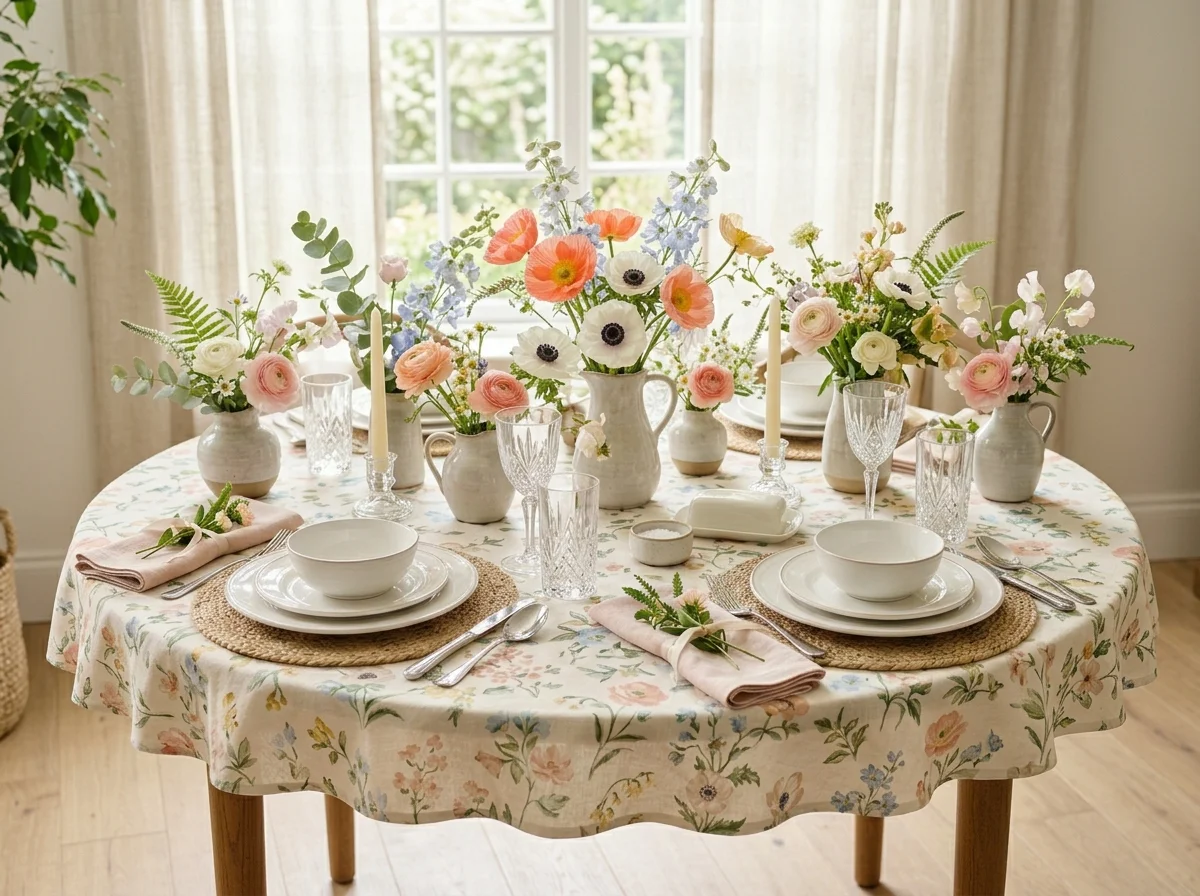
The dinner for four last Saturday happened on a 90cm round table. The tablescape was: an oatmeal linen runner laid diagonally across the centre, a single line of mixed eucalyptus and dried wheat down the runner, three brass candlesticks of varying heights, one small ceramic bowl of clementines, and the place settings. That was the entire table. The four of us ate, talked, and finished two bottles of wine without anything getting in the way.
A small table needs more restraint than a large one. The same arrangement that would read as generous on a 200cm rectangular table reads as crowded on a 90cm round one. The key is using fewer elements but choosing them well.
From the same corner of the site: Intimate Entertaining at Home, Breakfast Nook Styling, and Dining Room Decor Fundamentals.
A small table sets a more intimate table than a banquet ever could — but it needs styling that leaves room to actually eat. These thirteen ideas create a layered, warm tablescape on a small or round table without crowding the plates. Pick the ones that suit your table and the kind of evening you're setting.
1. Start With a Linen Runner
A linen runner down the centre of a small table is the foundation of the tablescape — it defines the styling zone, adds soft texture, and leaves the place settings on bare table. A washed linen runner in a warm neutral creases relaxed and reads considered. On a round table, a square of linen or a small cloth does the same job.
2. Keep the Centre Low
On a small table, the centrepiece must stay low enough to see over and narrow enough to leave room for food. A low bowl, a short jug of stems, a row of tealights — nothing tall that blocks sightlines or eats the space plates need. The low centre is the single rule that makes a small-table tablescape actually work.
3. Light It With Candles in Mixed Holders
Candlelight is the heart of an intimate table. A cluster of candles in mismatched holders — tapers, tealights, a couple of pillars at different heights — down the centre gives warm, flattering light and a sense of occasion. Mixed holders read collected and relaxed where a matching set reads formal. The flicker is what makes the evening.
4. Use Earthy Ceramics and Mixed Plates
Layered, slightly mismatched earthy ceramics — handmade plates, stoneware bowls, vintage finds — read warmer and more personal than a matching dinner service. The variation in tone and form makes the table look collected and considered. On a small, intimate table, the character of handmade ceramics is exactly the warmth you want up close.
5. Bring in Seasonal Greenery
Foraged branches, garden herbs, citrus, or seasonal stems laid low along the runner bring nature and seasonality to the table for almost nothing. A sprig of rosemary at each setting, a few stems in a low jug, a scatter of leaves. Greenery reads more relaxed and current than a formal florist arrangement, and it ties the table to the time of year.
6. Layer the Place Setting
On a small table, the place settings are part of the tablescape, so layer them — a charger or a linen napkin under the plate, a folded napkin with a sprig of herb or a place card on top. The layered setting adds richness at each seat without crowding the centre, building the styling outward to where each guest sits.
7. Add a Personal Touch at Each Place
A handwritten place card, a tiny party favour, a sprig of something, or a small personal note at each setting turns a dinner into your dinner. On an intimate small table these touches are seen and appreciated up close. They needn't cost much — the thought is what a guest notices, and it's what makes a small gathering memorable.
8. Add a Tabletop Lamp for Glow
Borrowed from restaurant design, a small cordless tabletop lamp brings a warm, low glow that flatters faces and styles the table without needing florals or a tall centrepiece. On a small table it's a sophisticated, modern alternative to candles alone, and it reads cosy and considered. The little lamp is having a real moment for good reason.
9. Vary the Heights, Low to Lower
Even on a small table, a little height variation gives the tablescape rhythm — a low jug slightly taller than the tealights around it, a small footed bowl among flat plates. Keep everything below sightline, but let the low elements step up and down a little. The subtle variation reads styled where a flat, uniform centre reads plain.
10. Choose a Tight, Warm Palette
A small tablescape reads cohesive when its elements share a tight, warm palette — linen in oatmeal, terracotta ceramics, brass holders, amber glass, green stems. A jumble of colours reads busy on a small surface. Pulling the table together in two or three warm tones makes even a simple setting look deliberately composed.
11. Pre-Plate to Save Space
On a small table, a pre-plated meal saves the space that serving dishes would eat and reads considered and restaurant-like. Where you do serve communally, keep serving dishes small and remove them as they empty. Managing how the food sits on a small table is part of the tablescape — the styling has to leave room for the meal itself.
12. Embrace the Squeeze
A small table that seats people close, shoulder to shoulder, is intimate and convivial in a way a vast table never is. Don't apologise for the closeness — lean into it. Pull in mismatched chairs, let people squeeze, and the proximity becomes the warmth of the evening. The small table's intimacy is its whole advantage; style it to celebrate that.
13. Edit Ruthlessly — Less Is More
The defining discipline of small-table styling: edit. Every element must earn its place, because there isn't room for the ones that don't. A linen runner, low candles, a small low arrangement, layered settings — and stop. A small table over-styled reads cluttered and leaves nowhere for the food; restraint is what makes it read elegant and usable.
The Method Behind Styling a Small Table
The ideas above are the menu; the principles below are the structure — the runner foundation, keeping the centre low, and the layering that builds a considered table without leaving anywhere to put the food.
The Linen Runner as the Foundation
A linen runner down the centre of the table is the foundation of small-table tablescaping. The runner:
- Adds visual softness without consuming much surface area
- Defines a centre line for the rest of the arrangement
- Reads more sophisticated than no runner and less heavy than a full tablecloth
- Can be diagonal across a round table (visually interesting) or straight down a rectangular one
Linen runners in oatmeal, warm white, sage green, or muted oxblood work across seasons. Width: 30-50cm for a round table, 35-60cm for a rectangular one. Length: long enough to drop 15-25cm off each end of the table.
Sources: MagicLinen sells runners at £40-80, Linen Tales at £35-70, H&M Home at £25-40. Vintage linen runners from estate sales run £10-25 and read more interesting than new.
A bare table without runner can work for casual settings, but for a dinner party, the runner is what shifts the table from everyday into hosted.
The Centre Line: Low and Long
Down the runner runs a loose arrangement of foliage or seasonal elements. The principle is low and continuous rather than tall and clustered.
Seasonal options:
- Autumn: dried wheat, eucalyptus, branches with rust-coloured leaves, small pumpkins or pomegranates
- Winter: evergreen cuttings (cedar, fir, eucalyptus), loose-laid down the runner
- Spring: branches with new growth, flowering stems, fresh herbs
- Summer: roses laid loose, sweet peas in small bottles, sprigs of mint and lavender
The foliage doesn't need to be in vessels for most of its length. A long loose laying directly on the runner reads more natural than five small vases. One or two small vessels can punctuate the line.
For a 90cm round table: a single armful of cedar laid in a curving line across the runner is enough. The fragrance alone earns its place.
The Candle Cluster
Three to five candles is the right number for a small table. Cluster them in two groups or distribute at intervals along the runner.
Candle heights: vary between 15cm and 25cm. Taller than 25cm and they start to interfere with sightlines. Tealights and votives work in addition to tapers but never instead.
Holders should not match. A pair of brass candlesticks plus a pair of ceramic stick holders plus one vintage iron candleholder reads collected. Five identical candleholders reads as set design.
Candle colours: white, cream, beeswax amber, oxblood, deep burgundy, sage. Skip explicit red and green (Christmas), and bright primary colours.
Light the candles before guests arrive. Lit candles when guests walk in shifts the room from "ready" to "welcoming" in one detail.
The Small Object Punctuation
In addition to the runner, foliage, and candles, one or two small low objects punctuate the arrangement:
- A low ceramic bowl of clementines, pomegranates, or pears
- A pair of small terracotta dishes with salt and butter (functional and decorative)
- A small brass tray holding pepper grinder and salt cellar
- One or two stick candles in low candleholders separate from the main cluster
- A wide low bowl of cut roses with stems just visible above the water line
The small objects fill visual gaps without adding height. They also serve actual function (the salt and butter are used; the clementines might be dessert).
Place Setting Restraint
For a small table, the place settings consume real surface area. Restraint matters.
The cosy small-table place setting:
- Dinner plate
- Smaller plate stacked on top for the starter (cleared and reused for dessert if needed)
- Single wine glass plus water glass (skip the second wine glass unless serving two distinct wines)
- Linen napkin folded simply, not in a fancy shape
- Knife and fork for main; dessert spoon or fork placed horizontally at the top of the setting
Avoid:
- Multiple sets of cutlery laid out in formal order
- Bread plates (use a small communal bread board in the centre instead)
- Place cards for an intimate dinner
- Decorative chargers under the dinner plate
- Napkin rings (the simple fold reads more current)
For four place settings around a 90cm round table, this configuration uses about 60% of the surface area, leaving the other 40% for the centre arrangement.
What to Skip on a Small Table
Tablecloths covering the entire surface. They make the table read smaller and require ironing. Use a runner instead.
Floral arrangements taller than 25cm. Blocks sightlines across the small space.
Multiple vessels of flowers at intervals down the table. They consume too much surface area. One central arrangement (loose along the runner) suffices.
Matching candleholder sets. Mismatched candles read collected; matched sets read like a wedding gift.
Bread baskets that take up a whole corner. Use a small board or a folded linen napkin in the centre instead.
Decorative napkin rings or origami napkin folds. Both date faster than any other tablescape element.
Themed table runners. Halloween, Christmas, Easter — themed textiles read tired faster than seasonal foliage in plain linen does.
A small table reads more sophisticated with restraint than with abundance. Four elements arranged carefully beat fourteen elements crowded together.
Seasonal Variations
The basic structure (runner + foliage + candles + one or two small objects) holds across seasons. What changes is the foliage and the candle colour.
Autumn dinner: oatmeal runner, dried wheat and eucalyptus, brass candlesticks with oxblood tapers, small bowl of pomegranates.
Winter holiday dinner: white linen runner, fresh cedar and fir cuttings, brass and white ceramic candlesticks with white tapers, bowl of clementines and walnuts.
Spring dinner: sage green or warm white runner, branches with new growth or fresh herbs, simple white candles in mixed holders, a small bowl of citrus.
Summer dinner: unbleached linen runner, loose roses or sweet peas laid down the runner, white candles, a small bowl of figs or summer berries.
Each variation uses the same structure with different seasonal materials. The room shifts; the table technique doesn't.
A Tablescape for Two
The same principles apply at smaller scale. For a dinner-for-two on a 70-90cm table:
- A shorter runner laid down the centre or diagonal
- A small armful of foliage along the runner
- Two or three short candles
- One small bowl of fruit or low decorative element
The arrangement compresses but the principle holds. A tablescape for two should still read as deliberate rather than as everyday casual.