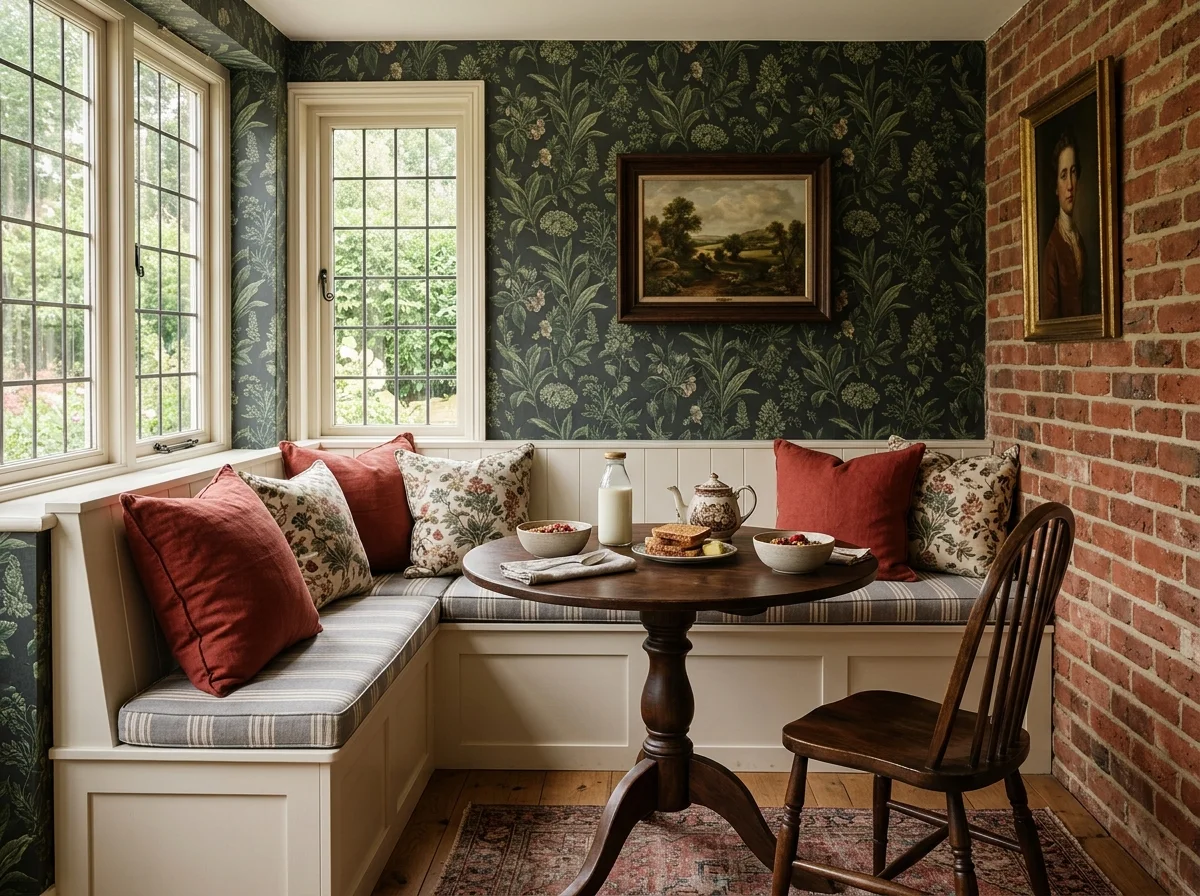
The breakfast nook in the corner of the kitchen has a banquette bench on two sides, a 95cm round table, two simple wooden chairs on the open sides, and a single paper pendant 32 inches above the table. The bench cushions are oatmeal linen. There is a small ceramic lamp on the window ledge. Most mornings, this is where I read the newspaper. Most evenings, it is where my flatmate and I eat dinner. The nook earns more daily use than the full dining table.
A breakfast nook is one of the most underrated cosy rooms in a house. It works because it's smaller than a dining room, more intimate than the kitchen counter, and built for the actual rhythm of a household — newspaper in the morning, casual dinner in the evening, the place where the conversation happens before anyone has fully woken up.
Related, and genuinely useful here: Intimate Entertaining at Home and Warm Kitchen Design Ideas Without Going Full.
A breakfast nook is the cosiest place to eat in the house — bathed in morning light, tucked into a corner or a bay. These thirteen ideas cover building it, seating it, and styling it so it earns its keep from breakfast through to a casual supper. Pick the ones that fit your kitchen and your light.
1. Build a Banquette Into the Corner
The classic breakfast nook is an L-shaped banquette tucked into a corner, seating more people in less space than chairs and reading built-in and permanent. Run it along two walls, cushion it well, and add storage underneath. The corner banquette is the most space-efficient and the cosiest way to seat a family for breakfast.
2. Use the Bay Window for Light
If you have a bay, build the nook into it — a bench around the bay catches morning light from several directions and gives the breakfast spot a view. The light is what makes a breakfast nook special; positioning it in the brightest corner of the kitchen turns the first meal of the day into something worth lingering over.
3. Pair a Round Table With a Banquette
A round or oval table suits a banquette nook best — no corners to climb over, and everyone can slide in and reach the centre. It seats more people comfortably than a rectangle in the same space and softens the angular geometry of a corner bench. The round table is the breakfast nook's natural partner.
4. Cushion the Bench Properly
A breakfast nook is only as good as its cushion. A firm foam cushion, 5 to 8cm thick, in a washable tailored cover makes the bench comfortable to sit on through a long breakfast. Add a couple of scatter cushions against the wall to lean on. Skimp on the cushion and the nook looks built but goes unused.
5. Add Storage Under the Bench
The space under a banquette is too good to waste. Lift-up hinged seats or drawers swallow tablecloths, board games, and kitchen overflow, earning the nook its footprint twice. In a kitchen, where storage is always short, the under-bench store is one of the best reasons to build a banquette in the first place.
6. Hang a Pendant Low Over the Table
A warm pendant hung low over the nook table — 75 to 90cm above the surface, on a dimmer — pools light on the table and anchors the nook as its own little room within the kitchen. In the morning it's bright and cheerful; dimmed in the evening it turns the nook into an intimate supper spot. The light defines the space.
7. Make It Work for Supper Too
A breakfast nook needn't only do breakfast. Styled and lit right — a dimmable pendant, candles, a runner — the same nook becomes the cosiest spot for a casual supper or a glass of wine in the evening. Designing it to flex from morning coffee to evening meal earns it far more use than a single-purpose breakfast spot.
8. Mix Bench and Chairs
A nook with a bench on one or two sides and loose chairs on the open side reads relaxed and seats flexibly — the bench for children to shuffle along, chairs that pull away for grown-ups. The mix of fixed and loose seating is more sociable and adaptable than an all-bench or all-chair arrangement. Bench in, chairs out.
9. Style the Table Simply
A breakfast nook reads cosy with the simplest styling — a small jug of stems or herbs, a bowl of fruit, a runner, the good butter dish left out. Keep it low and uncluttered so the table stays usable. The lived-in, ready-for-breakfast look reads warmer than a formal centrepiece. Style it for use, not for show.
10. Soften It With Cushions and a Runner
Layer soft textiles into the nook — scatter cushions on the bench, a runner on the table, a Roman blind at the window. The fabric warms the hard kitchen surfaces and the acoustics, and makes the nook the soft, inviting corner of an otherwise hard-edged room. Textiles are what tip a nook from functional to cosy.
11. Choose a Wipeable Table Surface
A breakfast nook table takes daily, messy use — cereal, coffee, children. A wipeable surface, a sealed wood, or a wood that takes patina handles it without you policing every spill. The table that gets used every morning is the one you don't have to worry about; choose a surface built for real, daily breakfast life.
12. Add a Wall Light or Sconce
Beyond the pendant, a wall sconce beside the nook gives a second, lower layer of light for the evening and a reading light for someone lingering over coffee and the paper. The extra light source makes the nook usable and cosy after dark, and reads more considered than a single overhead. Two lights, two moods.
13. Back It With Panelling or Colour
Treat the wall behind the nook as a feature — tongue-and-groove panelling, a deeper paint colour, or a warm wallpaper — to define the nook as its own pocket within the kitchen. The backdrop turns a bench against a blank wall into a deliberate, designed nook. It's the finishing move that makes the corner read intentional.
The Method Behind a Breakfast Nook That Works
The ideas above are the menu; the principles below are the structure — the table size, the bench depth, and the proportions that decide whether a nook is genuinely comfortable to sit and eat in.
The Right Table Size
The table size determines whether the nook works. Two configurations dominate:
Round table in a corner. A 90-100cm round table seats four with reasonable elbow room. Two chairs on the open sides, a banquette curving around the wall sides. The round table tucks into the corner more efficiently than a rectangular one and creates more natural conversation flow.
Rectangular table against a wall. A 120cm rectangular table against one wall, with a banquette bench on the wall side and two chairs on the open side. This configuration works for wider rectangular nooks. Seats four; with extension, can stretch to six for occasional larger meals.
Square tables work but feel formal. Pedestal bases work better than four-legged tables in nooks because chairs can tuck closer when there's no leg in the way.
The Banquette Question
A banquette bench transforms a breakfast nook from a small dining area into a cosy room. The bench:
- Maximises seating in less floor space than chairs
- Provides storage underneath (in built versions)
- Reads cosier than four chairs around a small table
- Encourages sitting longer than chairs do
Banquette construction options:
- A simple wooden bench (DIY plywood or solid wood) with loose cushions on top
- A built-in upholstered banquette with hinged storage seat
- A purchased freestanding bench from suppliers like Vitsoe, OKA, or vintage sources
- A church pew or repurposed school bench (auction houses and reclamation yards)
The cosiest version is a custom wooden bench with thick, loose linen cushions on top. The cushions are removable for washing and the wooden bench underneath ages with use.
Lighting the Nook
A single pendant 30-36 inches above the table is the standard. Paper pendants, woven rattan, or warm-glass pendants suit breakfast nooks particularly because the diffuse light reads as morning rather than as restaurant.
For nooks against windows, the morning light does much of the lighting work. The pendant becomes critical only in the evening.
Add one small lamp somewhere in the nook — on the table itself, on a window ledge, on a shelf at one end. A small ceramic lamp with a 25-watt warm bulb is enough. The lamp transforms the nook from breakfast-only into a place where you'd sit in the evening with a glass of wine.
The pendant should be on a dimmer if possible. Breakfast wants bright; evening wants dim.
Window Treatments
A breakfast nook with a window is the standard configuration. The window treatment matters:
Linen curtains. Hung from the ceiling line, falling to the floor, in unbleached linen. The morning light through linen is one of the most cosy effects in any room.
Cafe curtains (occasionally). Half-height curtains on the bottom half of the window, leaving the top half exposed. This is one of the few rooms where café curtains work. Suits older houses and rooms with a cottage aesthetic.
Roller blinds or roman blinds. Suit nooks where curtains would interfere with the table or bench. Linen or natural-fibre roman blinds in oatmeal or warm white.
Simple sheer linen. A single layer of sheer linen on a tension rod inside the window frame. Diffuses light without blocking it. Best for nooks where privacy isn't a concern.
Avoid: heavy curtains that block morning light, blackout curtains, or any treatment that fights the nook's reason for being (which is the morning light).
The Table Surface
The nook table gets hard use. Choose a surface that takes scratches and water rings without showing them.
Solid wood (oak, walnut, elm, reclaimed pine): the standard. Develops patina; small marks add character.
Honed marble or soapstone: cosy but high-maintenance. Marble stains from coffee and red wine; soapstone less so.
Painted MDF or veneer: shows every mark within months. Avoid in a nook.
Glass: shows every fingerprint, reflects upward, uncosy. Skip.
A good nook table is one you'd happily put a wet glass down on without a coaster.
Styling the Nook
A working breakfast nook needs:
- Linen cushions on the banquette (loose, not fixed, washable)
- A simple woven basket under or beside the bench (newspapers, books, throws)
- A small lamp somewhere visible
- One piece of art on the wall above or beside the nook
- A small foliage element on the table (a single stem in a small bottle, a low bowl of fruit)
That is the entire styling inventory. The nook reads cosier without additional decoration.
What not to add:
- Wall mounted shelves crowded with decor (they make the nook feel cluttered)
- Matching cushion sets (the loose mix of one or two textiles reads more inhabited)
- A tablecloth at all times (the bare table with a runner only when entertaining reads more honest)
- Floral arrangements taller than 25cm (they block sightlines across the small table)
A breakfast nook earns its cosy by being actually used at breakfast. The fancy version that sits empty most mornings is just a small dining room with worse light.
Storage in a Nook
If you have built or are building a banquette, hinged storage under the seat is the highest-return use of space. The storage suits:
- Off-season tableware (Christmas plates, summer linens)
- Extra cushions and throws
- Board games and puzzles
- Children's craft materials
- Spare table linens
The hinged-lid construction is straightforward — a piano hinge along the back of the seat, with a removable cushion on top. DIY plywood banquettes with this configuration cost £150-300 in materials and provide several cubic feet of storage.
A Nook Without a Window
If your nook configuration is in an interior corner with no window, the nook still works but requires more lighting attention. Two pendants instead of one (over the table at different heights), wall sconces if appropriate, and a lamp on the window-side wall to compensate.
The nook without window light leans more toward an "evening room" than a "breakfast room" — it's a place for dinner and reading after dark rather than morning newspaper.
Restaurant-Style Versus Home-Style
The boundary between cosy and restaurant-style is mostly about the bench upholstery. Booth-style padded benches with leatherette upholstery and a uniform appearance read as restaurant. Wooden benches with loose linen cushions read as home.
The same logic applies to:
- Matching place settings (restaurant) versus mixed plates and glassware (home)
- A printed menu of "house cocktails" (restaurant) versus a glass of whatever's open (home)
- Branded coasters (restaurant) versus a stack of books or a small lamp on the table (home)
Skip the restaurant references entirely. The cosy nook is the opposite of dining out.