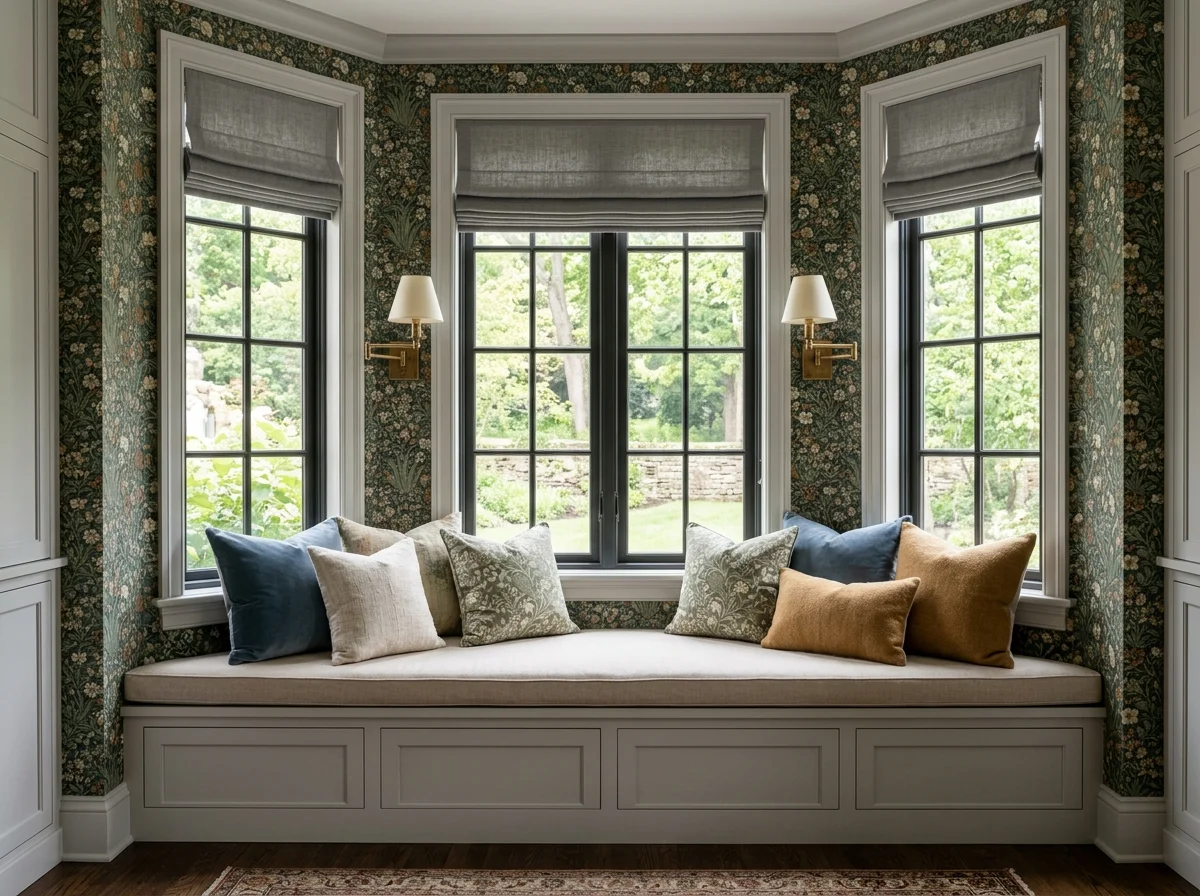
The bay window in the living room here juts out about 50cm from the wall — a typical Victorian three-sided bay. For four years the space held nothing but a small side table and a houseplant. Last autumn I built a window seat — plywood box construction, hinged lid for storage, 90mm of foam wrapped in linen — and it has become the most-used spot in the flat. The cat sleeps there during the day, I read there in the evening, and a guest stayed there for three nights when the daybed in the spare room broke. The corner went from empty to essential in one weekend's work.
A bay window is one of the highest-potential cosy locations in any home. The architecture already creates partial enclosure, the windows provide natural light, and the proportion is typically suited to a single seated person. The window seat earns its build cost within months of use.
For the wider picture, see Cosy Corner Design, Reading Nook Design, and Breakfast Nook Styling.
A bay window is a gift — a pocket of light and architecture begging to be sat in. These twelve ideas cover building the seat, dressing it, and making it earn its keep year-round. Choose what suits your bay's shape and the room it opens onto.
1. Build a Simple Bench Into the Reveal
The cleanest bay seat is a built-in bench spanning the reveal, 45cm high to match a chair, with a firm cushion on top. Carpenters build it from ply and MDF for a few hundred pounds; the result reads architectural and permanent rather than a chair shoved into the bay.
2. Add Lift-Up or Drawer Storage Underneath
The space under a window seat is too good to waste. A lift-up hinged top or a row of drawers swallows blankets, board games, and seasonal clutter. In a small room this single move justifies the whole build — seating and storage in the footprint of neither.
3. Top It With a Firm Tailored Cushion
A bay seat needs a firm foam cushion, 8 to 12cm thick, in a tailored cover — boxed edges, not a floppy pad. Washed linen or a hard-wearing wool. The firmness is what makes it comfortable to sit on for an hour; a soft squashy cushion bottoms out and the seat goes unused.
4. Pile Cushions Against Each Return
A bay has two side returns, and a cushion banked against each turns a bench into a place to lean and read sideways. Mix sizes and one pattern among solids. This is where the bay stops being a window ledge and becomes seating you'd choose over the sofa.
5. Hang Café Curtains or a Roman Blind
Dress the bay without drowning the light: a Roman blind fitted inside each window, or café curtains covering the lower half, gives privacy and softness while the seat keeps its view and daylight. Full floor curtains fight a window seat; keep the treatment up at the glass.
6. Make It a Reading Spot With a Wall Light
Add a swing-arm wall light or a small sconce beside the bay and the seat becomes a reading nook for the evening, not just a daytime perch. Warm bulb, positioned to fall over the shoulder. Now the bay works after dark, which is when most reading actually happens.
7. Turn It Into a Breakfast Nook
Pull a small round or drop-leaf table up to a bay seat and you've made a breakfast nook bathed in morning light. Add one or two loose chairs on the open side. It's the cosiest place to eat in the house and it uses a bay that would otherwise just hold cushions.
8. Wrap a U-Shaped Seat Around the Bay
In a deep bay, run the bench around all three sides in a U. It seats several people, frames the view, and creates a defined pocket that feels like its own little room. Continuous cushions soften the corners; storage under each run multiplies the payoff.
9. Add a Small Side Surface
Even a window seat needs somewhere to set a mug. A slim side table at the open end, a tray that sits on the cushion, or a narrow ledge along the back of the seat. Small, but it's the difference between the seat being used and being admired.
10. Layer a Throw for the Cold Months
A bay is the coolest spot in the room in winter — glass on three sides. A folded wool throw over one end of the seat invites you to pull it over your legs, and reads cosy even unused. Swap to a lighter linen throw in summer when the bay becomes the breeziest seat instead.
11. Place a Plant in the Light
A bay is the best-lit spot in most rooms, which makes it ideal for a plant that wants light. A trailing plant at one return, a small tree on the floor beside the seat, or herbs on the sill of a kitchen bay. Greenery in the light reads alive and softens the hard window lines.
12. Let the Seat Double as Guest Sleeping
A deep bay bench, around 60cm, with a long firm cushion can double as a daybed for an afternoon nap or an occasional child's sleepover. Add a couple of bolsters and it reads as a deliberate daybed rather than an oversized window seat. Function stacked on function.
The Method Behind a Bay Seat That Works
The ideas above are the menu; the principles below are the structure — the bench depth, cushion build, and proportions that decide whether a window seat gets used daily or becomes a shelf for cushions.
The Bench Construction
The simplest construction is a plywood box with a hinged lid. Build it as a freestanding piece that fits the bay (rather than building it into the walls), so it can be removed if you move and so it doesn't require carpenter-level skills.
Materials for a typical 90cm-wide × 50cm-deep × 42cm-tall bench:
- 18mm birch plywood for the box construction — £80-150 for all panels
- 6mm plywood for the lid panel — £15-25
- A piano hinge for the lid — £15-25
- Construction adhesive and screws — £15
- Hard wax oil or paint for the finish — £25-40
Construction sequence:
- Cut plywood panels for the sides, back, front, and bottom.
- Assemble the box with glue and screws.
- Cut the lid to size. Attach with the piano hinge along the back.
- Sand and finish (hard wax oil for natural wood, paint for matched-to-wall finish).
- Place in the bay window — the bench can be wedged against the side walls or freestanding.
Total build time: a full weekend for a beginner. Total materials: £150-260.
For more complex bays (irregular angles, curved walls), the construction can be more involved. A made-to-measure local carpenter quote ranges £400-1,200 depending on detail.
The Cushion: Where Money Goes
The cushion makes or breaks the window seat. Skimping here produces a bench that nobody sits on.
The cushion construction:
- 80-100mm of high-density foam cut to the bench dimensions
- Cotton batting wrapped around the foam for softness
- Upholstery fabric (linen, wool, or heavy cotton) covering the assembly
- Either fully upholstered or with a removable cover (zip along one edge)
For a 90×50cm cushion at 90mm depth:
- Foam: £40-80 from a local foam supplier
- Batting: £15-25
- Linen or wool fabric (1.5m of 140cm-wide fabric): £40-120
- Zip: £8-12
Total cushion cost: £100-240 depending on fabric choice.
For removable covers (recommended for washability), commission a local upholsterer or DIY with basic sewing skills. The cover sews up like a giant cushion cover with a zip on one edge.
Back Cushions for Support
The seat cushion alone doesn't make the bench comfortable for sitting. Back cushions against the window wall provide the support that makes the seat usable for reading.
The back cushions:
- Two or three 50×50cm cushions in linen or wool
- Stuffed with feather/down or high-density foam
- Different colours from the seat cushion for visual interest
- Mixed textures (a wool cushion next to a linen one, perhaps a leather one for variation)
The total cushion arrangement on a 90cm-wide window seat: one long seat cushion, two or three back cushions, possibly one small decorative cushion. Five total maximum.
Storage Underneath
The hinged-lid construction creates substantial storage. The space under a 90×50×42cm window seat holds:
- Several wool blankets and throws (off-season)
- Board games and puzzles
- A duvet for occasional guest use
- Children's craft supplies
- Spare table linens
The lid lifts cleanly if the hinge is properly installed. A small dampening strut (£10-15) prevents the lid from slamming and holds it open while you reach inside.
For frequently-accessed storage, the hinged lid works. For rarely-accessed storage, consider drawers in the front face of the bench instead of (or in addition to) the hinged top.
Styling the Window Seat
The window seat is most cosy when it shows evidence of use. Style elements:
- A folded wool throw at one end of the seat
- One or two books on a corner of the cushion or on the windowsill
- A small candle in a holder on the windowsill
- A small lamp on the windowsill if the seat doesn't get sufficient ambient light
- A single foliage stem in a small bottle on the windowsill
That's the entire styling inventory. The window seat doesn't need additional decoration because the architecture (the bay, the windows, the natural light) already provides visual interest.
The Window Treatment
Curtains in a bay window with a built-in seat want to fall behind the seat back, not in front. Three approaches:
Curtains fall to the seat back. A curtain rod that goes across the bay (following the bay's angles) with curtains that drop to just above the cushion. This works when the curtain weight is supported by a strong rod (wood or thick brass).
Roller blinds or roman blinds. Blinds at the window itself, behind the seat, that can be raised and lowered without interfering with the bench. Linen or natural-fibre blinds in oatmeal or warm white.
No curtains, just simple linen sheers or nothing. For bay windows with good privacy, the bare window plus the seat reads minimal and editorial.
Avoid: full-length curtains that fall in front of the seat (they look stuck-on top of the seat); heavy curtains pooled on the cushion (they look unkempt).
The Reading Bay Window Seat
The window seat configured specifically as a reading nook needs a few additions to the basic configuration:
- A small side table or stool at one end, holding a lamp at chair-arm height
- A small bookshelf or books in arm's reach
- A small floor lamp behind the seat for evening reading if the window is the only light source
The reading bay window seat is one of the cosiest configurations available in any home. The architecture (bay enclosure), the natural light, the comfort of cushioned seating, and the books within reach combine to produce a corner that pulls people in.
The bay window seat earns its build cost within months of use. The architecture already provides the enclosure; the bench and cushion supply the comfort.
Bay Window Seats in Small Rooms
A bay window seat works disproportionately well in small rooms because it provides seating without consuming the floor area that a chair or sofa would. The bay was already "wasted" space; the seat reclaims it.
For small living rooms: the window seat can substitute for one of the main seating pieces, especially in flats where space is at a premium. Two armchairs facing the seat across a coffee table produces seating for four in less floor space than a sofa would require.
For small bedrooms with a bay window: the window seat doubles as additional seating for getting dressed, putting on shoes, or reading. The storage underneath handles seasonal clothes or extra bedding.
For small kitchens with a bay window: a small bay window seat creates a breakfast nook for two, with a small round table in front and one chair on the open side.
What to Skip
Decorative-only cushions. A cushion thinner than 60mm that exists only to look pretty in photographs. The seat needs to be actually sittable.
Matching pillow sets. Five identical decorative pillows on a window seat reads as a furniture-shop display. Mix textures and colours within a palette.
Heavy curtains pooled on the seat. They make the seat unusable and look unkempt within days.
Built-in shelving above the seat. Often suggested in design articles, rarely works in practice. The shelves above the window become impractical (too high to reach without standing on the seat) and visually heavy (compressing the window). Better to keep the seat space open.
Window seats that are too narrow. A bench less than 35cm deep doesn't work as actual seating regardless of how good the cushions are. Build deeper or build something else.